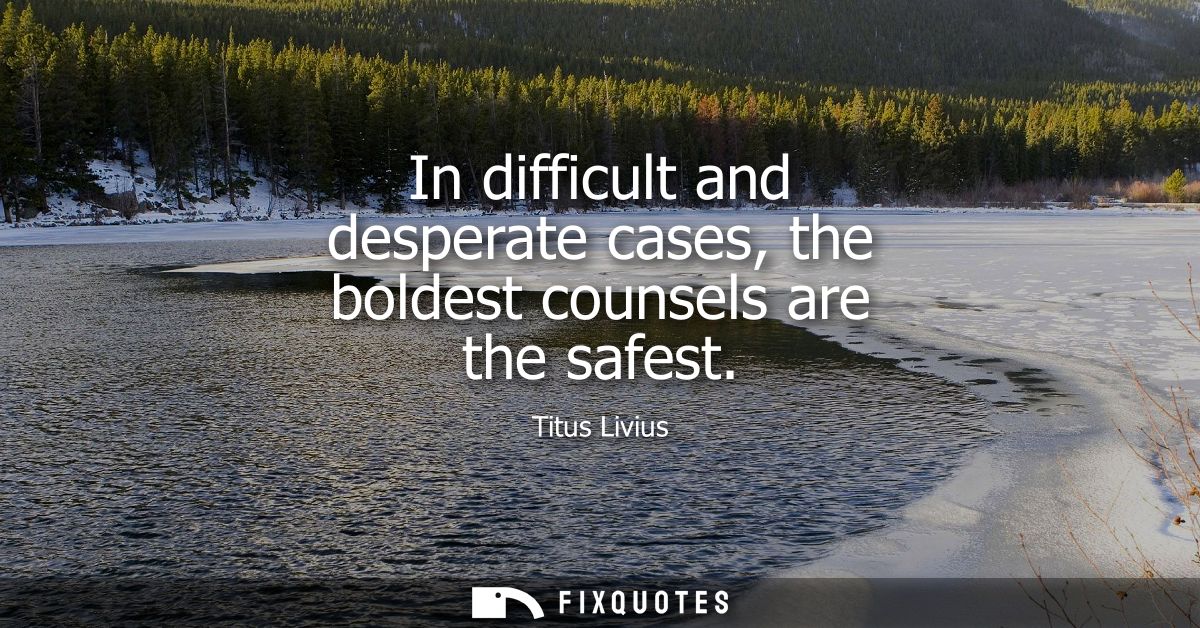
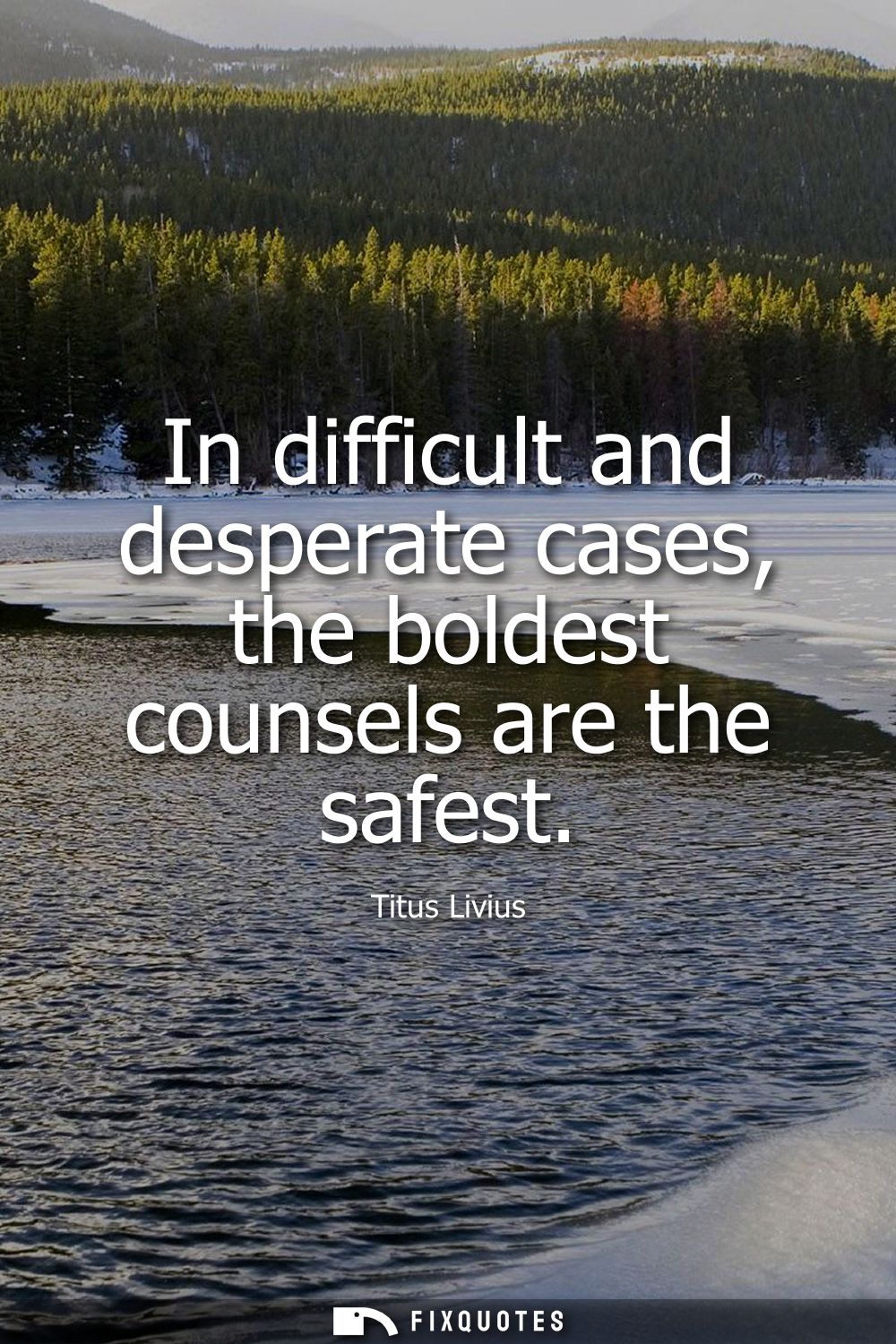
"In difficult and desperate cases, the boldest counsels are the safest"
About this Quote
“In difficult and desperate cases, the boldest counsels are the safest” is Livy doing what he often does best: laundering politics into morality while pretending he’s merely recording history. On its face, it’s a maxim about decision-making under pressure. Underneath, it’s an argument about legitimacy. When a situation is already collapsing, half-measures don’t read as prudence; they read as weakness, fragmentation, failure of nerve. Boldness becomes “safest” not because it guarantees success, but because it imposes coherence on chaos. It tells everyone watching - soldiers, senators, rival factions - that someone is actually in charge.
That’s the Roman subtext: in extremis, authority is performative. A daring plan doesn’t just try to change the battlefield; it changes the psychology of the room. Livy’s Rome runs on public confidence, and public confidence runs on visible resolve. The line also flatters the kind of leader Romans liked to mythologize: the commander who gambles everything and makes the gamble look like destiny.
Context matters because Livy is writing under Augustus, in an era allergic to civil-war uncertainty and hungry for stories that justify decisive rule. The maxim can be read as a tidy retrospective defense of extraordinary action - the kind that suspends normal restraints because the alternative is ruin. It’s history as a user manual: when the republic’s usual procedures can’t cope, the narrative quietly tilts toward the strong move, the clean break, the choice that stops debate by ending the crisis.
That’s the Roman subtext: in extremis, authority is performative. A daring plan doesn’t just try to change the battlefield; it changes the psychology of the room. Livy’s Rome runs on public confidence, and public confidence runs on visible resolve. The line also flatters the kind of leader Romans liked to mythologize: the commander who gambles everything and makes the gamble look like destiny.
Context matters because Livy is writing under Augustus, in an era allergic to civil-war uncertainty and hungry for stories that justify decisive rule. The maxim can be read as a tidy retrospective defense of extraordinary action - the kind that suspends normal restraints because the alternative is ruin. It’s history as a user manual: when the republic’s usual procedures can’t cope, the narrative quietly tilts toward the strong move, the clean break, the choice that stops debate by ending the crisis.
Quote Details
| Topic | Decision-Making |
|---|---|
| Source | Help us find the source |
| Cite |
Citation Formats
APA Style (7th ed.)
Livius, Titus. (2026, January 15). In difficult and desperate cases, the boldest counsels are the safest. FixQuotes. https://fixquotes.com/quotes/in-difficult-and-desperate-cases-the-boldest-65962/
Chicago Style
Livius, Titus. "In difficult and desperate cases, the boldest counsels are the safest." FixQuotes. January 15, 2026. https://fixquotes.com/quotes/in-difficult-and-desperate-cases-the-boldest-65962/.
MLA Style (9th ed.)
"In difficult and desperate cases, the boldest counsels are the safest." FixQuotes, 15 Jan. 2026, https://fixquotes.com/quotes/in-difficult-and-desperate-cases-the-boldest-65962/. Accessed 8 Mar. 2026.
More Quotes by Titus
Add to List