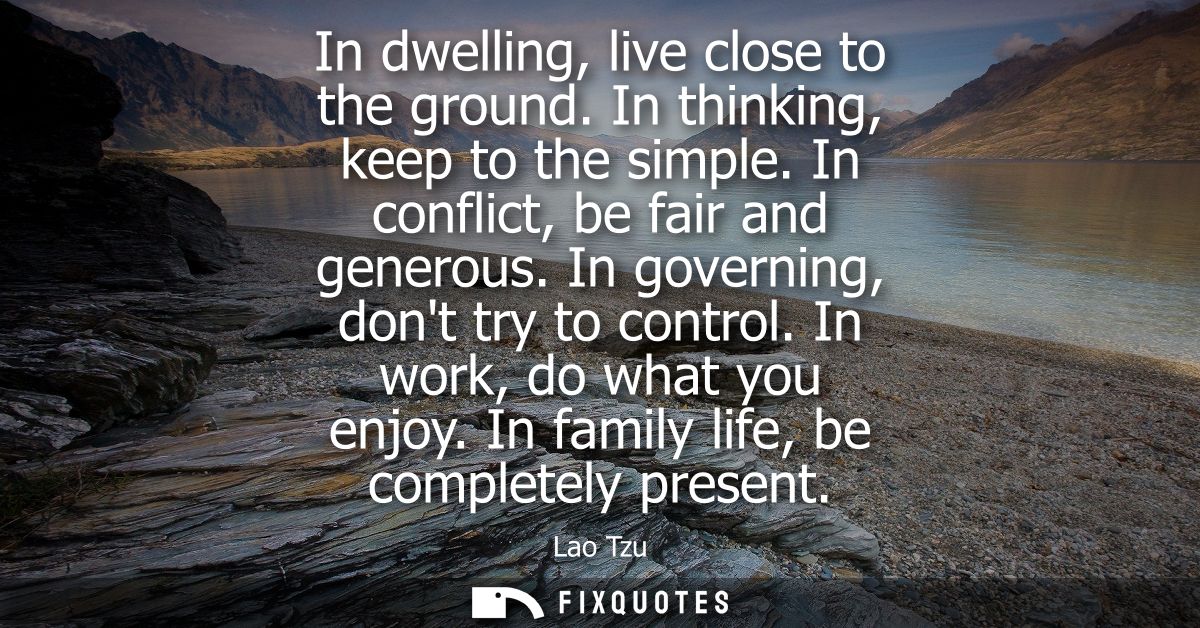
"In dwelling, live close to the ground. In thinking, keep to the simple. In conflict, be fair and generous. In governing, don't try to control. In work, do what you enjoy. In family life, be completely present"
About this Quote
A checklist of virtues disguised as anti-checklist philosophy: Lao Tzu’s counsel works by refusing the modern itch to optimize life into a system you can dominate. Each line is a small act of subtraction, aimed at puncturing the prestige traps of his era - status, cleverness, force, and managerial control - the same traps that still run our lives under shinier branding.
“Live close to the ground” is less cottagecore than epistemology: stay near what’s basic, bodily, and real, because abstraction breeds delusion. “Keep to the simple” isn’t anti-intellectual; it’s anti-performative. Taoist simplicity distrusts the mind’s talent for inventing problems to prove it’s smart enough to solve them. The subtext is a warning about ego: complexity can be a flex, and flexing can become a way of losing the Tao.
The lines on conflict and governing target power directly. “Be fair and generous” rejects victory as the primary metric; it assumes that winning at someone else’s expense is a long-term loss, socially and spiritually. “Don’t try to control” lands hardest in political context: Lao Tzu writes from a world of warring states and brittle authority, where coercion looks like strength but produces backlash. The Taoist alternative is rule by restraint, making space for order to emerge rather than be imposed.
Then the philosophy drops into the intimate: enjoy your work, be present with family. Not self-care slogans - a final insistence that the Tao is measured in attention, not ambition. Presence becomes the real governance.
“Live close to the ground” is less cottagecore than epistemology: stay near what’s basic, bodily, and real, because abstraction breeds delusion. “Keep to the simple” isn’t anti-intellectual; it’s anti-performative. Taoist simplicity distrusts the mind’s talent for inventing problems to prove it’s smart enough to solve them. The subtext is a warning about ego: complexity can be a flex, and flexing can become a way of losing the Tao.
The lines on conflict and governing target power directly. “Be fair and generous” rejects victory as the primary metric; it assumes that winning at someone else’s expense is a long-term loss, socially and spiritually. “Don’t try to control” lands hardest in political context: Lao Tzu writes from a world of warring states and brittle authority, where coercion looks like strength but produces backlash. The Taoist alternative is rule by restraint, making space for order to emerge rather than be imposed.
Then the philosophy drops into the intimate: enjoy your work, be present with family. Not self-care slogans - a final insistence that the Tao is measured in attention, not ambition. Presence becomes the real governance.
Quote Details
| Topic | Wisdom |
|---|
More Quotes by Lao
Add to List