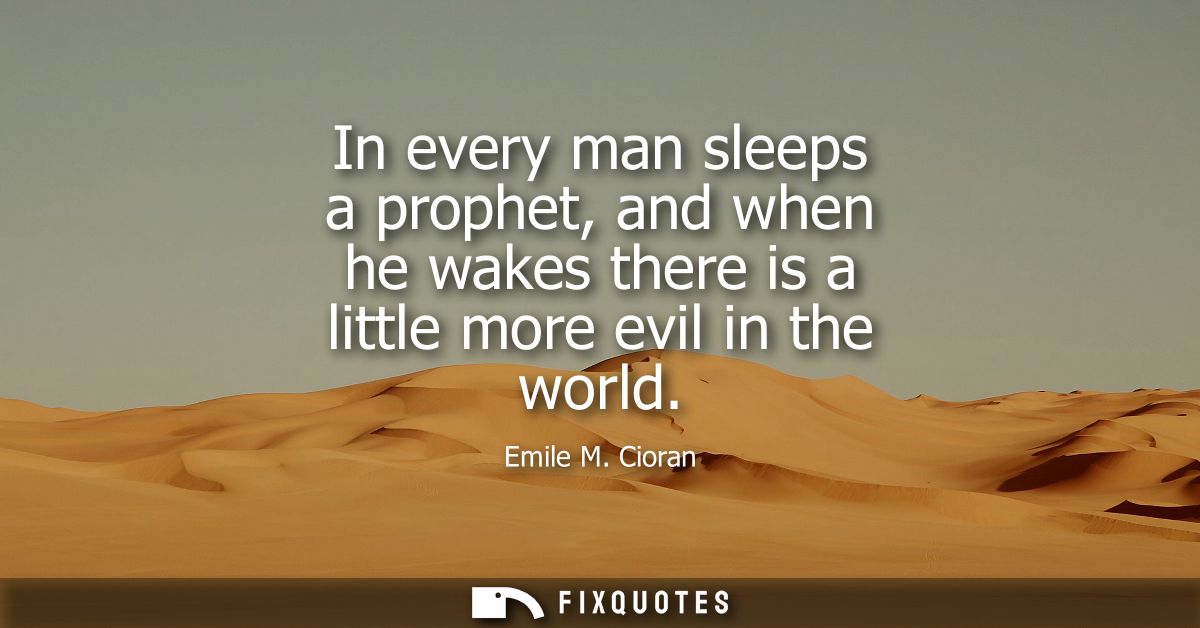
"In every man sleeps a prophet, and when he wakes there is a little more evil in the world"
About this Quote
The subtext is Cioran’s lifelong suspicion of conviction. Prophets don’t just predict; they authorize. They convert private feeling into public mandate, laundering desire, resentment, or fear into moral necessity. Once you speak in the register of destiny - history is going here, God wants this, the people demand that - you gain permission to simplify, to purge ambiguity, to treat dissent as corruption. Evil arrives incrementally because the “prophet” rarely thinks he’s doing harm; he thinks he’s finally telling the truth.
Context matters: Cioran wrote in the shadow of Europe’s ideological catastrophes, after watching utopian rhetoric and nationalist fervor turn metaphysical promises into political machinery. His own early flirtations with extremist currents sharpened his later allergy to salvation narratives. The sentence works because it’s compact, cynical, and diagnostic: it doesn’t argue against prophecy on theological grounds, but on psychological ones. It’s not that humans lack vision; it’s that vision, once voiced as authority, so often becomes a weapon.
Quote Details
| Topic | Deep |
|---|---|
| Source | Help us find the source |
| Cite |
Citation Formats
APA Style (7th ed.)
Cioran, Emile M. (2026, January 15). In every man sleeps a prophet, and when he wakes there is a little more evil in the world. FixQuotes. https://fixquotes.com/quotes/in-every-man-sleeps-a-prophet-and-when-he-wakes-46472/
Chicago Style
Cioran, Emile M. "In every man sleeps a prophet, and when he wakes there is a little more evil in the world." FixQuotes. January 15, 2026. https://fixquotes.com/quotes/in-every-man-sleeps-a-prophet-and-when-he-wakes-46472/.
MLA Style (9th ed.)
"In every man sleeps a prophet, and when he wakes there is a little more evil in the world." FixQuotes, 15 Jan. 2026, https://fixquotes.com/quotes/in-every-man-sleeps-a-prophet-and-when-he-wakes-46472/. Accessed 31 Mar. 2026.