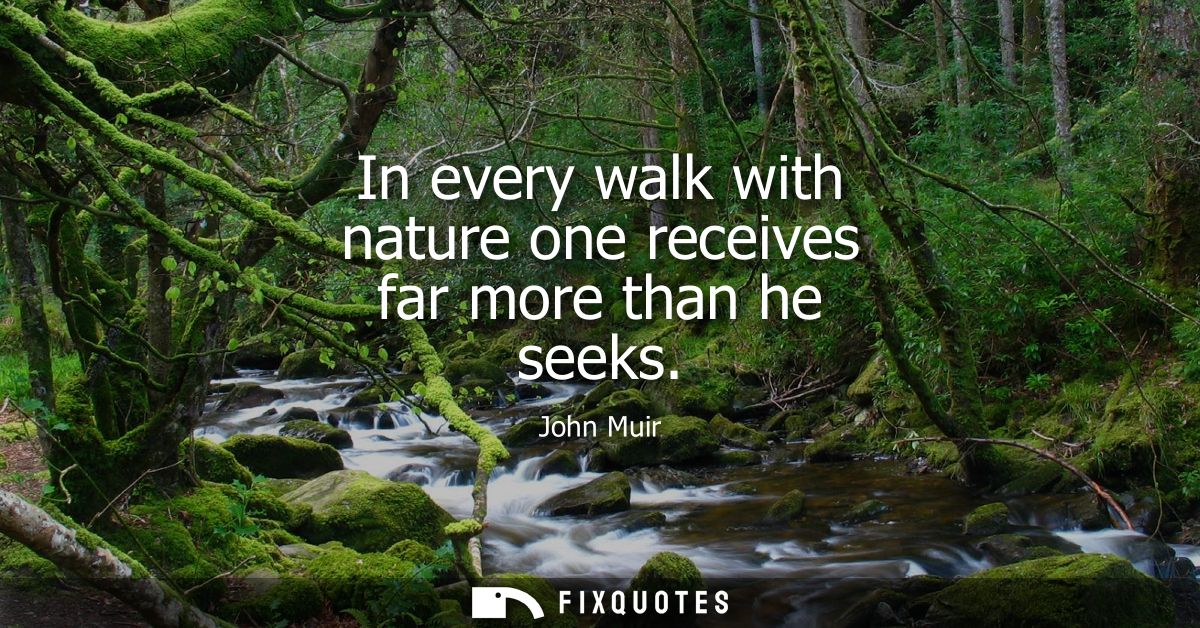
"In every walk with nature one receives far more than he seeks"
About this Quote
Muir’s line works because it sneaks a gentle rebuke inside a blessing. “In every walk with nature” sounds casual, almost domestic: not an expedition, not conquest, just a walk. Then he flips the expected economy of experience. You go out seeking something specific - exercise, solitude, clarity, a pretty view - and nature, indifferent to your agenda, overwhelms you with surplus. The phrasing “far more” turns the outdoors into a kind of anti-market, where value isn’t measured by what you extract but by what you’re forced to notice.
The subtext is a critique of the 19th-century American mindset that treated land as inventory. In Muir’s era, the West was being surveyed, logged, dammed, and monetized at industrial speed; “seeks” hints at the human habit of approaching landscapes with an objective, a use-case. His counterclaim is that real encounter isn’t transactional. Nature gives, but not like a supplier. It gives by rearranging your scale: the patience of stone, the indifference of weather, the riot of detail in a fern or a glacier’s scrape marks. What you “receive” is humility, not just scenery.
There’s also a rhetorical sleight of hand: he universalizes the outcome (“in every walk”) to make the promise feel repeatable, almost scientific, while keeping the experience intimate and personal (“one”). It’s advocacy without a manifesto - a sentence that sells preservation by making the reader remember the last time the world felt bigger than their plans.
The subtext is a critique of the 19th-century American mindset that treated land as inventory. In Muir’s era, the West was being surveyed, logged, dammed, and monetized at industrial speed; “seeks” hints at the human habit of approaching landscapes with an objective, a use-case. His counterclaim is that real encounter isn’t transactional. Nature gives, but not like a supplier. It gives by rearranging your scale: the patience of stone, the indifference of weather, the riot of detail in a fern or a glacier’s scrape marks. What you “receive” is humility, not just scenery.
There’s also a rhetorical sleight of hand: he universalizes the outcome (“in every walk”) to make the promise feel repeatable, almost scientific, while keeping the experience intimate and personal (“one”). It’s advocacy without a manifesto - a sentence that sells preservation by making the reader remember the last time the world felt bigger than their plans.
Quote Details
| Topic | Nature |
|---|---|
| Source | Help us find the source |
| Cite |
Citation Formats
APA Style (7th ed.)
Muir, John. (2026, January 18). In every walk with nature one receives far more than he seeks. FixQuotes. https://fixquotes.com/quotes/in-every-walk-with-nature-one-receives-far-more-14724/
Chicago Style
Muir, John. "In every walk with nature one receives far more than he seeks." FixQuotes. January 18, 2026. https://fixquotes.com/quotes/in-every-walk-with-nature-one-receives-far-more-14724/.
MLA Style (9th ed.)
"In every walk with nature one receives far more than he seeks." FixQuotes, 18 Jan. 2026, https://fixquotes.com/quotes/in-every-walk-with-nature-one-receives-far-more-14724/. Accessed 30 Mar. 2026.
More Quotes by John
Add to List