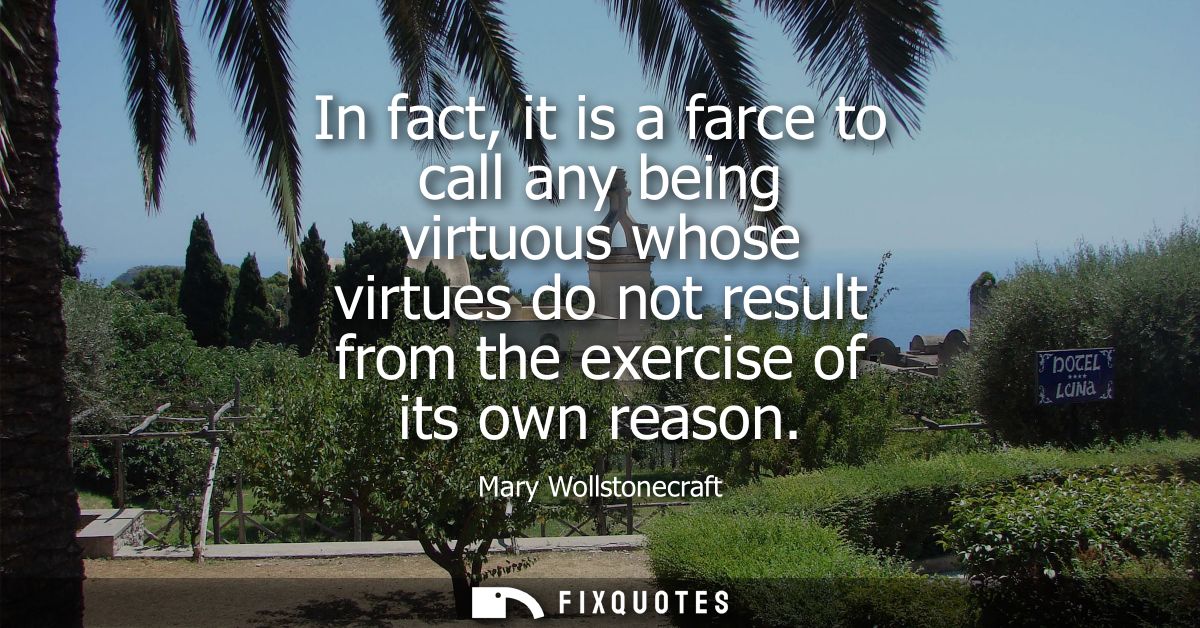
"In fact, it is a farce to call any being virtuous whose virtues do not result from the exercise of its own reason"
About this Quote
The key move is her standard for legitimacy: virtues must "result from the exercise of its own reason". That phrasing quietly detonates a whole moral economy built on obedience. If goodness is merely habit, fear, or imitation, it’s not goodness at all; it’s management. Wollstonecraft reframes moral praise as political technology: a culture that rewards unreasoning "virtue" is really rewarding governability.
Context matters. Writing in the wake of the Enlightenment and alongside revolutionary arguments about rights, she applies the era’s faith in rational agency to those excluded from it. Her target isn’t religion or morality per se; it’s the way moral language is used to justify inequality. The subtext is radical and practical: educate people as reasoning beings, and you don’t just liberate minds, you raise the bar for what counts as ethical. Virtue becomes less about purity and more about autonomy, which is why the sentence still feels like a live wire in debates about agency, social conditioning, and "good" behavior that’s really just learned compliance.
Quote Details
| Topic | Ethics & Morality |
|---|---|
| Source | Help us find the source |
| Cite |
Citation Formats
APA Style (7th ed.)
Wollstonecraft, Mary. (2026, January 18). In fact, it is a farce to call any being virtuous whose virtues do not result from the exercise of its own reason. FixQuotes. https://fixquotes.com/quotes/in-fact-it-is-a-farce-to-call-any-being-virtuous-7493/
Chicago Style
Wollstonecraft, Mary. "In fact, it is a farce to call any being virtuous whose virtues do not result from the exercise of its own reason." FixQuotes. January 18, 2026. https://fixquotes.com/quotes/in-fact-it-is-a-farce-to-call-any-being-virtuous-7493/.
MLA Style (9th ed.)
"In fact, it is a farce to call any being virtuous whose virtues do not result from the exercise of its own reason." FixQuotes, 18 Jan. 2026, https://fixquotes.com/quotes/in-fact-it-is-a-farce-to-call-any-being-virtuous-7493/. Accessed 22 Feb. 2026.