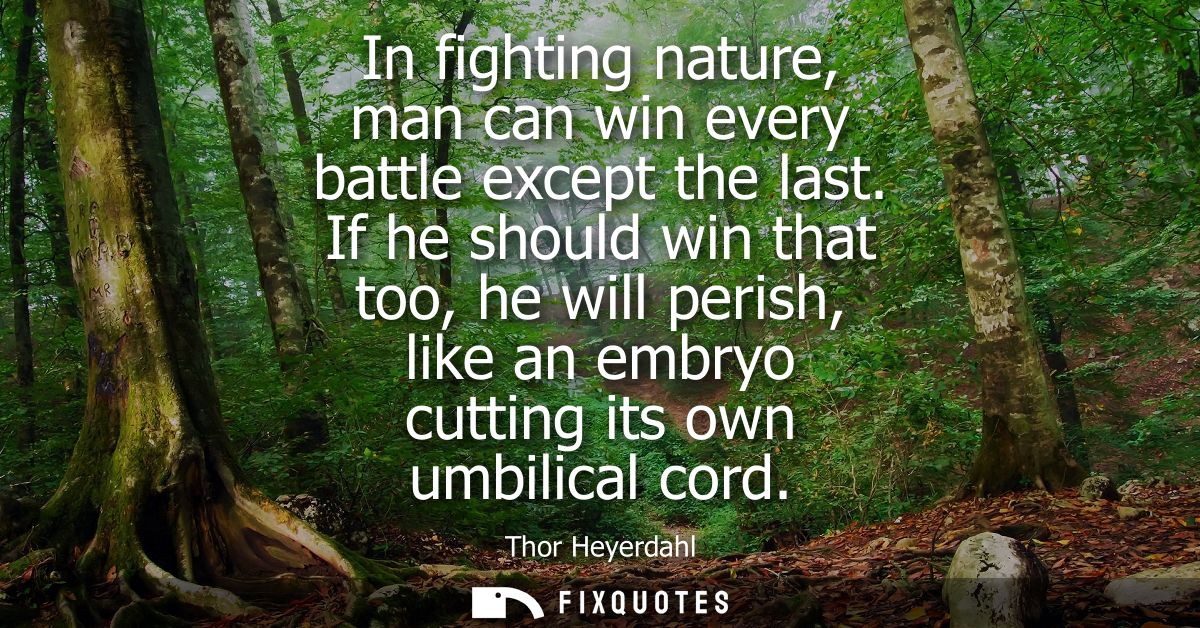
"In fighting nature, man can win every battle except the last. If he should win that too, he will perish, like an embryo cutting its own umbilical cord"
About this Quote
The embryo image is doing heavy work. It flips the usual heroic story of severing dependence into a horror story. Cutting the umbilical cord early isn’t freedom, it’s self-strangulation by independence. Heyerdahl smuggles an ecological argument into bodily common sense: you can’t outmuscle your own conditions of survival. The metaphor also punctures techno-triumphalism without sounding like a lecture. It’s visceral, almost embarrassing in its simplicity, which is why it sticks.
Context matters: as a 20th-century explorer, Heyerdahl operated at the hinge between romantic adventure and industrial modernity. He admired human ingenuity and ancient seafaring skill, yet watched the modern world turn oceans and forests into “problems” to solve. The subtext is a critique of domination masquerading as progress: when the goal becomes total control, the victory condition is extinction. The line reads today like an early climate-era aphorism: not anti-technology, but anti-delusion about what we’re allowed to sever and still expect to live.
Quote Details
| Topic | Mortality |
|---|---|
| Source | Evidence:
Thor Heyerdahl. fau , like our friends down in the village , like us , or ... In fighting nature , man can win every battle except the last . If he should win that too , he will perish , like an embryo cutting its own umbilical cord ... |
| Cite |
Citation Formats
APA Style (7th ed.)
Heyerdahl, Thor. (2026, February 12). In fighting nature, man can win every battle except the last. If he should win that too, he will perish, like an embryo cutting its own umbilical cord. FixQuotes. https://fixquotes.com/quotes/in-fighting-nature-man-can-win-every-battle-172161/
Chicago Style
Heyerdahl, Thor. "In fighting nature, man can win every battle except the last. If he should win that too, he will perish, like an embryo cutting its own umbilical cord." FixQuotes. February 12, 2026. https://fixquotes.com/quotes/in-fighting-nature-man-can-win-every-battle-172161/.
MLA Style (9th ed.)
"In fighting nature, man can win every battle except the last. If he should win that too, he will perish, like an embryo cutting its own umbilical cord." FixQuotes, 12 Feb. 2026, https://fixquotes.com/quotes/in-fighting-nature-man-can-win-every-battle-172161/. Accessed 27 Mar. 2026.