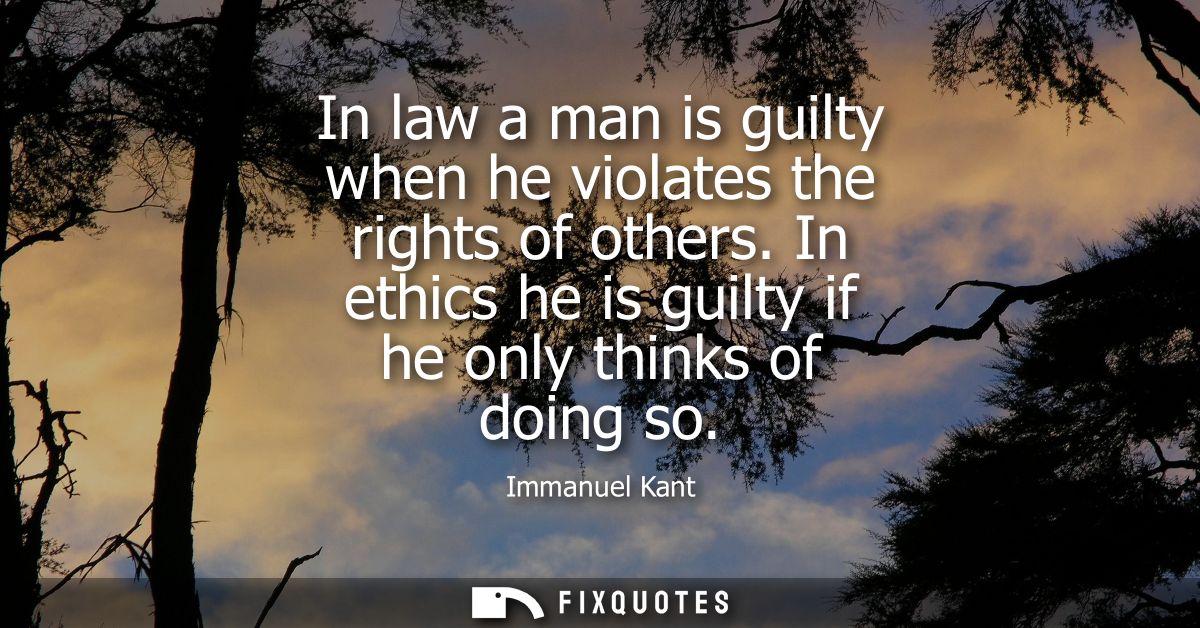
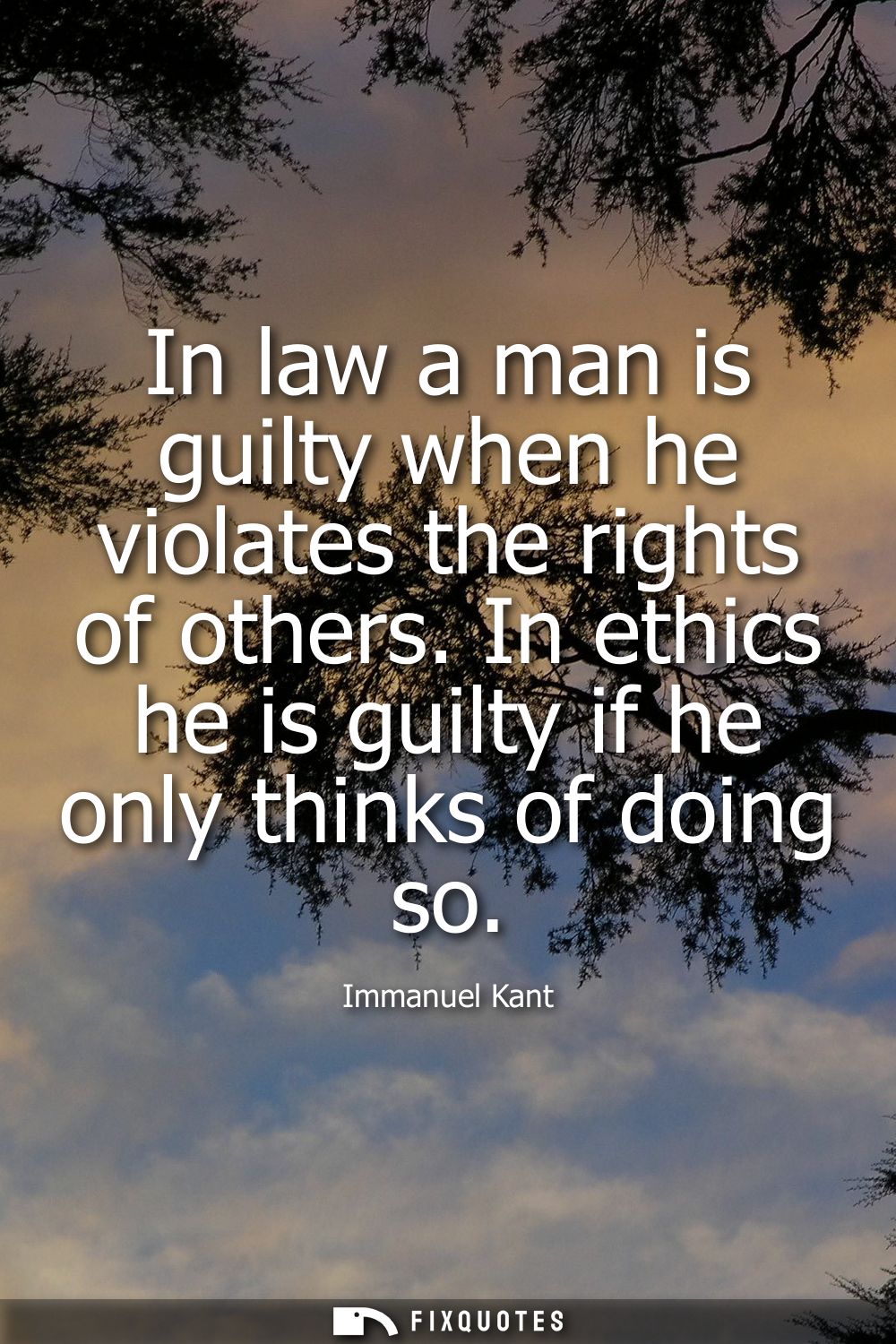
"In law a man is guilty when he violates the rights of others. In ethics he is guilty if he only thinks of doing so"
About this Quote
The specific intent is to separate external compliance from genuine moral worth. You can obey every statute out of fear, habit, or self-interest and still be ethically compromised, because none of that proves you respect other people as ends in themselves. Kant’s subtext is a warning against the comforting loophole of “I didn’t do it.” If you’re the kind of person who is entertained by the idea of harm, or who treats others’ rights as obstacles to maneuver around, the moral failure is already in place. Action is just the sequel.
Context matters: Kant is writing in an Enlightenment world trying to rationalize politics and personal conduct. He’s helping build the modern distinction between legality and legitimacy, between rule-following and principled autonomy. The quote also anticipates a contemporary discomfort: we like rights-based law because it’s measurable; we distrust thought-policing because it’s invasive. Kant isn’t advocating a moral secret police. He’s saying ethics is an internal discipline, a demand for self-governance so rigorous that merely entertaining wrongdoing signals you haven’t yet made yourself fit for freedom.
Quote Details
| Topic | Ethics & Morality |
|---|---|
| Source | Later attribution: IAS Mains Paper 4 Ethics Integrity & Aptitude 2021 (Mohit Sharma, Sujit Kumar, Dr Priya Goel, 2020) modern compilationISBN: 9789324199454 · ID: BlQfEAAAQBAJ
Evidence: ... Kant said that killing is immoral, whatever be the circumstances. that society, that individual would be guilty of ... In law a man is guilty when he violates the rights of others. In ethics he is guilty if he only thinks of doing so ... Other candidates (1) Immanuel Kant (Immanuel Kant) compilation36.2% vational data brought into prominence the problem of the status of the nebulæ and with it the theory of the island un... |
| Cite |
Citation Formats
APA Style (7th ed.)
Kant, Immanuel. (2026, January 13). In law a man is guilty when he violates the rights of others. In ethics he is guilty if he only thinks of doing so. FixQuotes. https://fixquotes.com/quotes/in-law-a-man-is-guilty-when-he-violates-the-369/
Chicago Style
Kant, Immanuel. "In law a man is guilty when he violates the rights of others. In ethics he is guilty if he only thinks of doing so." FixQuotes. January 13, 2026. https://fixquotes.com/quotes/in-law-a-man-is-guilty-when-he-violates-the-369/.
MLA Style (9th ed.)
"In law a man is guilty when he violates the rights of others. In ethics he is guilty if he only thinks of doing so." FixQuotes, 13 Jan. 2026, https://fixquotes.com/quotes/in-law-a-man-is-guilty-when-he-violates-the-369/. Accessed 12 Feb. 2026.