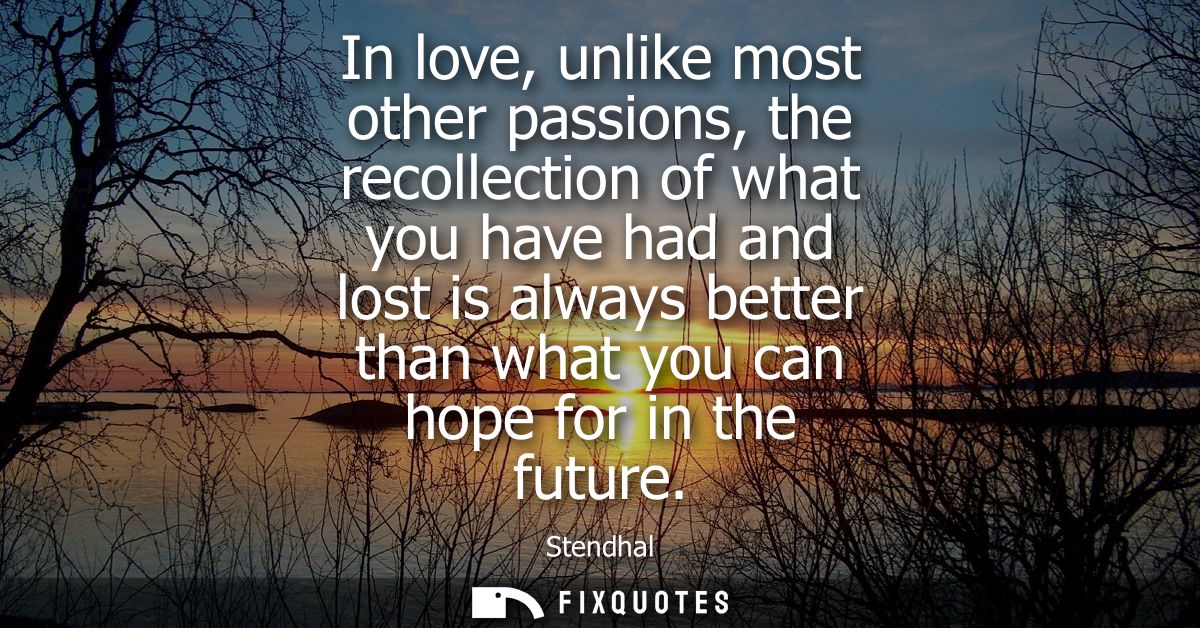
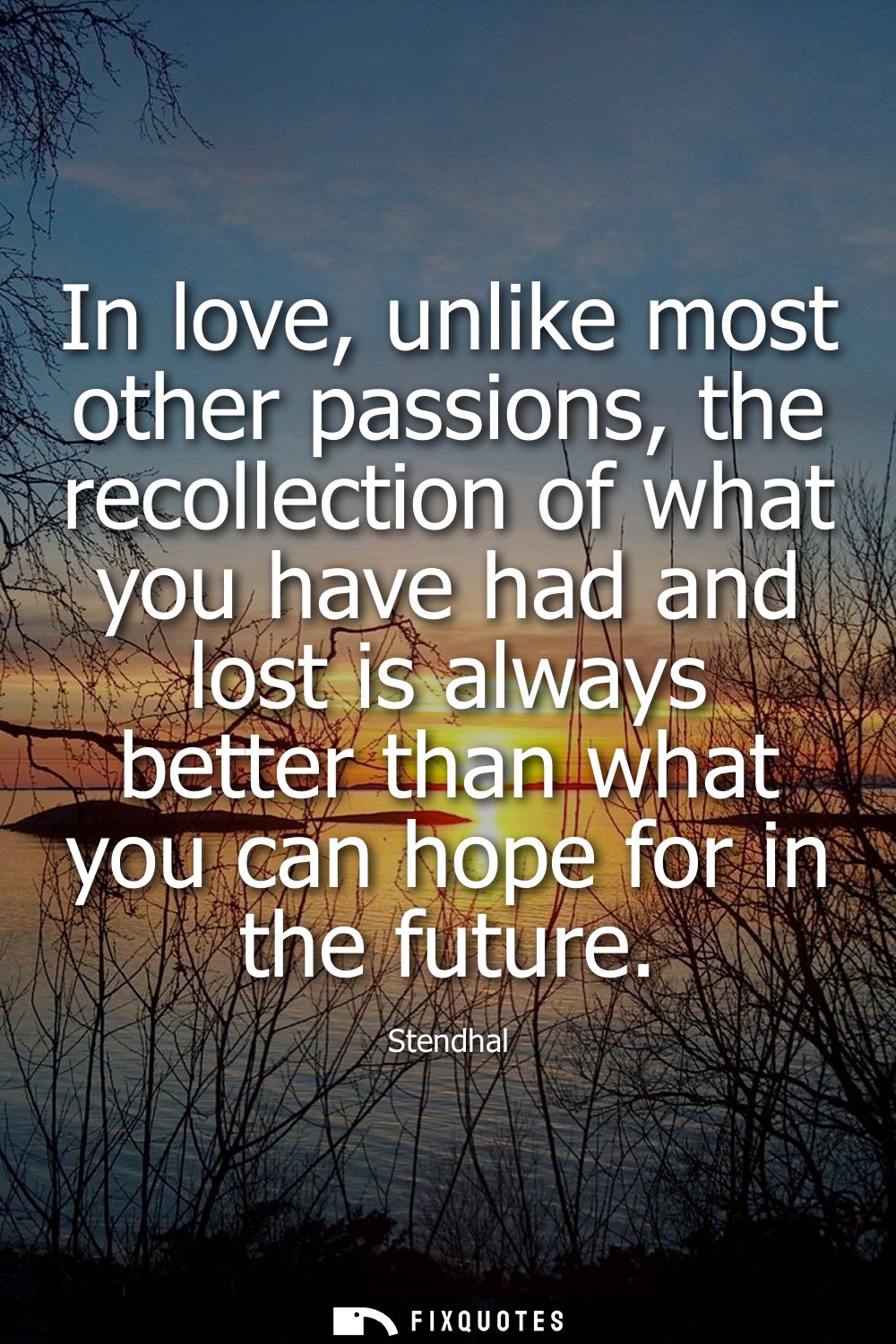
"In love, unlike most other passions, the recollection of what you have had and lost is always better than what you can hope for in the future"
About this Quote
The intent is quietly clinical. Stendhal isn’t mourning lost love so much as exposing a mechanism: longing thrives on certainty, and the past offers certainty even when it’s false. Hope is risk, bargaining with someone else’s freedom; recollection is ownership, a private archive that can’t talk back. That’s the subtextual power move: the lost beloved is safer, more pliable, and therefore more “perfect” than any real person you might meet next.
Context matters. Writing in the early 19th century, Stendhal helped define modern psychological realism, fascinated by self-deception and the way desire manufactures its own evidence. The quote also brushes up against his famous idea of “crystallization,” where love coats an ordinary reality in glittering projections. After loss, crystallization hardens into myth. The future can’t compete with myth because myth has already won the editing war.
Quote Details
| Topic | Heartbreak |
|---|---|
| Source | Help us find the source |
| Cite |
Citation Formats
APA Style (7th ed.)
Stendhal. (2026, January 15). In love, unlike most other passions, the recollection of what you have had and lost is always better than what you can hope for in the future. FixQuotes. https://fixquotes.com/quotes/in-love-unlike-most-other-passions-the-21318/
Chicago Style
Stendhal. "In love, unlike most other passions, the recollection of what you have had and lost is always better than what you can hope for in the future." FixQuotes. January 15, 2026. https://fixquotes.com/quotes/in-love-unlike-most-other-passions-the-21318/.
MLA Style (9th ed.)
"In love, unlike most other passions, the recollection of what you have had and lost is always better than what you can hope for in the future." FixQuotes, 15 Jan. 2026, https://fixquotes.com/quotes/in-love-unlike-most-other-passions-the-21318/. Accessed 27 Mar. 2026.