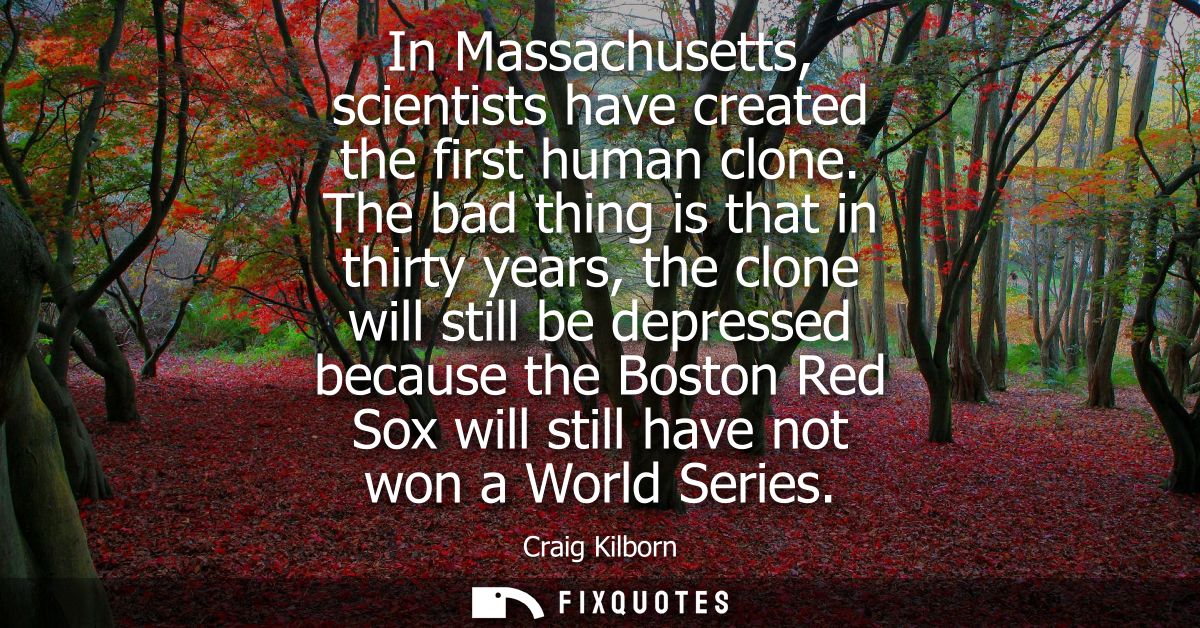
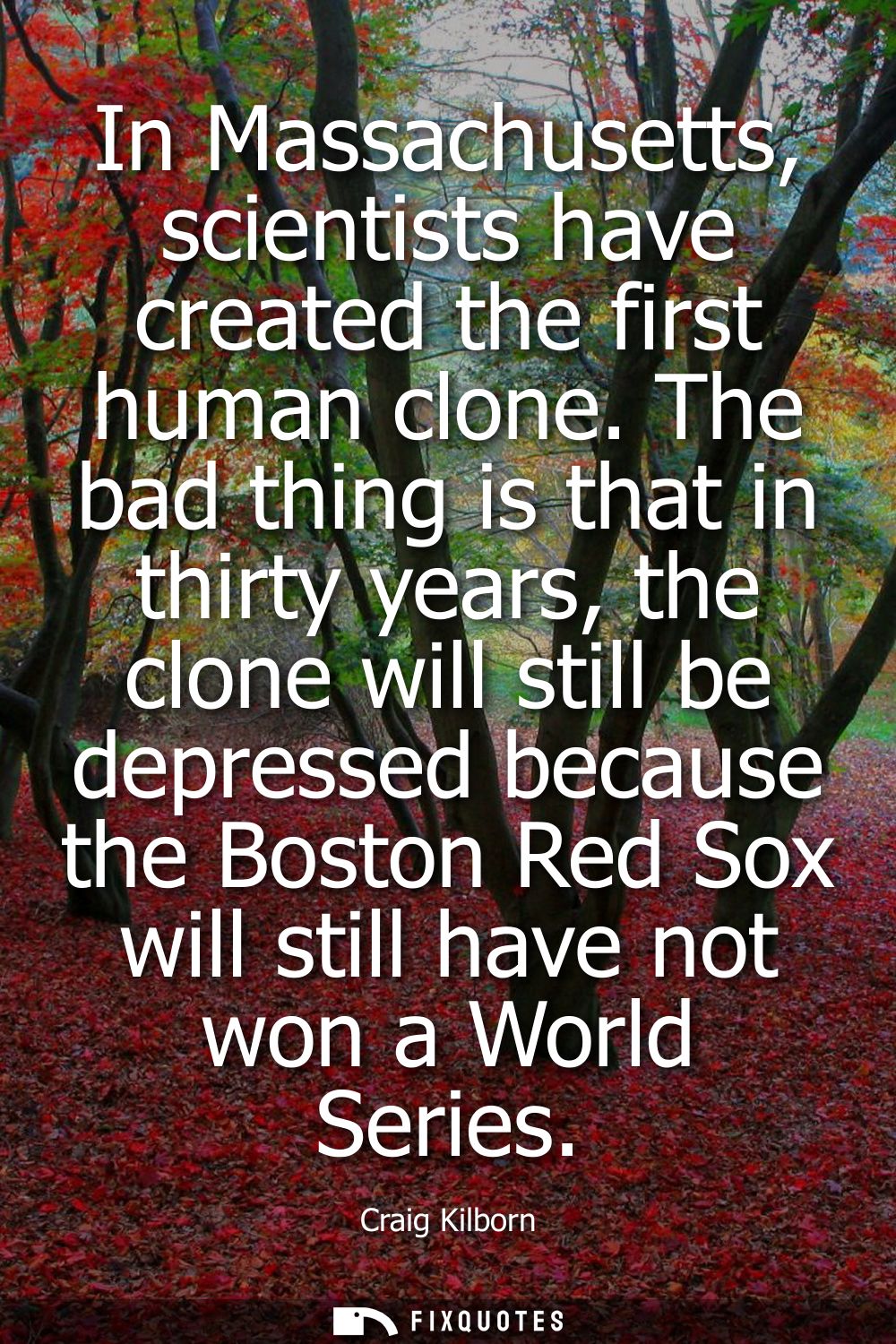
"In Massachusetts, scientists have created the first human clone. The bad thing is that in thirty years, the clone will still be depressed because the Boston Red Sox will still have not won a World Series"
About this Quote
The intent is classic late-night deflation. Kilborn takes a headline designed to inspire awe and punctures it with a regional, everyday pain point. “Thirty years” does double duty: it’s the standard horizon for scientific consequences and the familiar timeframe Sox fans used to measure disappointment. The clone’s depression is a comic exaggeration, but the subtext is sharper: even if you could manufacture a “new” human, you can’t clone your way out of cultural baggage. In this universe, despair isn’t a chemical imbalance; it’s a civic tradition.
Context matters, too. Kilborn’s comedic era thrived on pop-culture omnivorousness, the nightly ritual of turning the news into a series of manageable laughs. Before the Red Sox finally broke through in 2004, their drought functioned as a national shorthand for futility, a ready-made metaphor with instant recognition. The joke works because it treats the World Series not as a game but as a cosmic verdict, and science as a footnote to the real drama: the long, inherited story a city tells itself about hope.
Quote Details
| Topic | Witty One-Liners |
|---|---|
| Source | Help us find the source |
| Cite |
Citation Formats
APA Style (7th ed.)
Kilborn, Craig. (2026, January 15). In Massachusetts, scientists have created the first human clone. The bad thing is that in thirty years, the clone will still be depressed because the Boston Red Sox will still have not won a World Series. FixQuotes. https://fixquotes.com/quotes/in-massachusetts-scientists-have-created-the-139984/
Chicago Style
Kilborn, Craig. "In Massachusetts, scientists have created the first human clone. The bad thing is that in thirty years, the clone will still be depressed because the Boston Red Sox will still have not won a World Series." FixQuotes. January 15, 2026. https://fixquotes.com/quotes/in-massachusetts-scientists-have-created-the-139984/.
MLA Style (9th ed.)
"In Massachusetts, scientists have created the first human clone. The bad thing is that in thirty years, the clone will still be depressed because the Boston Red Sox will still have not won a World Series." FixQuotes, 15 Jan. 2026, https://fixquotes.com/quotes/in-massachusetts-scientists-have-created-the-139984/. Accessed 28 Mar. 2026.