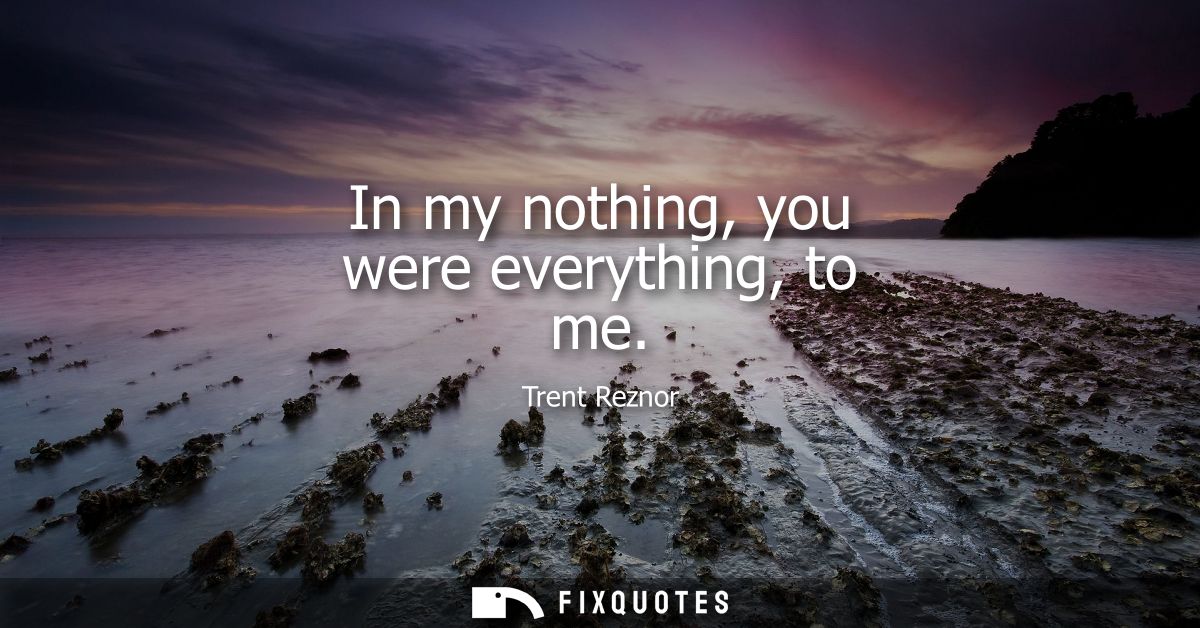
"In my nothing, you were everything, to me"
About this Quote
A gut-punch of devotion told from the floor of self-erasure, Reznor’s line turns romance into a power imbalance you can feel in your teeth. “In my nothing” isn’t just low self-esteem; it’s a whole identity collapsed into absence, the kind of emotional null state that makes any attention feel like salvation. Then comes the pivot: “you were everything, to me.” Not “my everything” in the greeting-card sense, but everything as a totalizing force. The comma before “to me” matters: it quietly admits subjectivity, like he knows this worship is less about the other person’s actual magnitude and more about the narrator’s own vacuum.
The intent is confessional and accusatory at once. It reads like gratitude, but it’s also a warning flare: if someone becomes your “everything,” they inherit an impossible job description. The subtext is dependency disguised as tenderness - a relationship structured around need, not mutual recognition. Reznor has made a career out of narrators who swing between control and surrender, and this line sits right in that uneasy middle: the self describes itself as nothing, but in doing so it also frames the other person as responsible for meaning.
Contextually, it fits the Nine Inch Nails emotional landscape: intimacy as a battleground, vulnerability as both truth and trap. It’s romantic in the way a storm is romantic - intense, cinematic, and potentially destructive. The line works because it refuses to resolve that tension; it just names the math of desperation and lets you sit with the cost.
The intent is confessional and accusatory at once. It reads like gratitude, but it’s also a warning flare: if someone becomes your “everything,” they inherit an impossible job description. The subtext is dependency disguised as tenderness - a relationship structured around need, not mutual recognition. Reznor has made a career out of narrators who swing between control and surrender, and this line sits right in that uneasy middle: the self describes itself as nothing, but in doing so it also frames the other person as responsible for meaning.
Contextually, it fits the Nine Inch Nails emotional landscape: intimacy as a battleground, vulnerability as both truth and trap. It’s romantic in the way a storm is romantic - intense, cinematic, and potentially destructive. The line works because it refuses to resolve that tension; it just names the math of desperation and lets you sit with the cost.
Quote Details
| Topic | Soulmate |
|---|---|
| Source | Help us find the source |
More Quotes by Trent
Add to List