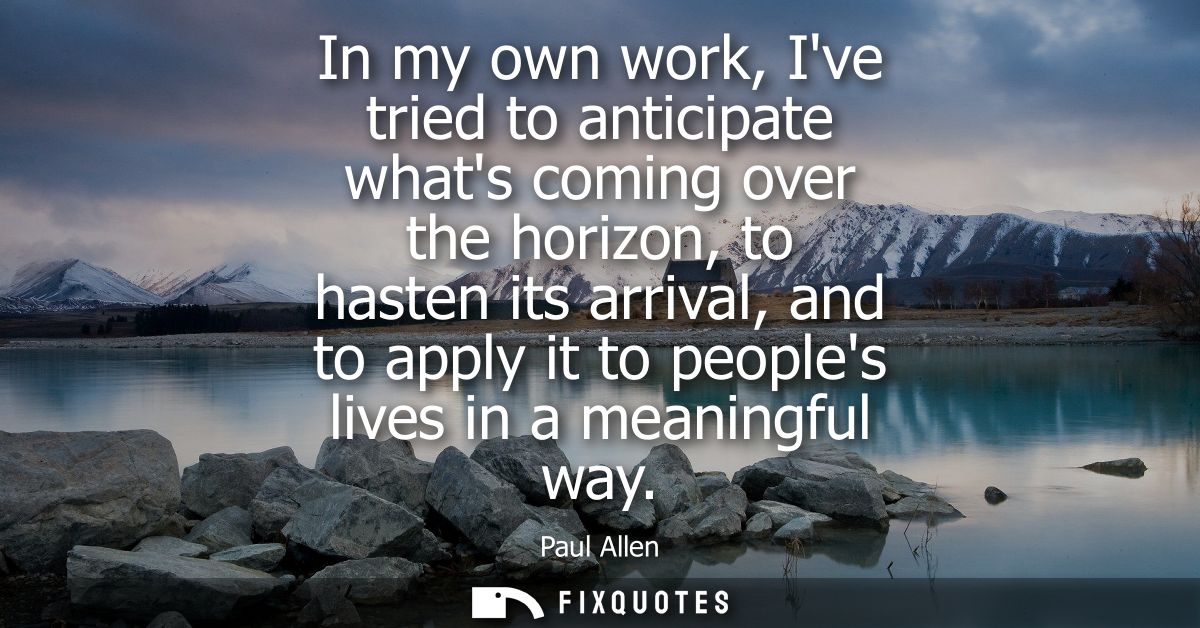
"In my own work, I've tried to anticipate what's coming over the horizon, to hasten its arrival, and to apply it to people's lives in a meaningful way"
About this Quote
The subtext is a familiar Silicon Valley moral geometry: curiosity becomes inevitability, and inevitability becomes virtue. “Over the horizon” borrows the romance of exploration, but it also lets him dodge messier questions about who decides what counts as progress and who pays the costs of “arrival.” When you hasten a technology, you also hasten its side effects: labor displacement, privacy erosion, monopoly gravity. The quote is written as if meaning can be poured into innovation after the fact, like a final coat of varnish. That’s optimistic, maybe strategic.
Context matters because Allen’s biography practically demands this narrative. As Microsoft’s co-founder, he lived through the moment when software stopped being a hobbyist’s tool and became infrastructure. Later, through Vulcan, philanthropy, and big-science bets, he kept positioning himself as a patron of the next thing. The line functions as self-portrait and gentle defense: not just wealth accumulation, but future-building with a conscience. It’s a mission statement that turns ambition into public service, without admitting how often those two goals collide.
Quote Details
| Topic | Technology |
|---|---|
| Source | Help us find the source |
| Cite |
Citation Formats
APA Style (7th ed.)
Allen, Paul. (2026, January 16). In my own work, I've tried to anticipate what's coming over the horizon, to hasten its arrival, and to apply it to people's lives in a meaningful way. FixQuotes. https://fixquotes.com/quotes/in-my-own-work-ive-tried-to-anticipate-whats-130402/
Chicago Style
Allen, Paul. "In my own work, I've tried to anticipate what's coming over the horizon, to hasten its arrival, and to apply it to people's lives in a meaningful way." FixQuotes. January 16, 2026. https://fixquotes.com/quotes/in-my-own-work-ive-tried-to-anticipate-whats-130402/.
MLA Style (9th ed.)
"In my own work, I've tried to anticipate what's coming over the horizon, to hasten its arrival, and to apply it to people's lives in a meaningful way." FixQuotes, 16 Jan. 2026, https://fixquotes.com/quotes/in-my-own-work-ive-tried-to-anticipate-whats-130402/. Accessed 3 Apr. 2026.