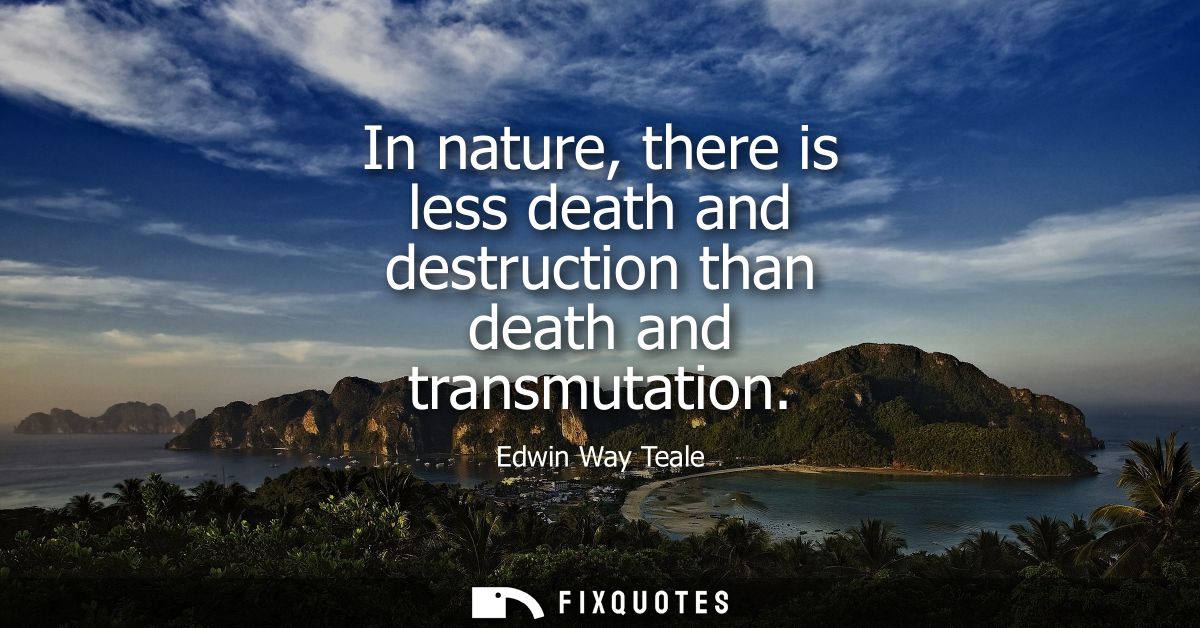
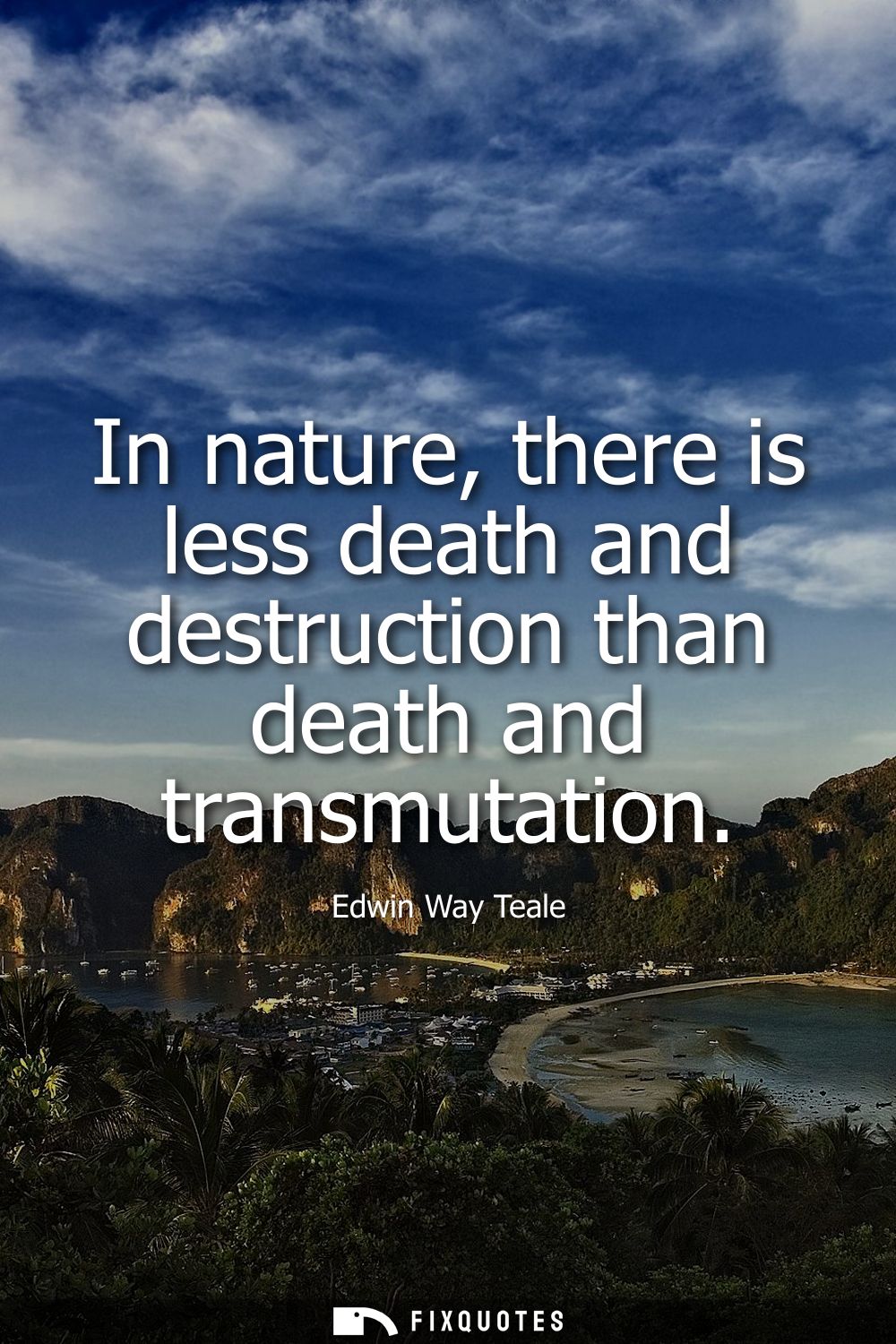
"In nature, there is less death and destruction than death and transmutation"
About this Quote
The intent feels corrective, almost pedagogical, but not blandly optimistic. Teale is not denying violence in ecosystems; he's denying the human habit of calling every loss "waste". Transmutation is a word with alchemical residue: it suggests a hidden continuity beneath appearances, the way decay becomes soil, heat becomes migration, bodies become energy routes for other bodies. That word choice is the subtextual rebuke: your horror at "destruction" may be less about the woods than about your need for permanence.
Context matters. Teale made his name translating close observation of the natural world into accessible, lyrical prose for a 20th-century audience increasingly separated from land by suburbia, industry, and war. Against a century of mechanized annihilation - where death really can be sheer negation - he draws a boundary: nature's "ending" is usually someone else's beginning. It's an ecological argument smuggled in as a semantic one, and that's why it lands.
Quote Details
| Topic | Change |
|---|---|
| Source | Later attribution: Uncle John's Bathroom Reader Nature Calls (Bathroom Readers' Institute, 2012) modern compilationISBN: 9781607106944 · ID: cClZDwAAQBAJ
Evidence:
... In nature , there is less death and destruction than death and transmutation . ” -Toba Beta -Edwin Way Teale " A lion's work hours are only when he's hungry ; once he's satisfied , the predator and prey live peacefully together ... |
| Cite |
Citation Formats
APA Style (7th ed.)
Teale, Edwin Way. (2026, February 13). In nature, there is less death and destruction than death and transmutation. FixQuotes. https://fixquotes.com/quotes/in-nature-there-is-less-death-and-destruction-136834/
Chicago Style
Teale, Edwin Way. "In nature, there is less death and destruction than death and transmutation." FixQuotes. February 13, 2026. https://fixquotes.com/quotes/in-nature-there-is-less-death-and-destruction-136834/.
MLA Style (9th ed.)
"In nature, there is less death and destruction than death and transmutation." FixQuotes, 13 Feb. 2026, https://fixquotes.com/quotes/in-nature-there-is-less-death-and-destruction-136834/. Accessed 25 Mar. 2026.