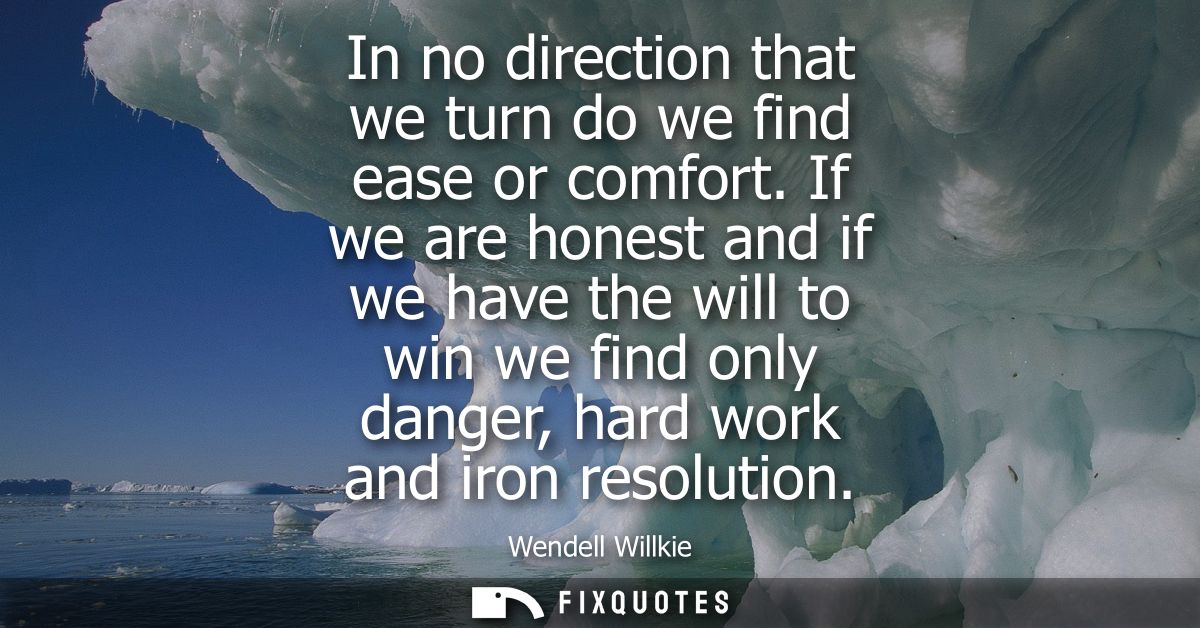
"In no direction that we turn do we find ease or comfort. If we are honest and if we have the will to win, we find only danger, hard work and iron resolution"
About this Quote
The specific intent is to discipline public expectation. Willkie, a lawyer by trade and a wartime public voice by necessity, isn’t selling optimism; he’s prosecuting complacency. “If we are honest” is the quiet trap in the sentence: it implies that many people aren’t, that self-deception is the real domestic threat. Then he adds “if we have the will to win,” framing victory not as entitlement but as a choice with a price tag. The reward for choosing correctly isn’t relief. It’s “only danger.”
Subtextually, the rhetoric converts anxiety into duty. “Hard work” is democratic language - everyone can contribute, no aristocratic heroism required - while “iron resolution” gives the moment its steel. The phrase echoes the era’s mobilization vocabulary, when national seriousness had to be manufactured against the inertia of normal life. Even without naming an enemy, the quote makes one visible: the temptation to look away, to bargain for “ease” while the world turns violent.
Context matters: Willkie’s politics often leaned internationalist at a time when isolationism was a live option. This sentence is a refusal of that option, a demand that adult citizenship begins exactly where comfort ends.
Quote Details
| Topic | Perseverance |
|---|---|
| Source | Help us find the source |
| Cite |
Citation Formats
APA Style (7th ed.)
Willkie, Wendell. (2026, February 17). In no direction that we turn do we find ease or comfort. If we are honest and if we have the will to win, we find only danger, hard work and iron resolution. FixQuotes. https://fixquotes.com/quotes/in-no-direction-that-we-turn-do-we-find-ease-or-96483/
Chicago Style
Willkie, Wendell. "In no direction that we turn do we find ease or comfort. If we are honest and if we have the will to win, we find only danger, hard work and iron resolution." FixQuotes. February 17, 2026. https://fixquotes.com/quotes/in-no-direction-that-we-turn-do-we-find-ease-or-96483/.
MLA Style (9th ed.)
"In no direction that we turn do we find ease or comfort. If we are honest and if we have the will to win, we find only danger, hard work and iron resolution." FixQuotes, 17 Feb. 2026, https://fixquotes.com/quotes/in-no-direction-that-we-turn-do-we-find-ease-or-96483/. Accessed 26 Mar. 2026.