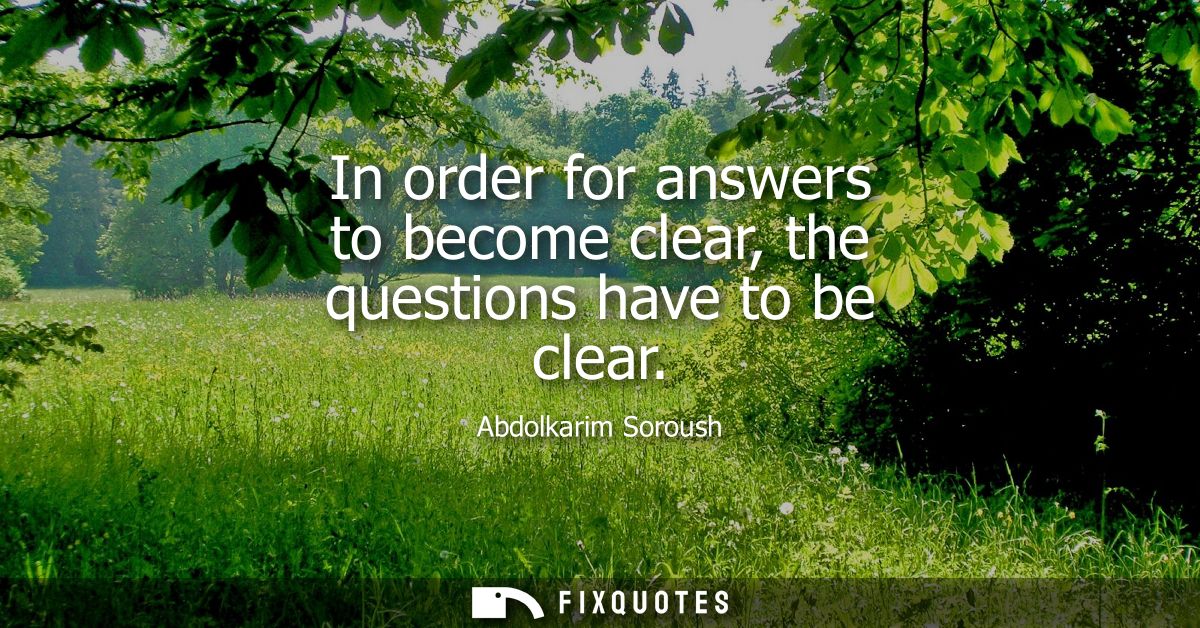
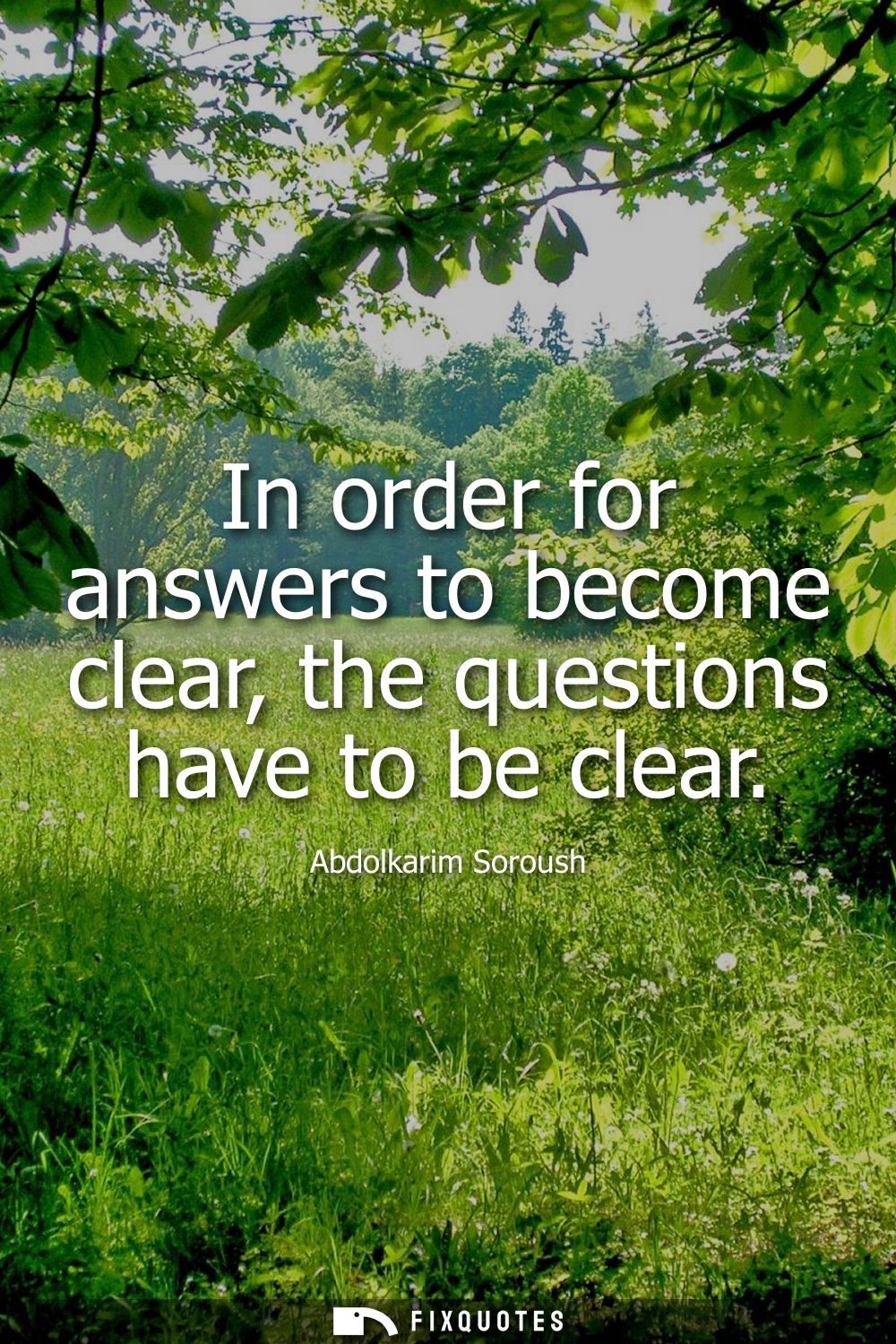
"In order for answers to become clear, the questions have to be clear"
About this Quote
Clarity is a moral demand disguised as a methodological tip. Soroush’s line looks like commonsense advice, but it’s really a warning about power: whoever controls the questions often controls the “answers” that later get treated as inevitable. By insisting that questions must be clear first, he’s pushing back against a familiar trick in ideological debate - the loaded question, the false binary, the premise smuggled in as neutral framing. In politics and religion especially, muddy questions produce crisp answers that feel authoritative precisely because they’re responding to a rigged setup.
The subtext is epistemic humility with teeth. Soroush isn’t romanticizing uncertainty; he’s arguing that clarity about what we’re asking (and what we’re assuming) is the only honest path to knowledge. A blurry question invites a confident answerer to fill the gaps with their own theology, ideology, or interests. A clear question forces accountability: define terms, specify scope, admit what kind of evidence would count, and identify what would change your mind.
Context matters because Soroush is not a philosopher speaking in a vacuum. As an Iranian thinker associated with reformist religious thought, he’s spent decades grappling with how interpretation, authority, and language shape public life. The quote reads as a critique of doctrinal certainty: when religious or political authorities claim final answers, the first thing to inspect is the question they’re answering. If the question presumes infallibility, the answer will too. The real reform begins upstream, in the framing.
The subtext is epistemic humility with teeth. Soroush isn’t romanticizing uncertainty; he’s arguing that clarity about what we’re asking (and what we’re assuming) is the only honest path to knowledge. A blurry question invites a confident answerer to fill the gaps with their own theology, ideology, or interests. A clear question forces accountability: define terms, specify scope, admit what kind of evidence would count, and identify what would change your mind.
Context matters because Soroush is not a philosopher speaking in a vacuum. As an Iranian thinker associated with reformist religious thought, he’s spent decades grappling with how interpretation, authority, and language shape public life. The quote reads as a critique of doctrinal certainty: when religious or political authorities claim final answers, the first thing to inspect is the question they’re answering. If the question presumes infallibility, the answer will too. The real reform begins upstream, in the framing.
Quote Details
| Topic | Reason & Logic |
|---|---|
| Source | Help us find the source |
| Cite |
Citation Formats
APA Style (7th ed.)
Soroush, Abdolkarim. (2026, January 17). In order for answers to become clear, the questions have to be clear. FixQuotes. https://fixquotes.com/quotes/in-order-for-answers-to-become-clear-the-75126/
Chicago Style
Soroush, Abdolkarim. "In order for answers to become clear, the questions have to be clear." FixQuotes. January 17, 2026. https://fixquotes.com/quotes/in-order-for-answers-to-become-clear-the-75126/.
MLA Style (9th ed.)
"In order for answers to become clear, the questions have to be clear." FixQuotes, 17 Jan. 2026, https://fixquotes.com/quotes/in-order-for-answers-to-become-clear-the-75126/. Accessed 20 Mar. 2026.
More Quotes by Abdolkarim
Add to List