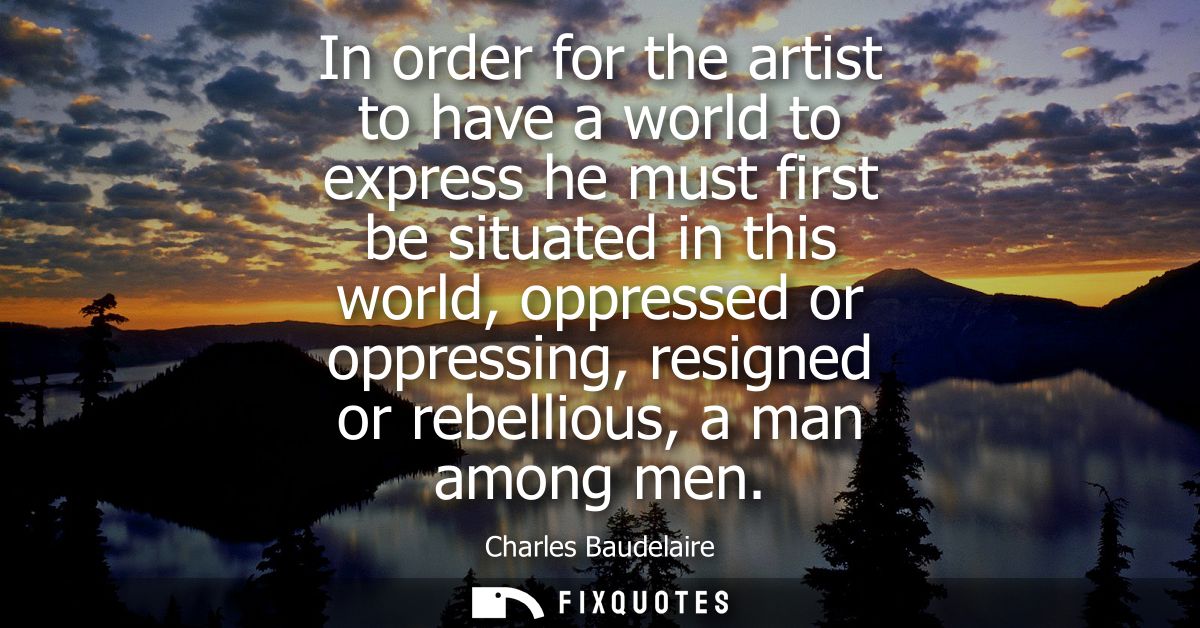
"In order for the artist to have a world to express, he must first be situated in this world, oppressed or oppressing, resigned or rebellious, a man among men"
About this Quote
The paired opposites do the real work. “Oppressed or oppressing” refuses the comforting position of the innocent observer; even suffering can become a posture, and even privilege can masquerade as neutrality. Baudelaire isn’t offering a checklist of identities so much as insisting that art is born from conditions, not just feelings. You can be resigned or rebellious, he allows, but you can’t be absent. That final phrase, “a man among men,” is deliberately leveling: the artist’s authority comes not from special access to truth but from proximity to the human mess, including complicity.
Context matters. Baudelaire wrote out of a 19th-century Paris being violently remodeled by modernity, where the crowd, the commodity, and the spectacle were becoming everyday facts. His own stance was famously double-edged: the flaneur who watches and judges, the poet who hungers for transcendence yet keeps getting dragged back to the street. The intent here is almost disciplinary. If you want to speak for “the world,” you don’t earn it by claiming purity; you earn it by admitting where you stand inside the grind of class, desire, boredom, and power.
Quote Details
| Topic | Art |
|---|---|
| Source | Help us find the source |
| Cite |
Citation Formats
APA Style (7th ed.)
Baudelaire, Charles. (2026, February 19). In order for the artist to have a world to express, he must first be situated in this world, oppressed or oppressing, resigned or rebellious, a man among men. FixQuotes. https://fixquotes.com/quotes/in-order-for-the-artist-to-have-a-world-to-50659/
Chicago Style
Baudelaire, Charles. "In order for the artist to have a world to express, he must first be situated in this world, oppressed or oppressing, resigned or rebellious, a man among men." FixQuotes. February 19, 2026. https://fixquotes.com/quotes/in-order-for-the-artist-to-have-a-world-to-50659/.
MLA Style (9th ed.)
"In order for the artist to have a world to express, he must first be situated in this world, oppressed or oppressing, resigned or rebellious, a man among men." FixQuotes, 19 Feb. 2026, https://fixquotes.com/quotes/in-order-for-the-artist-to-have-a-world-to-50659/. Accessed 12 Mar. 2026.