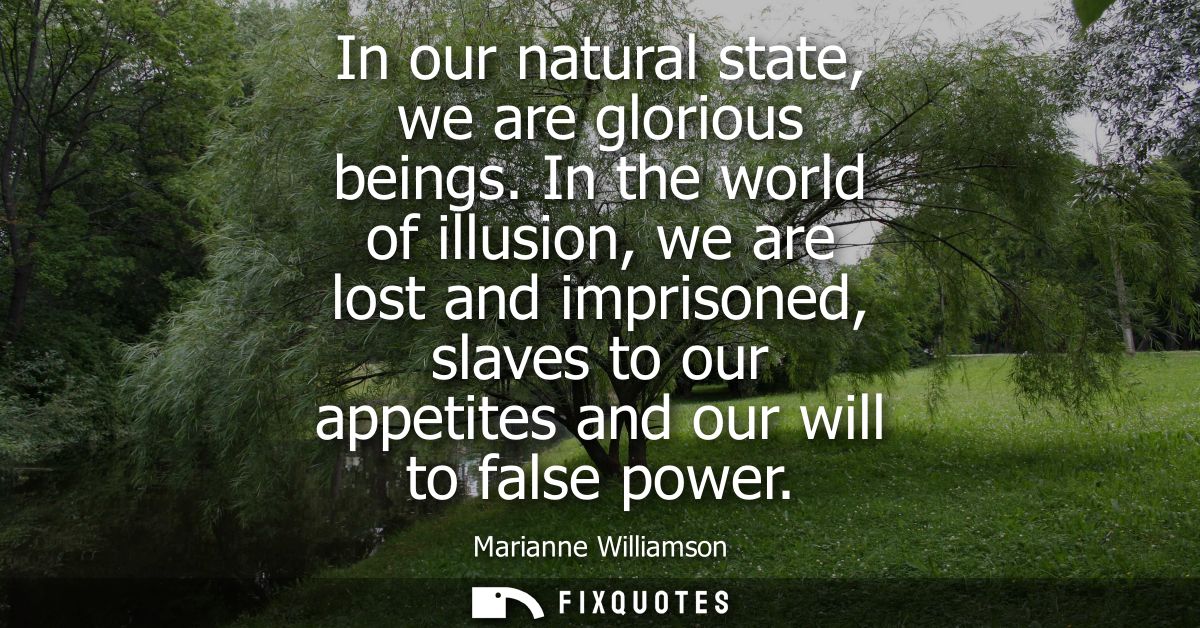
"In our natural state, we are glorious beings. In the world of illusion, we are lost and imprisoned, slaves to our appetites and our will to false power"
About this Quote
The line works because it stages a moral drama in the language of addiction and incarceration. “Lost and imprisoned” is not mild self-help; it’s an indictment. “Slaves to our appetites” nods to ancient religious suspicion of desire, but Williamson modernizes it with “will to false power,” a phrase that points at the hunger to dominate, to curate an image, to win at someone else’s scoreboard. The subtext is: your cravings are not just personal weaknesses; they are symptoms of a collective trance, and that trance is profitable to someone.
Context matters. Williamson’s career sits at the intersection of New Age spirituality and late-20th-century therapeutic culture, later spilling into politics. That blend explains the quote’s persuasion strategy: it offers inner liberation as the first step, then quietly implies that social life is structured to keep you spiritually small. It’s less a diagnosis than a recruitment pitch: wake up, opt out, and redefine power as alignment rather than conquest.
Quote Details
| Topic | Faith |
|---|---|
| Source | Help us find the source |
| Cite |
Citation Formats
APA Style (7th ed.)
Williamson, Marianne. (2026, January 18). In our natural state, we are glorious beings. In the world of illusion, we are lost and imprisoned, slaves to our appetites and our will to false power. FixQuotes. https://fixquotes.com/quotes/in-our-natural-state-we-are-glorious-beings-in-14837/
Chicago Style
Williamson, Marianne. "In our natural state, we are glorious beings. In the world of illusion, we are lost and imprisoned, slaves to our appetites and our will to false power." FixQuotes. January 18, 2026. https://fixquotes.com/quotes/in-our-natural-state-we-are-glorious-beings-in-14837/.
MLA Style (9th ed.)
"In our natural state, we are glorious beings. In the world of illusion, we are lost and imprisoned, slaves to our appetites and our will to false power." FixQuotes, 18 Jan. 2026, https://fixquotes.com/quotes/in-our-natural-state-we-are-glorious-beings-in-14837/. Accessed 17 Feb. 2026.