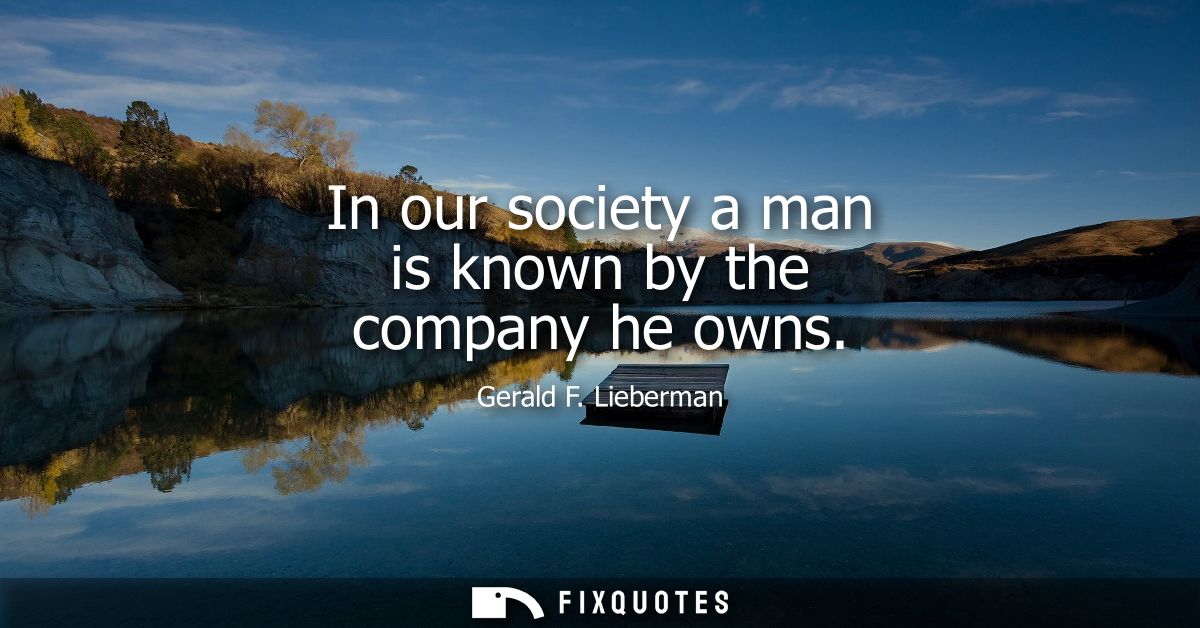
"In our society, a man is known by the company he owns"
About this Quote
Lieberman twists an old moral yardstick into a corporate measuring stick, and that tiny pivot does all the work. “Known by the company he keeps” once implied character revealed through chosen relationships; “the company he owns” swaps ethics for assets. The line lands as a dry indictment of a culture where reputation is no longer a social achievement but a balance-sheet outcome. In this world, your values don’t introduce you; your portfolio does.
The intent feels less like a complaint about business itself than about how business colonizes identity. “In our society” broadens the target from individual vanity to a shared system of recognition: status is outsourced to brands, titles, and equity. Ownership becomes a shortcut around trust. If you own the company, you don’t need to be good company. People assume the rest.
Subtext: the social game has been rewritten from companionship to control. Keeping company suggests mutuality and risk; owning a company suggests hierarchy and insulation. Lieberman’s phrasing hints at how power sanitizes perception: the messiness of who you are gets flattened into what you command. It’s also a subtle jab at masculinity as a credentialing apparatus - “a man is known” reads like a memo from an older social order, one that increasingly equates manhood with dominion and acquisition.
Contextually, the line fits neatly into late-20th-century American anxieties about corporate culture: the rise of the executive as celebrity, the idea that success is a moral alibi, the shift from community standing to market standing. It’s a sentence that understands how capitalism doesn’t just price goods; it prices people.
The intent feels less like a complaint about business itself than about how business colonizes identity. “In our society” broadens the target from individual vanity to a shared system of recognition: status is outsourced to brands, titles, and equity. Ownership becomes a shortcut around trust. If you own the company, you don’t need to be good company. People assume the rest.
Subtext: the social game has been rewritten from companionship to control. Keeping company suggests mutuality and risk; owning a company suggests hierarchy and insulation. Lieberman’s phrasing hints at how power sanitizes perception: the messiness of who you are gets flattened into what you command. It’s also a subtle jab at masculinity as a credentialing apparatus - “a man is known” reads like a memo from an older social order, one that increasingly equates manhood with dominion and acquisition.
Contextually, the line fits neatly into late-20th-century American anxieties about corporate culture: the rise of the executive as celebrity, the idea that success is a moral alibi, the shift from community standing to market standing. It’s a sentence that understands how capitalism doesn’t just price goods; it prices people.
Quote Details
| Topic | Wealth |
|---|---|
| Source | Help us find the source |
| Cite |
Citation Formats
APA Style (7th ed.)
Lieberman, Gerald F. (2026, February 16). In our society, a man is known by the company he owns. FixQuotes. https://fixquotes.com/quotes/in-our-society-a-man-is-known-by-the-company-he-124540/
Chicago Style
Lieberman, Gerald F. "In our society, a man is known by the company he owns." FixQuotes. February 16, 2026. https://fixquotes.com/quotes/in-our-society-a-man-is-known-by-the-company-he-124540/.
MLA Style (9th ed.)
"In our society, a man is known by the company he owns." FixQuotes, 16 Feb. 2026, https://fixquotes.com/quotes/in-our-society-a-man-is-known-by-the-company-he-124540/. Accessed 16 Mar. 2026.
More Quotes by Gerald
Add to List