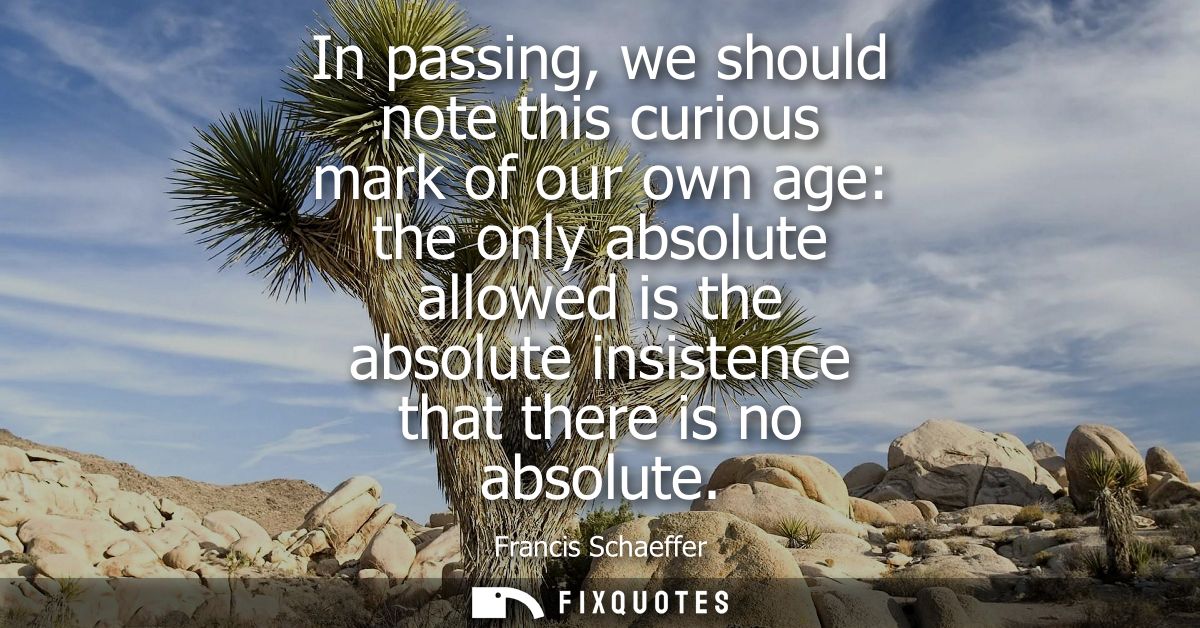
"In passing, we should note this curious mark of our own age: the only absolute allowed is the absolute insistence that there is no absolute"
About this Quote
Schaeffer’s intent isn’t just to score a clever point against fashionable skepticism. It’s to expose what he sees as a new orthodoxy operating under the banner of neutrality. The subtext is cultural: institutions (universities, media, law) increasingly treat moral and metaphysical claims as private preferences, while enforcing that stance publicly. That enforcement is the tell. Relativism, in his telling, doesn’t float above the fray; it disciplines the fray, defining which kinds of conviction are admissible.
Context matters. Writing and speaking in the postwar West, Schaeffer watched modernism’s confidence erode into the late-20th-century suspicion of “metanarratives,” with “personal truth” replacing shared frameworks. As an evangelical theologian and apologist, he’s arguing that Christianity isn’t simply one lifestyle option among many; it makes truth-claims that collide with the era’s etiquette. The quote works because it recasts relativism not as humility but as power: a rule that denies it is a rule.
Quote Details
| Topic | Truth |
|---|---|
| Source | Help us find the source |
| Cite |
Citation Formats
APA Style (7th ed.)
Schaeffer, Francis. (2026, January 17). In passing, we should note this curious mark of our own age: the only absolute allowed is the absolute insistence that there is no absolute. FixQuotes. https://fixquotes.com/quotes/in-passing-we-should-note-this-curious-mark-of-51106/
Chicago Style
Schaeffer, Francis. "In passing, we should note this curious mark of our own age: the only absolute allowed is the absolute insistence that there is no absolute." FixQuotes. January 17, 2026. https://fixquotes.com/quotes/in-passing-we-should-note-this-curious-mark-of-51106/.
MLA Style (9th ed.)
"In passing, we should note this curious mark of our own age: the only absolute allowed is the absolute insistence that there is no absolute." FixQuotes, 17 Jan. 2026, https://fixquotes.com/quotes/in-passing-we-should-note-this-curious-mark-of-51106/. Accessed 31 Mar. 2026.