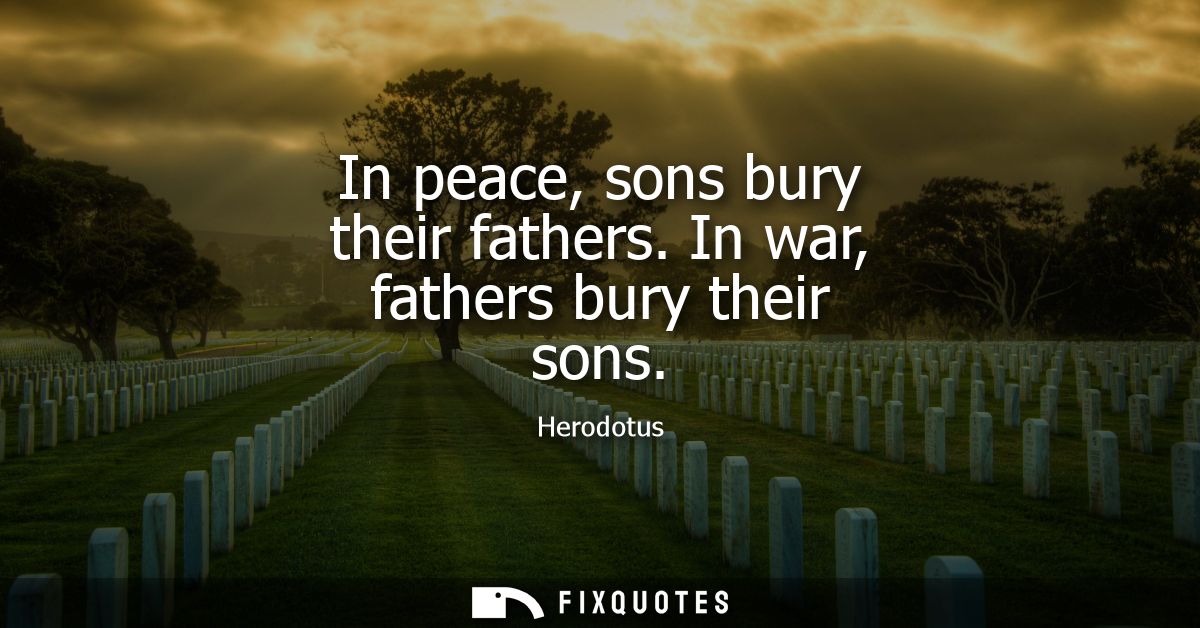
"In peace, sons bury their fathers. In war, fathers bury their sons"
About this Quote
A neat little chiasmus that lands like a verdict: peace preserves the expected order of life, war reverses it. Herodotus isn’t offering comfort or even “wisdom” so much as a cold inventory of what conflict does to the most basic human contract between generations. The symmetry of the line is the trick. By balancing “sons” and “fathers” on either side of “peace” and “war,” it makes war’s offense feel structural, not incidental. Casualties aren’t just numbers; they’re a moral distortion of time itself.
The intent is diagnostic. Herodotus, writing in a world where the Persian Wars and the feuding of Greek city-states formed the background noise of civic life, treats war as a machine that reliably produces unnatural outcomes. That’s the subtext: don’t romanticize the battlefield. Even victory carries the stink of funerals done out of order. When fathers bury sons, society isn’t merely mourning; it’s being forced to admit it has failed at its most ancient promise, continuity.
The line also flatters no one. It quietly indicts leaders who talk about honor and destiny while outsourcing the price to households. Peace here isn’t idealized as bliss; it’s defined almost bureaucratically as the condition under which the ordinary sequence of inheritance and memory can proceed. War, by contrast, is characterized by its domestic consequences, turning history from grand narrative into graveside accounting.
The intent is diagnostic. Herodotus, writing in a world where the Persian Wars and the feuding of Greek city-states formed the background noise of civic life, treats war as a machine that reliably produces unnatural outcomes. That’s the subtext: don’t romanticize the battlefield. Even victory carries the stink of funerals done out of order. When fathers bury sons, society isn’t merely mourning; it’s being forced to admit it has failed at its most ancient promise, continuity.
The line also flatters no one. It quietly indicts leaders who talk about honor and destiny while outsourcing the price to households. Peace here isn’t idealized as bliss; it’s defined almost bureaucratically as the condition under which the ordinary sequence of inheritance and memory can proceed. War, by contrast, is characterized by its domestic consequences, turning history from grand narrative into graveside accounting.
Quote Details
| Topic | War |
|---|---|
| Source | Help us find the source |
| Cite | Cite this Quote |
Citation Formats
APA Style (7th ed.)
Herodotus. (2026, January 15). In peace, sons bury their fathers. In war, fathers bury their sons. FixQuotes. https://fixquotes.com/quotes/in-peace-sons-bury-their-fathers-in-war-fathers-163603/
Chicago Style
Herodotus. "In peace, sons bury their fathers. In war, fathers bury their sons." FixQuotes. January 15, 2026. https://fixquotes.com/quotes/in-peace-sons-bury-their-fathers-in-war-fathers-163603/.
MLA Style (9th ed.)
"In peace, sons bury their fathers. In war, fathers bury their sons." FixQuotes, 15 Jan. 2026, https://fixquotes.com/quotes/in-peace-sons-bury-their-fathers-in-war-fathers-163603/. Accessed 3 Feb. 2026.
More Quotes by Herodotus
Add to List