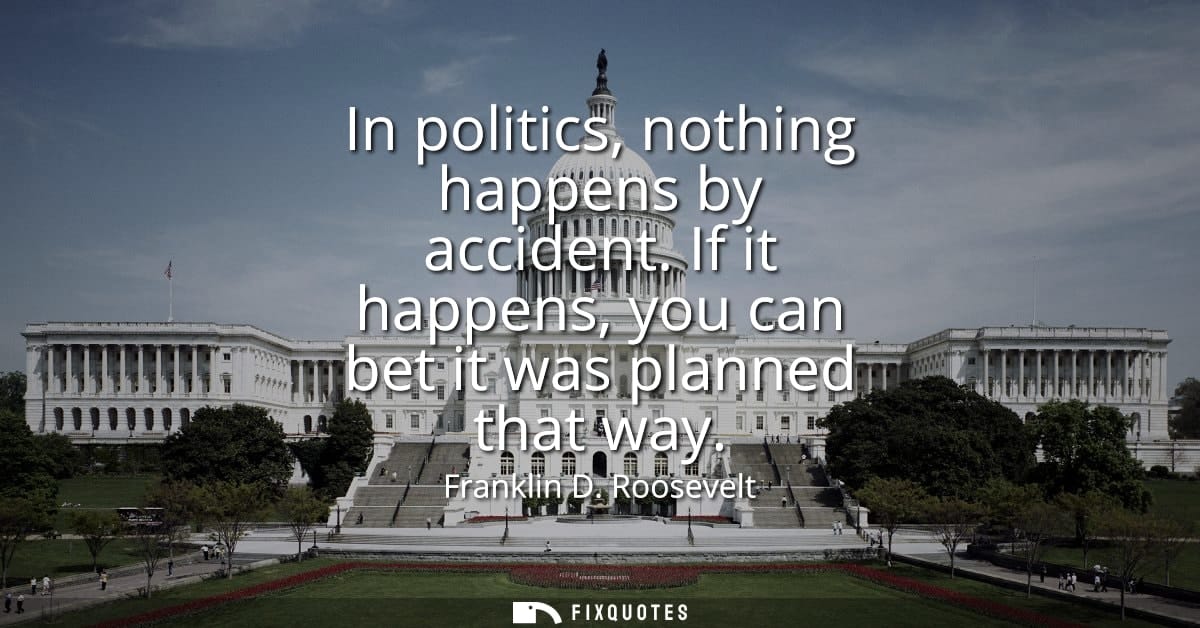
"In politics, nothing happens by accident. If it happens, you can bet it was planned that way"
About this Quote
The subtext is FDR’s favorite instrument: managed perception. The quote flattens chaos into design, nudging citizens (and rivals) to assume intentionality behind leaks, coalitions, sudden “grassroots” surges, even legislative failure. It’s a way of reclaiming narrative control in a system that constantly produces plausible deniability. If you can convince people every event has an author, you can also imply there’s a responsible party to praise or punish. That’s accountability, but it’s also a pressure tactic.
Context matters: Roosevelt governed through overlapping emergencies - Depression, then global war - when the public was hungry for coherence and opponents accused him of backroom manipulation. The New Deal’s policy wins were inseparable from meticulous coalition-building, patronage, and message discipline; wartime strategy demanded secrecy and staged disclosure. The line reads as both confession and deterrent: confession that power is engineered, deterrent to anyone imagining they can stumble into influence without a plan.
It also carries an embedded cynicism about innocence. In FDR’s world, “accident” is what the naive call coordination, and “planned” is what the powerful call survival.
Quote Details
| Topic | Vision & Strategy |
|---|---|
| Source | Later attribution: Public Private Partnership (Walter Schönthaler, 2025) modern compilation
Evidence: ... Franklin D. Roosevelt, who supposedly said, "Hardly anything in politics happens by chance." Roosevelt's original quote reads as follows: "In politics, nothing happens by accident. If it happens, you can bet it was planned that way ... Other candidates (2) Franklin D. Roosevelt (Franklin D. Roosevelt) compilation37.8% nce in politics having spent eight years in the highest office in the land when it came to a job of work he was Inaugural Address of Franklin Delano Roosevelt: Given in ... (Roosevelt, Franklin D. (Franklin Delano), 1945) primary35.1% uring political mechanism the modern world has ever seen it has met every stress of vast expansion of territory |
| Featured | This quote was our Quote of the Day on December 18, 2024 |
| Cite |
Citation Formats
APA Style (7th ed.)
Roosevelt, Franklin D. (2026, February 7). In politics, nothing happens by accident. If it happens, you can bet it was planned that way. FixQuotes. https://fixquotes.com/quotes/in-politics-nothing-happens-by-accident-if-it-16499/
Chicago Style
Roosevelt, Franklin D. "In politics, nothing happens by accident. If it happens, you can bet it was planned that way." FixQuotes. February 7, 2026. https://fixquotes.com/quotes/in-politics-nothing-happens-by-accident-if-it-16499/.
MLA Style (9th ed.)
"In politics, nothing happens by accident. If it happens, you can bet it was planned that way." FixQuotes, 7 Feb. 2026, https://fixquotes.com/quotes/in-politics-nothing-happens-by-accident-if-it-16499/. Accessed 27 Mar. 2026.