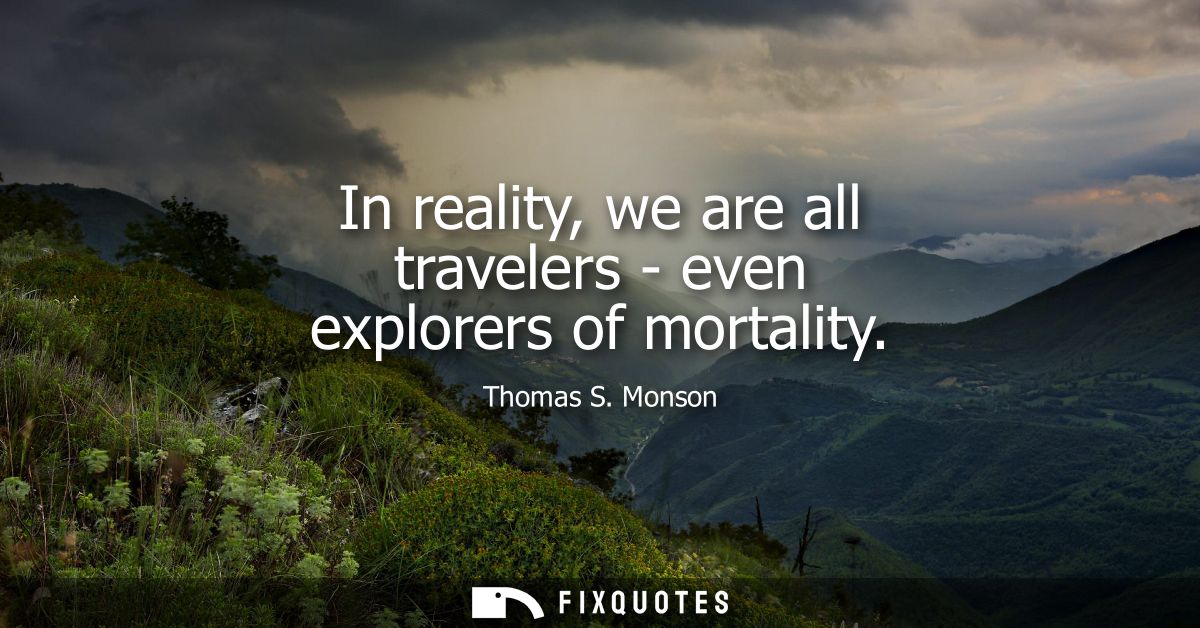
"In reality, we are all travelers - even explorers of mortality"
About this Quote
Monson’s line turns the well-worn metaphor of “life as a journey” into a pastoral directive: stop pretending you’re stationary. “Travelers” is gentle, communal language, the kind that quietly dissolves hierarchy. No one gets to be an exception, not the grieving, not the faithful, not the leader at the pulpit. Then he tightens the screw with “even explorers of mortality,” a phrase that reframes death from a taboo endpoint into territory with contours you can study, walk, and (crucially) prepare for.
The intent is less poetic than practical. As a clergyman, Monson is speaking into a culture that often treats mortality as either medical failure or private dread. He offers an alternative frame: mortality is not an accident interrupting “real life,” it’s the terrain life is lived on. “Explorers” suggests agency and curiosity rather than panic. It’s an invitation to live with spiritual posture - to plan, repent, reconcile, forgive - because the map ends for everyone.
The subtext carries a soft but unmistakable theological premise: if we are “exploring” mortality, there is something on the other side worth orienting toward. The sentence also does a subtle piece of emotional management. It dignifies uncertainty without glamorizing it. You don’t have to conquer death; you have to acknowledge you’re already in motion with it.
Contextually, this fits Monson’s broader Latter-day Saint emphasis on purposeful living, family bonds, and preparedness. The line functions like a sermon in miniature: comfort first, then a quiet call to accountability.
The intent is less poetic than practical. As a clergyman, Monson is speaking into a culture that often treats mortality as either medical failure or private dread. He offers an alternative frame: mortality is not an accident interrupting “real life,” it’s the terrain life is lived on. “Explorers” suggests agency and curiosity rather than panic. It’s an invitation to live with spiritual posture - to plan, repent, reconcile, forgive - because the map ends for everyone.
The subtext carries a soft but unmistakable theological premise: if we are “exploring” mortality, there is something on the other side worth orienting toward. The sentence also does a subtle piece of emotional management. It dignifies uncertainty without glamorizing it. You don’t have to conquer death; you have to acknowledge you’re already in motion with it.
Contextually, this fits Monson’s broader Latter-day Saint emphasis on purposeful living, family bonds, and preparedness. The line functions like a sermon in miniature: comfort first, then a quiet call to accountability.
Quote Details
| Topic | Mortality |
|---|---|
| Source | Help us find the source |
| Cite |
Citation Formats
APA Style (7th ed.)
Monson, Thomas S. (2026, January 16). In reality, we are all travelers - even explorers of mortality. FixQuotes. https://fixquotes.com/quotes/in-reality-we-are-all-travelers-even-explorers-110879/
Chicago Style
Monson, Thomas S. "In reality, we are all travelers - even explorers of mortality." FixQuotes. January 16, 2026. https://fixquotes.com/quotes/in-reality-we-are-all-travelers-even-explorers-110879/.
MLA Style (9th ed.)
"In reality, we are all travelers - even explorers of mortality." FixQuotes, 16 Jan. 2026, https://fixquotes.com/quotes/in-reality-we-are-all-travelers-even-explorers-110879/. Accessed 30 Mar. 2026.
More Quotes by Thomas
Add to List