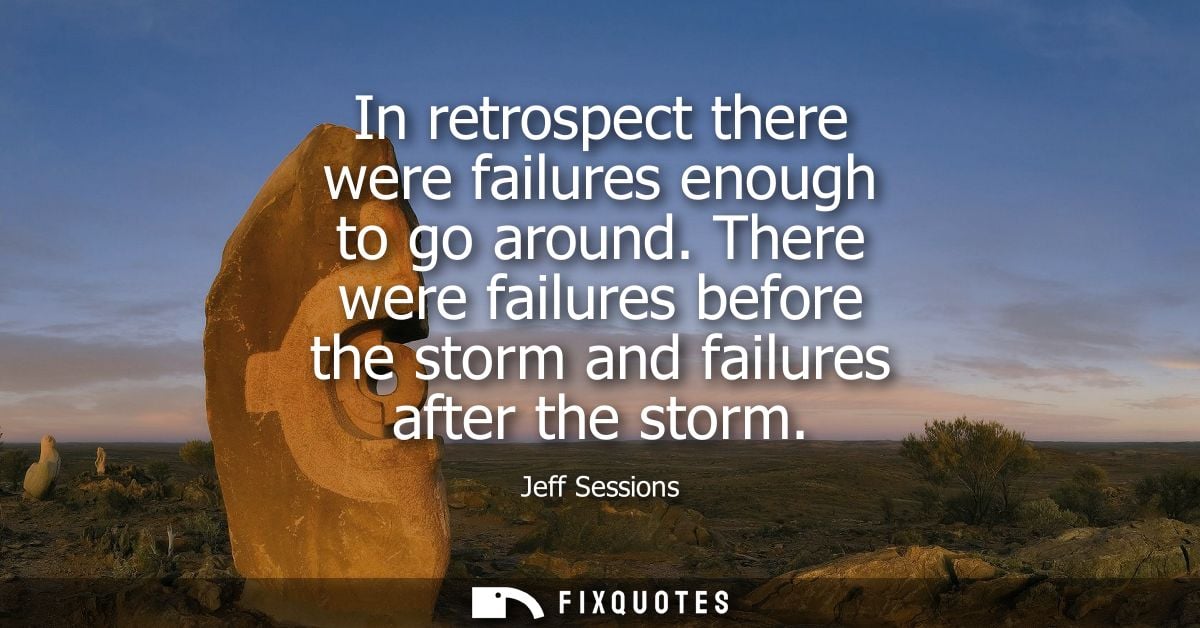
"In retrospect there were failures enough to go around. There were failures before the storm and failures after the storm"
About this Quote
“In retrospect” is the quiet tell. It doesn’t mean “we were wrong”; it means “we can now narrate events safely, with the benefit of distance and reduced liability.” It relocates error to the past tense and implies the real problem was clarity, not judgment. Then Sessions uses a neat temporal symmetry - “before the storm” / “after the storm” - to imply inevitability. If failures happened on both sides of the event, the event itself starts to read like an act of nature rather than a test of governance.
The context is the post-disaster autopsy that Washington always performs: assign fault without assigning consequence. “The storm” (whether a literal hurricane like Katrina or a broader crisis framed as weather) works as a rhetorical alibi. Nature becomes the antagonist; bureaucracy merely stumbled. The subtext is preservation: of institutions, of agencies, of political careers. It’s a sentence built to absorb outrage, not to answer it.
Quote Details
| Topic | Failure |
|---|---|
| Source | Help us find the source |
| Cite |
Citation Formats
APA Style (7th ed.)
Sessions, Jeff. (2026, January 17). In retrospect there were failures enough to go around. There were failures before the storm and failures after the storm. FixQuotes. https://fixquotes.com/quotes/in-retrospect-there-were-failures-enough-to-go-70272/
Chicago Style
Sessions, Jeff. "In retrospect there were failures enough to go around. There were failures before the storm and failures after the storm." FixQuotes. January 17, 2026. https://fixquotes.com/quotes/in-retrospect-there-were-failures-enough-to-go-70272/.
MLA Style (9th ed.)
"In retrospect there were failures enough to go around. There were failures before the storm and failures after the storm." FixQuotes, 17 Jan. 2026, https://fixquotes.com/quotes/in-retrospect-there-were-failures-enough-to-go-70272/. Accessed 3 Apr. 2026.