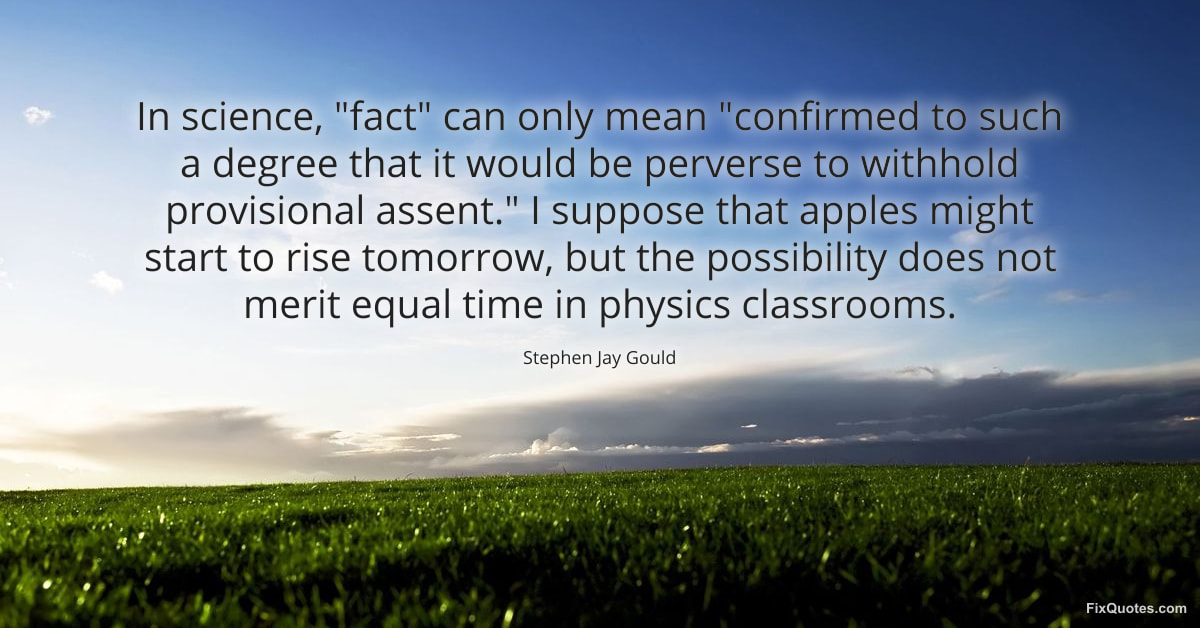
"In science, "fact" can only mean "confirmed to such a degree that it would be perverse to withhold provisional assent." I suppose that apples might start to rise tomorrow, but the possibility does not merit equal time in physics classrooms"
About this Quote
Gould needles two bad habits at once: the public craving for absolute certainty, and the rhetorical hustle that treats every doubt as a co-equal “side.” His definition of fact is deliberately unromantic. It won’t satisfy people who want science to function like scripture, because it frames knowledge as earned confidence, not metaphysical proof. The phrase “perverse to withhold provisional assent” is the tell: skepticism isn’t a virtue when it ignores how lopsided the evidence has become. At some point, refusing to agree stops being rigor and turns into performative contrarianism.
The apple line is more than a cute Newton callback. It’s a miniature lesson in probability, priors, and opportunity cost. Yes, the laws of nature could be wrong; science is built to survive that possibility. But classrooms aren’t debate clubs where every remote hypothesis deserves airtime. “Equal time” is a political phrase, not an epistemic one, and Gould uses it like a warning label: once you import fairness norms from civics into questions of evidence, you empower fringe claims by granting them the status they haven’t earned.
Context matters: Gould spent years battling creationism and “teach the controversy” campaigns aimed at evolution. He’s defending science as a method and a public institution, pushing back against a culture that confuses open-mindedness with an obligation to entertain every implausible alternative. The subtext is blunt: doubt is cheap; disciplined assent is costly, and that cost is the point.
The apple line is more than a cute Newton callback. It’s a miniature lesson in probability, priors, and opportunity cost. Yes, the laws of nature could be wrong; science is built to survive that possibility. But classrooms aren’t debate clubs where every remote hypothesis deserves airtime. “Equal time” is a political phrase, not an epistemic one, and Gould uses it like a warning label: once you import fairness norms from civics into questions of evidence, you empower fringe claims by granting them the status they haven’t earned.
Context matters: Gould spent years battling creationism and “teach the controversy” campaigns aimed at evolution. He’s defending science as a method and a public institution, pushing back against a culture that confuses open-mindedness with an obligation to entertain every implausible alternative. The subtext is blunt: doubt is cheap; disciplined assent is costly, and that cost is the point.
Quote Details
| Topic | Science |
|---|
More Quotes by Stephen
Add to List