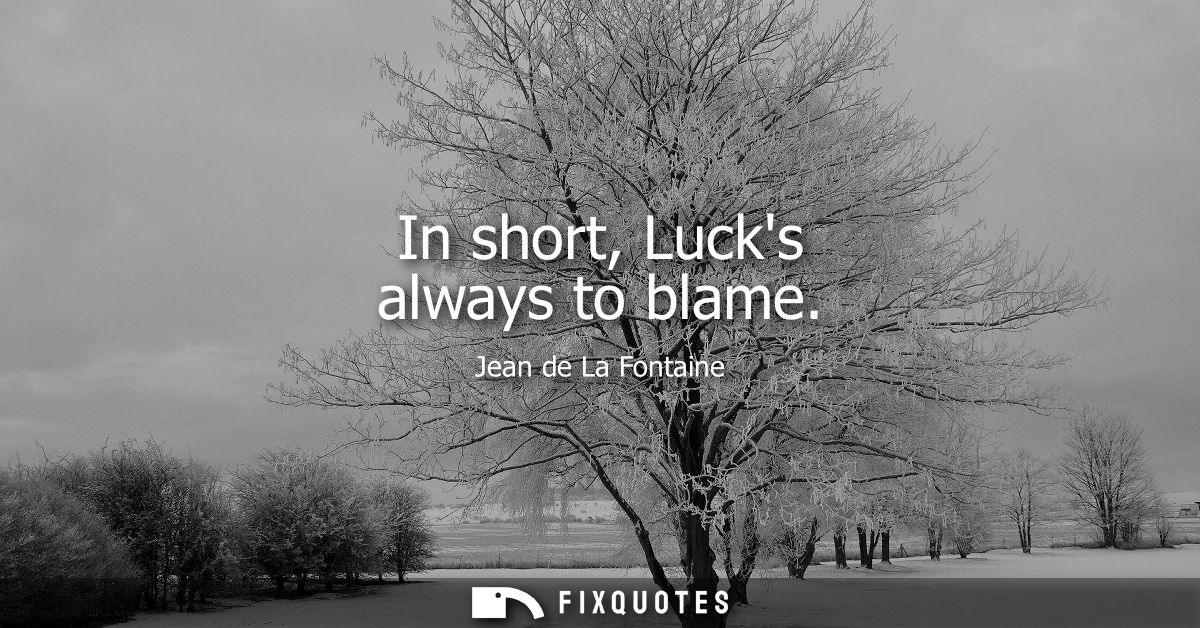
"In short, luck's always to blame"
About this Quote
A neat little alibi, sharpened to a point: if luck is “always to blame,” then nobody ever has to be. La Fontaine compresses an entire social habit into one shrug-sized line. The phrasing matters. “In short” performs impatience, as if we’ve heard the long, messy story and now the speaker cuts through it with a convenient verdict. It’s not wisdom so much as a shortcut, the kind people reach for when consequences are uncomfortable.
La Fontaine wrote fables for a courtly world where power liked to imagine itself as virtue. In that context, “luck” becomes a diplomatic scapegoat. The unlucky can be dismissed as unfortunate rather than wronged; the lucky can be praised as deserving rather than merely advantaged. Blame migrates from human choices to the weather of fate, which keeps hierarchies clean and consciences cleaner. The line also hints at how easily moral language gets swapped for probabilistic language: it’s not that someone gambled, exploited, or mismanaged; it’s that fortune turned.
There’s bite in the absolutism of “always.” It’s obviously untrue, which is why it lands. La Fontaine is teasing the reflex to narrate life like a roulette wheel, because that story flatters everyone: winners get mystique, losers get a myth. The subtext is less about cosmic randomness than about human accountability. When you blame luck, you’re often protecting someone - yourself, a patron, a system - from having to answer for what was done on purpose.
La Fontaine wrote fables for a courtly world where power liked to imagine itself as virtue. In that context, “luck” becomes a diplomatic scapegoat. The unlucky can be dismissed as unfortunate rather than wronged; the lucky can be praised as deserving rather than merely advantaged. Blame migrates from human choices to the weather of fate, which keeps hierarchies clean and consciences cleaner. The line also hints at how easily moral language gets swapped for probabilistic language: it’s not that someone gambled, exploited, or mismanaged; it’s that fortune turned.
There’s bite in the absolutism of “always.” It’s obviously untrue, which is why it lands. La Fontaine is teasing the reflex to narrate life like a roulette wheel, because that story flatters everyone: winners get mystique, losers get a myth. The subtext is less about cosmic randomness than about human accountability. When you blame luck, you’re often protecting someone - yourself, a patron, a system - from having to answer for what was done on purpose.
Quote Details
| Topic | Free Will & Fate |
|---|---|
| Source | Help us find the source |
| Cite |
Citation Formats
APA Style (7th ed.)
Fontaine, Jean de La. (2026, February 18). In short, luck's always to blame. FixQuotes. https://fixquotes.com/quotes/in-short-lucks-always-to-blame-63573/
Chicago Style
Fontaine, Jean de La. "In short, luck's always to blame." FixQuotes. February 18, 2026. https://fixquotes.com/quotes/in-short-lucks-always-to-blame-63573/.
MLA Style (9th ed.)
"In short, luck's always to blame." FixQuotes, 18 Feb. 2026, https://fixquotes.com/quotes/in-short-lucks-always-to-blame-63573/. Accessed 25 Mar. 2026.
More Quotes by Jean
Add to List