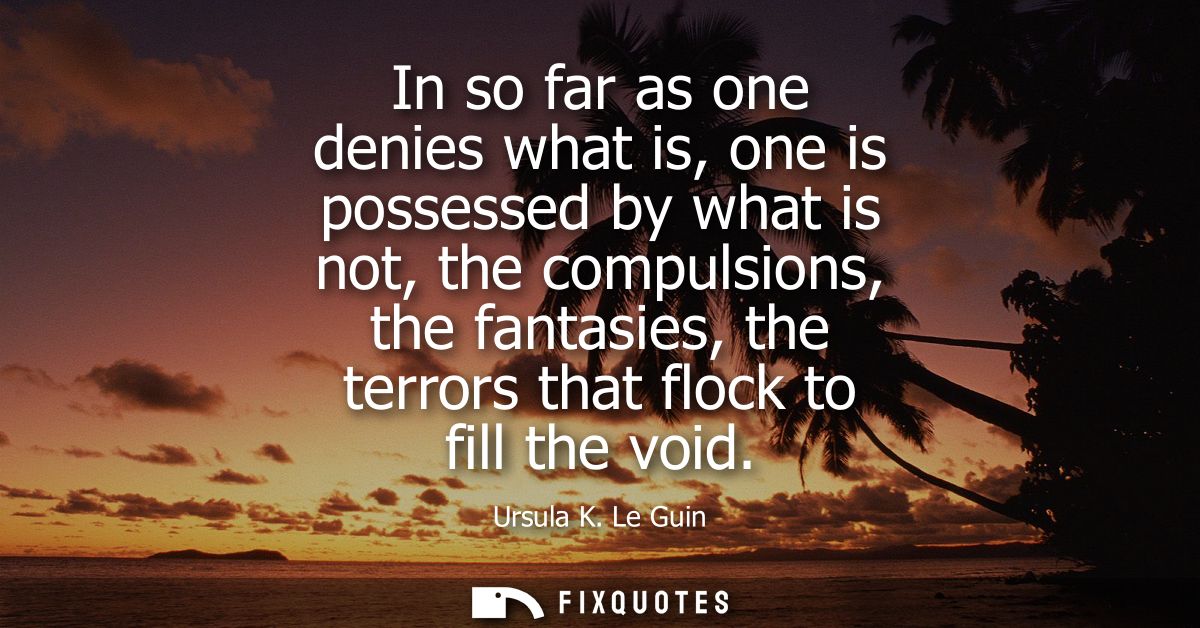
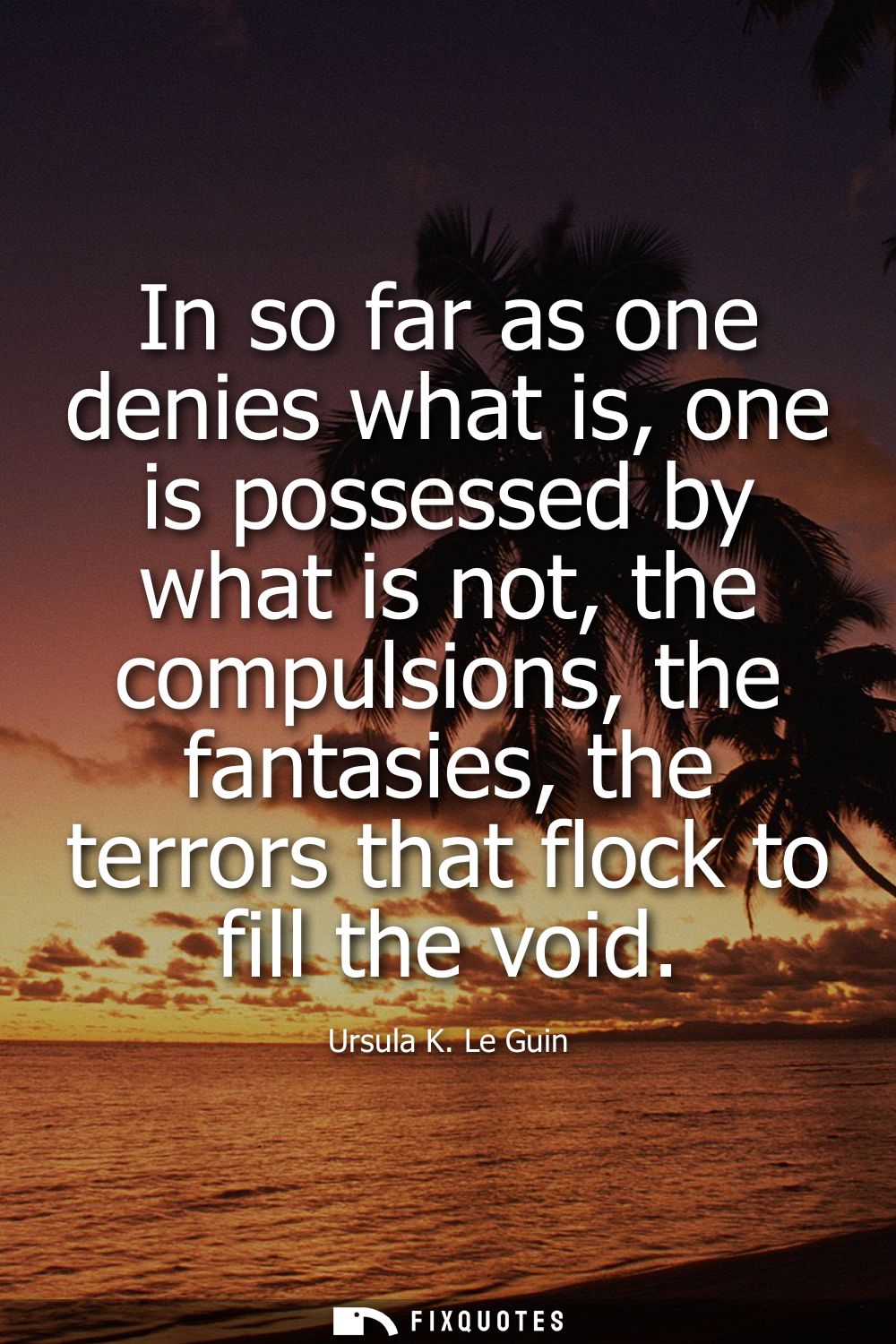
"In so far as one denies what is, one is possessed by what is not, the compulsions, the fantasies, the terrors that flock to fill the void"
About this Quote
The syntax does the real work. “In so far as” implies degree, not absolutes; denial is incremental, everyday. Then the line accelerates into a swarm: “compulsions, the fantasies, the terrors.” Those nouns aren’t argued for, they’re stacked like symptoms, each one more involuntary than the last. “Flock” is an inspired verb: it makes the mind a landscape where anxious creatures gather the moment there’s open space, as if imagination defaults to worst-case mythology when it’s cut off from the stubborn particularity of facts.
Le Guin’s broader context matters: her fiction is a sustained critique of societies that mask power with stories - utopias that become prisons, empires that call conquest “order,” individuals who confuse comfort with truth. The subtext is political and intimate at once. Deny ecological limits, deny injustice, deny grief, deny desire: the bill comes due as paranoia, ideology, and self-deception dressed up as conviction. The “void” isn’t empty; it’s a vacancy sign.
Quote Details
| Topic | Truth |
|---|---|
| Source | Evidence: He knew that in so far as one denies what is, one is possessed by what is not, the compulsions, the fantasies, the terrors that flock to fill the void. (Chapter 10 (page varies by edition)). This line appears verbatim in Ursula K. Le Guin’s novel The Lathe of Heaven, in Chapter 10 (confirmed via the official Ursula K. Le Guin website excerpt). The novel’s publication history indicates it was first serialized in Amazing Stories (March 1971 and May 1971) and then published as a book in 1971 (commonly cited as Charles Scribner's Sons for the hardcover; Avon for paperback). Because magazines don’t use stable 'page numbers' the way book editions do, and because book pagination changes across printings, the most stable locator is 'Chapter 10'. If you need the first appearance in print, it is likely the Amazing Stories serialization (1971) rather than the later 1971 book edition, but confirming the exact installment/page would require checking the March/May 1971 issues directly. Other candidates (1) Ursula K. Le Guin: Five Novels (LOA #379) (Ursula K. Le Guin, 2024)97.2% ... Ursula K. Le Guin Brian Attebery. Chapter Ten IT Il descend , réveillé , l'autre côté du ... in so far as one den... |
| Cite |
Citation Formats
APA Style (7th ed.)
Guin, Ursula K. Le. (2026, February 13). In so far as one denies what is, one is possessed by what is not, the compulsions, the fantasies, the terrors that flock to fill the void. FixQuotes. https://fixquotes.com/quotes/in-so-far-as-one-denies-what-is-one-is-possessed-127035/
Chicago Style
Guin, Ursula K. Le. "In so far as one denies what is, one is possessed by what is not, the compulsions, the fantasies, the terrors that flock to fill the void." FixQuotes. February 13, 2026. https://fixquotes.com/quotes/in-so-far-as-one-denies-what-is-one-is-possessed-127035/.
MLA Style (9th ed.)
"In so far as one denies what is, one is possessed by what is not, the compulsions, the fantasies, the terrors that flock to fill the void." FixQuotes, 13 Feb. 2026, https://fixquotes.com/quotes/in-so-far-as-one-denies-what-is-one-is-possessed-127035/. Accessed 10 Mar. 2026.