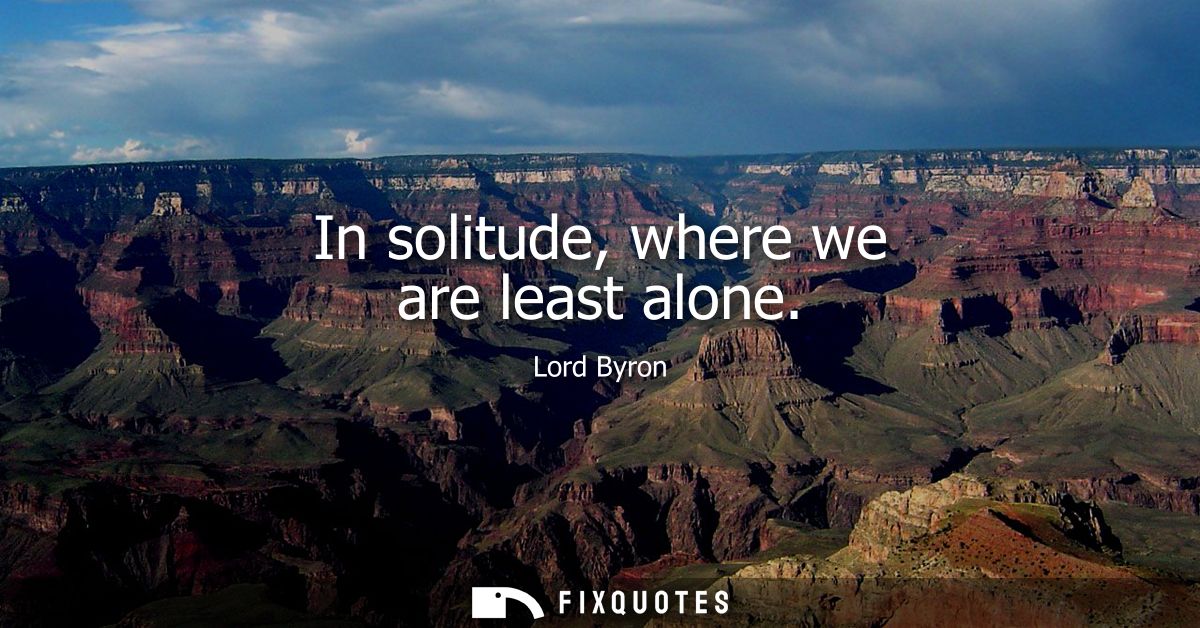
"In solitude, where we are least alone"
About this Quote
Byron’s line flips the usual panic about being by yourself into a dare: solitude isn’t the absence of company, it’s the one place where company stops lying to you. The neat paradox “least alone” works because it treats loneliness as a social condition, not a physical one. Among people, you’re forced into roles, small performances, reputations you didn’t fully choose. In solitude, the audience leaves. What’s left is not emptiness but an overcrowding of the mind: memory, desire, self-accusation, imagination. Byron, master of the romantic pose and the public scandal, knows exactly how noisy “alone” can be.
The subtext is both therapeutic and slightly venomous. Solitude offers honesty, but it’s also a rebuke to society’s shallow consolations. You can hear the Byronic hero lurking behind the grammar: the figure who retreats not because he’s fragile, but because the world is. “Least alone” suggests an intimate companion that’s always been there and can’t be ditched: the self. That’s comforting if you trust your inner life; it’s terrifying if you don’t.
Context matters. Byron wrote in an era that glamorized interiority and made melancholy stylish, but he also lived the cost of celebrity before the modern word existed. Hounded, admired, moralized against, he understood that crowds can isolate. The line’s intent is to reclaim control of intimacy: if solitude is where you’re least alone, then withdrawal isn’t defeat. It’s a form of sovereignty.
The subtext is both therapeutic and slightly venomous. Solitude offers honesty, but it’s also a rebuke to society’s shallow consolations. You can hear the Byronic hero lurking behind the grammar: the figure who retreats not because he’s fragile, but because the world is. “Least alone” suggests an intimate companion that’s always been there and can’t be ditched: the self. That’s comforting if you trust your inner life; it’s terrifying if you don’t.
Context matters. Byron wrote in an era that glamorized interiority and made melancholy stylish, but he also lived the cost of celebrity before the modern word existed. Hounded, admired, moralized against, he understood that crowds can isolate. The line’s intent is to reclaim control of intimacy: if solitude is where you’re least alone, then withdrawal isn’t defeat. It’s a form of sovereignty.
Quote Details
| Topic | Deep |
|---|---|
| Source | Help us find the source |
| Cite |
Citation Formats
APA Style (7th ed.)
Byron, Lord. (2026, January 15). In solitude, where we are least alone. FixQuotes. https://fixquotes.com/quotes/in-solitude-where-we-are-least-alone-8372/
Chicago Style
Byron, Lord. "In solitude, where we are least alone." FixQuotes. January 15, 2026. https://fixquotes.com/quotes/in-solitude-where-we-are-least-alone-8372/.
MLA Style (9th ed.)
"In solitude, where we are least alone." FixQuotes, 15 Jan. 2026, https://fixquotes.com/quotes/in-solitude-where-we-are-least-alone-8372/. Accessed 12 Feb. 2026.
More Quotes by Lord
Add to List