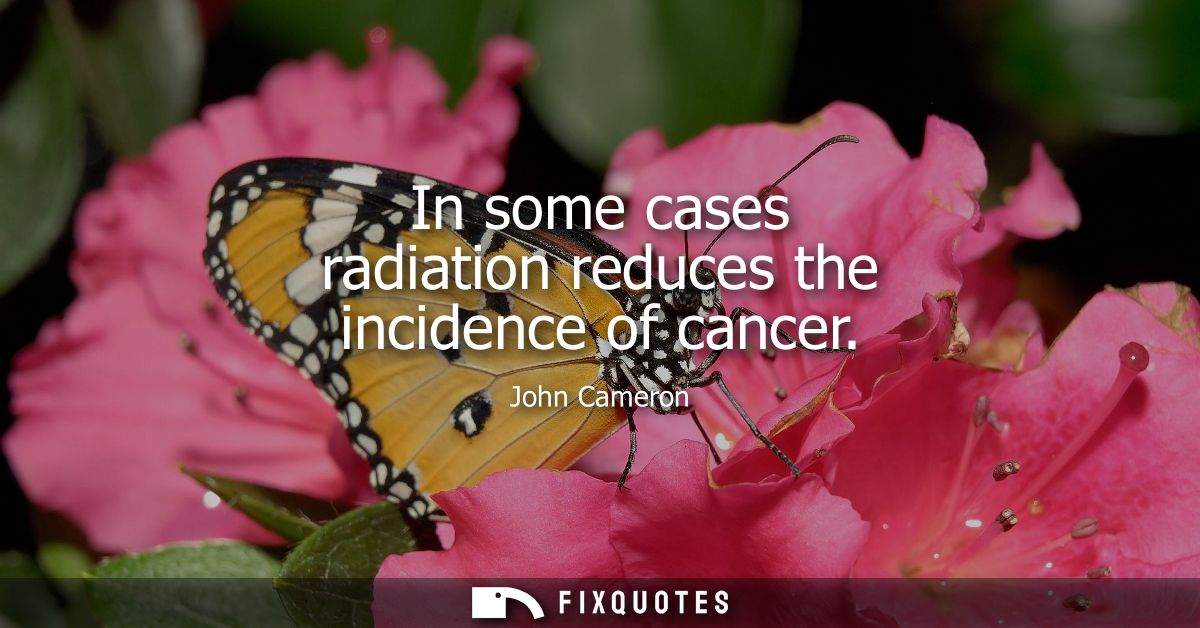
"In some cases, radiation reduces the incidence of cancer"
About this Quote
“In some cases radiation reduces the incidence of cancer” lands like a deliberately provocative thumb in the eye of public health common sense. Cameron’s phrasing is cautious on the surface - “in some cases” is doing a lot of legal and rhetorical work - but the intent is clear: pry open a conversation that popular culture tends to seal shut. Radiation, in the public imagination, is a one-way synonym for catastrophe: Hiroshima, Chernobyl, “toxic,” mutation. Cameron’s line exploits that reflex, then flips it.
The subtext is a critique of how risk gets narrated. We like clean moral binaries: radiation bad, nature good, technology dangerous. Cameron gestures toward a more uncomfortable reality: dose, context, and biological response matter. The sentence smuggles in the controversial idea of hormesis (the claim that low doses of a harmful agent can trigger protective mechanisms), without naming it, which is rhetorically savvy. By keeping it vague, he invites the reader to supply the outrage or curiosity.
Context matters because “radiation” isn’t a single thing. It can mean controlled therapeutic beams that kill tumors, diagnostic imaging that carries minimal risk, or environmental exposure. Cameron’s move is to collapse these meanings just enough to destabilize a simplistic fear, but not enough to do the hard work of separating legitimate reassurance from contrarian overreach.
What makes the quote work is its asymmetry: it’s not a full argument, it’s a fissure. It forces the audience to confront how much of our certainty is science, and how much is story.
The subtext is a critique of how risk gets narrated. We like clean moral binaries: radiation bad, nature good, technology dangerous. Cameron gestures toward a more uncomfortable reality: dose, context, and biological response matter. The sentence smuggles in the controversial idea of hormesis (the claim that low doses of a harmful agent can trigger protective mechanisms), without naming it, which is rhetorically savvy. By keeping it vague, he invites the reader to supply the outrage or curiosity.
Context matters because “radiation” isn’t a single thing. It can mean controlled therapeutic beams that kill tumors, diagnostic imaging that carries minimal risk, or environmental exposure. Cameron’s move is to collapse these meanings just enough to destabilize a simplistic fear, but not enough to do the hard work of separating legitimate reassurance from contrarian overreach.
What makes the quote work is its asymmetry: it’s not a full argument, it’s a fissure. It forces the audience to confront how much of our certainty is science, and how much is story.
Quote Details
| Topic | Health |
|---|---|
| Source | Help us find the source |
| Cite |
Citation Formats
APA Style (7th ed.)
Cameron, John. (2026, February 18). In some cases, radiation reduces the incidence of cancer. FixQuotes. https://fixquotes.com/quotes/in-some-cases-radiation-reduces-the-incidence-of-67285/
Chicago Style
Cameron, John. "In some cases, radiation reduces the incidence of cancer." FixQuotes. February 18, 2026. https://fixquotes.com/quotes/in-some-cases-radiation-reduces-the-incidence-of-67285/.
MLA Style (9th ed.)
"In some cases, radiation reduces the incidence of cancer." FixQuotes, 18 Feb. 2026, https://fixquotes.com/quotes/in-some-cases-radiation-reduces-the-incidence-of-67285/. Accessed 28 Mar. 2026.
More Quotes by John
Add to List