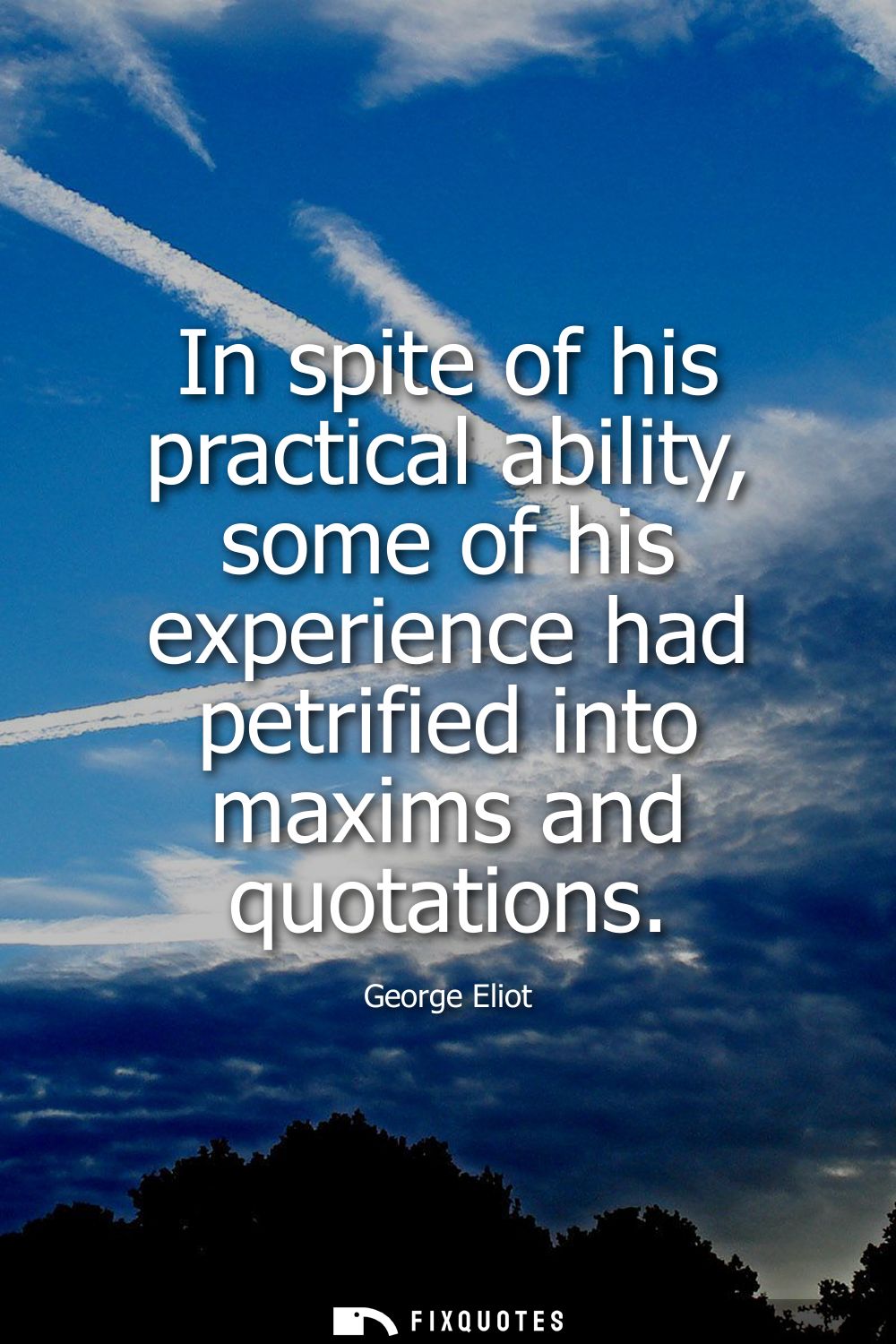
"In spite of his practical ability, some of his experience had petrified into maxims and quotations"
About this Quote
The subtext is moral and psychological. This is not an attack on learning, but on the moment learning stops moving. The person in question remains “practically” able - he can get things done - yet part of his mind has fossilized. Eliot spots a type: the capable man whose judgments arrive pre-packaged, who meets new problems with old sentences, who substitutes the authority of aphorism for the risk of thinking.
Context matters because Eliot writes in a culture newly addicted to self-improvement literature, moral slogans, and the Victorian habit of extracting “lessons” from life and art. Her realism resists that flattening. Novels, for Eliot, are machines for re-complicating human motives; maxims do the opposite. They make messy experience sound orderly, and they let the speaker sound wise without staying vulnerable to the evidence of the present. That’s why the line lands with such dry force: it’s a diagnosis of how wisdom can curdle into performance.
Quote Details
| Topic | Wisdom |
|---|---|
| Source | Help us find the source |
| Cite |
Citation Formats
APA Style (7th ed.)
Eliot, George. (2026, January 17). In spite of his practical ability, some of his experience had petrified into maxims and quotations. FixQuotes. https://fixquotes.com/quotes/in-spite-of-his-practical-ability-some-of-his-28236/
Chicago Style
Eliot, George. "In spite of his practical ability, some of his experience had petrified into maxims and quotations." FixQuotes. January 17, 2026. https://fixquotes.com/quotes/in-spite-of-his-practical-ability-some-of-his-28236/.
MLA Style (9th ed.)
"In spite of his practical ability, some of his experience had petrified into maxims and quotations." FixQuotes, 17 Jan. 2026, https://fixquotes.com/quotes/in-spite-of-his-practical-ability-some-of-his-28236/. Accessed 28 Mar. 2026.