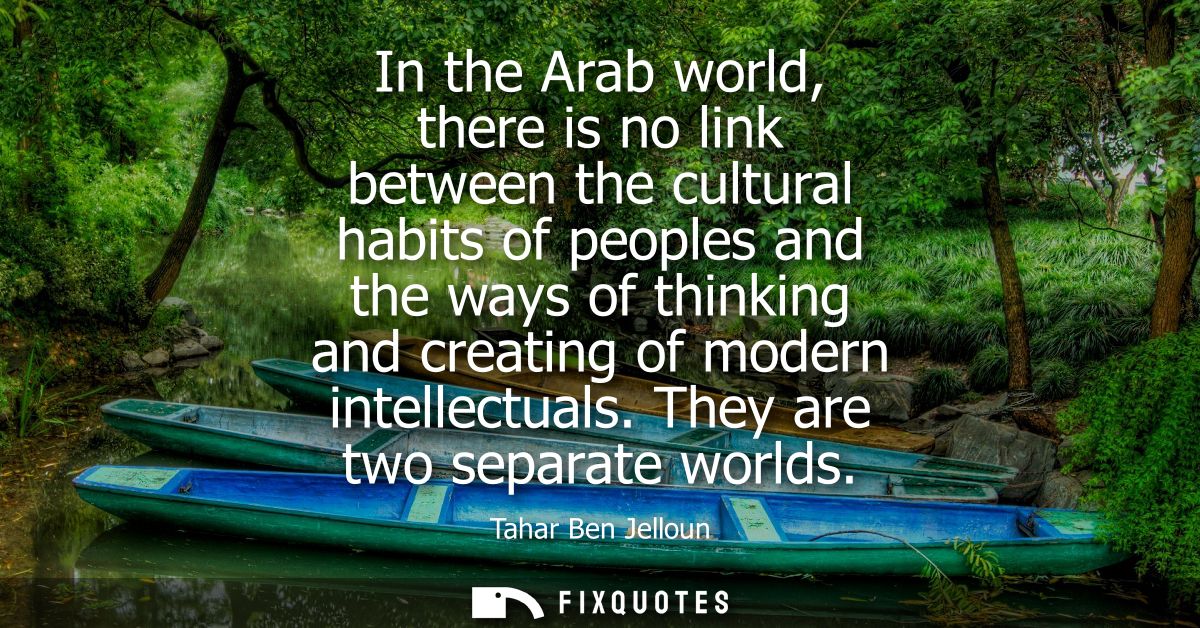
"In the Arab world, there is no link between the cultural habits of peoples and the ways of thinking and creating of modern intellectuals. They are two separate worlds"
About this Quote
The subtext is an indictment of mediation. “Cultural habits” signals everyday practice: oral storytelling, local aesthetics, codes of honor, communal memory. “Modern intellectuals” points to a professionalized mind, fluent in imported categories of critique and modernity, often forced into French (or into an Arabic stripped of its street-level dialects). When he says “no link,” he’s also mourning a severed feedback loop: intellectual production stops being metabolized by the public, and the public stops seeing intellectuals as custodians of meaning.
Context matters: Ben Jelloun, a Moroccan writing largely in French, speaks from inside the split he describes. His career embodies the paradox of visibility: to be heard internationally, the intellectual may have to adopt the very distance that makes local resonance harder. The line lands as both diagnosis and self-warning: a culture cannot be renewed if its thinkers are speaking through a pane of glass, observing life rather than conversing with it.
Quote Details
| Topic | Deep |
|---|---|
| Source | Help us find the source |
| Cite |
Citation Formats
APA Style (7th ed.)
Jelloun, Tahar Ben. (2026, January 16). In the Arab world, there is no link between the cultural habits of peoples and the ways of thinking and creating of modern intellectuals. They are two separate worlds. FixQuotes. https://fixquotes.com/quotes/in-the-arab-world-there-is-no-link-between-the-91134/
Chicago Style
Jelloun, Tahar Ben. "In the Arab world, there is no link between the cultural habits of peoples and the ways of thinking and creating of modern intellectuals. They are two separate worlds." FixQuotes. January 16, 2026. https://fixquotes.com/quotes/in-the-arab-world-there-is-no-link-between-the-91134/.
MLA Style (9th ed.)
"In the Arab world, there is no link between the cultural habits of peoples and the ways of thinking and creating of modern intellectuals. They are two separate worlds." FixQuotes, 16 Jan. 2026, https://fixquotes.com/quotes/in-the-arab-world-there-is-no-link-between-the-91134/. Accessed 5 Apr. 2026.