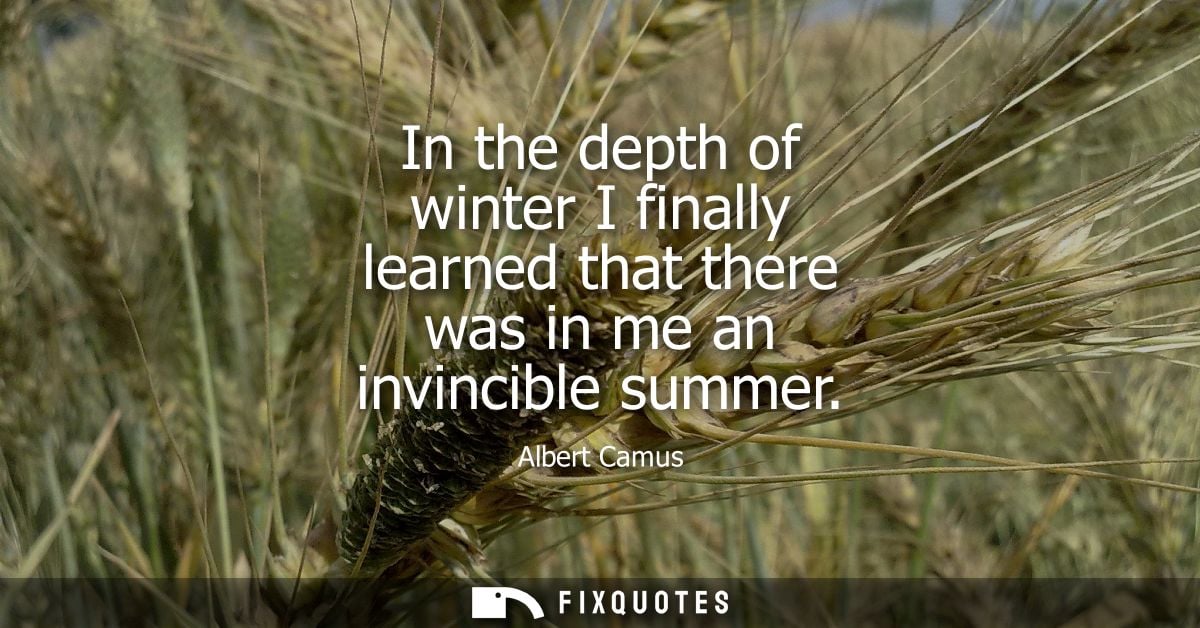
"In the depth of winter, I finally learned that there was in me an invincible summer"
About this Quote
Camus writes like someone suspicious of consolation. The phrase "I finally learned" is quiet but cutting; it suggests a hard-earned education, not a revelation delivered by grace. "Invincible" carries the existentialist dare: if the world is indifferent, if meaning isn’t guaranteed, what can’t be taken from you? His answer is not metaphysical certainty but an internal capacity to persist, to desire, to keep sensing beauty even when conditions argue against it. "Summer" is not happiness; it’s vitality, appetite, a stubborn yes inside the larger no.
The subtext is Camus’s central tension: lucidity without despair. In The Myth of Sisyphus, he frames suicide as the fundamental question; here, the rebuttal is compact and embodied. You don’t outthink the absurd, you outlast it. Written out of a 20th century that specialized in winters - war, totalitarianism, plague as allegory - the sentence functions like a pocket manifesto: accept the cold, refuse capitulation, and treat endurance as its own kind of defiance.
Quote Details
| Topic | Resilience |
|---|---|
| Source | Unverified source: L'Été (Albert Camus, 1954)
Evidence: Au milieu de l'hiver, j'apprenais enfin qu'il y avait en moi un été invincible. (Essay: « Retour à Tipasa » (page 68 in the Gallimard 'Les Essais' ed.)). Primary text location: Camus’s essay « Retour à Tipasa », later collected in L'Été (Gallimard, 1954). The commonly circulated English version y... Other candidates (1) Depth of Winter (Craig Johnson, 2018) compilation95.0% ... Albert Camus quote , “ In the depth of winter , I finally learned that there was in me an invincible summer . " I... |
| Cite |
Citation Formats
APA Style (7th ed.)
Camus, Albert. (2026, February 16). In the depth of winter, I finally learned that there was in me an invincible summer. FixQuotes. https://fixquotes.com/quotes/in-the-depth-of-winter-i-finally-learned-that-40524/
Chicago Style
Camus, Albert. "In the depth of winter, I finally learned that there was in me an invincible summer." FixQuotes. February 16, 2026. https://fixquotes.com/quotes/in-the-depth-of-winter-i-finally-learned-that-40524/.
MLA Style (9th ed.)
"In the depth of winter, I finally learned that there was in me an invincible summer." FixQuotes, 16 Feb. 2026, https://fixquotes.com/quotes/in-the-depth-of-winter-i-finally-learned-that-40524/. Accessed 24 Mar. 2026.