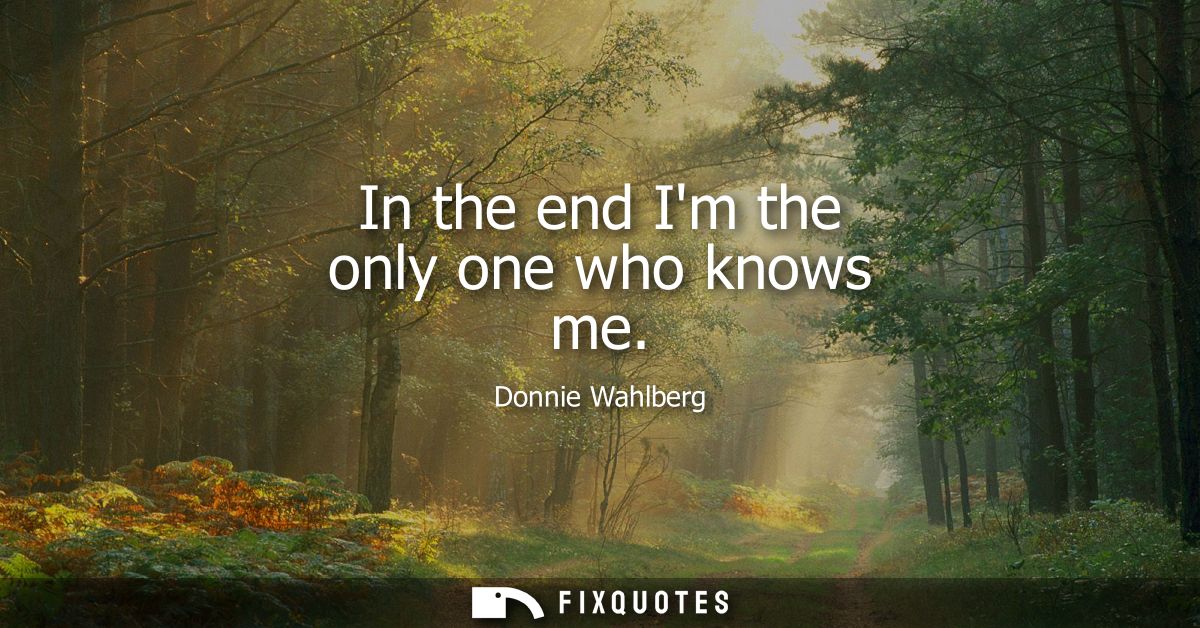
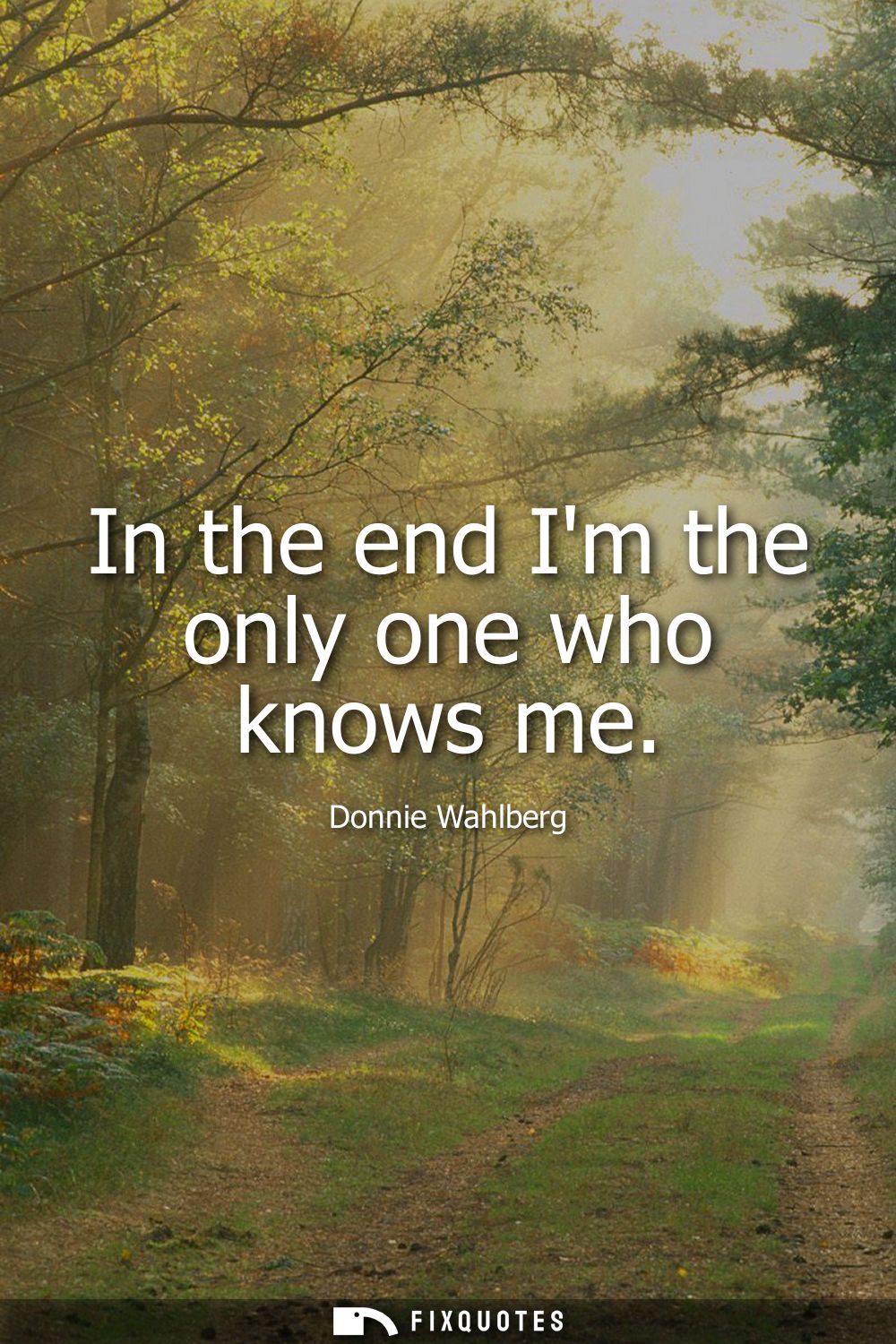
"In the end I'm the only one who knows me"
About this Quote
There’s a quiet defiance in “In the end I’m the only one who knows me,” the kind that sounds simple until you hear the subtext: stop pretending your version of me is the whole story. Coming from Donnie Wahlberg - a man whose career has unfolded under the twin spotlights of boy-band fandom and TV-era respectability - it reads like a boundary line drawn after years of being packaged, decoded, and re-sold.
The intent isn’t poetic mystery; it’s self-preservation. Celebrity runs on a weird bargain: the audience gets access, the star gets attention. Wahlberg’s sentence pushes back on that contract. It acknowledges that even the most “authentic” public persona is still a performance shaped by interviews, edits, branding, and fan projection. “In the end” matters: it suggests exhaustion, the long view, a life lived through other people’s narratives. When the noise dies down, when the cameras pivot away, the only witness with full access is the person inside the skin.
It also subtly reframes accountability. This isn’t “no one can judge me”; it’s “you can’t fully know the inputs.” That’s a mature, almost domestic kind of privacy claim - less rock-star rebellion than a working actor’s insistence on interiority. In a culture that treats people as searchable content, Wahlberg’s line lands as a reminder that the most important biography is the one that never gets published.
The intent isn’t poetic mystery; it’s self-preservation. Celebrity runs on a weird bargain: the audience gets access, the star gets attention. Wahlberg’s sentence pushes back on that contract. It acknowledges that even the most “authentic” public persona is still a performance shaped by interviews, edits, branding, and fan projection. “In the end” matters: it suggests exhaustion, the long view, a life lived through other people’s narratives. When the noise dies down, when the cameras pivot away, the only witness with full access is the person inside the skin.
It also subtly reframes accountability. This isn’t “no one can judge me”; it’s “you can’t fully know the inputs.” That’s a mature, almost domestic kind of privacy claim - less rock-star rebellion than a working actor’s insistence on interiority. In a culture that treats people as searchable content, Wahlberg’s line lands as a reminder that the most important biography is the one that never gets published.
Quote Details
| Topic | Self-Improvement |
|---|---|
| Source | Help us find the source |
| Cite |
Citation Formats
APA Style (7th ed.)
Wahlberg, Donnie. (2026, January 17). In the end I'm the only one who knows me. FixQuotes. https://fixquotes.com/quotes/in-the-end-im-the-only-one-who-knows-me-49696/
Chicago Style
Wahlberg, Donnie. "In the end I'm the only one who knows me." FixQuotes. January 17, 2026. https://fixquotes.com/quotes/in-the-end-im-the-only-one-who-knows-me-49696/.
MLA Style (9th ed.)
"In the end I'm the only one who knows me." FixQuotes, 17 Jan. 2026, https://fixquotes.com/quotes/in-the-end-im-the-only-one-who-knows-me-49696/. Accessed 20 Mar. 2026.
More Quotes by Donnie
Add to List