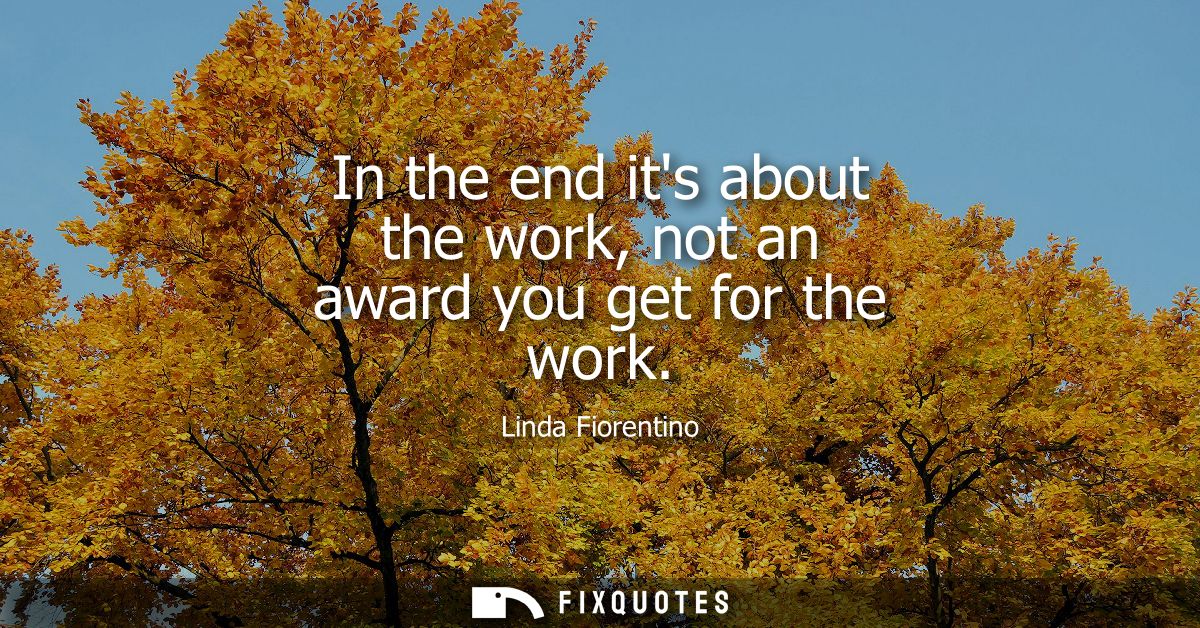
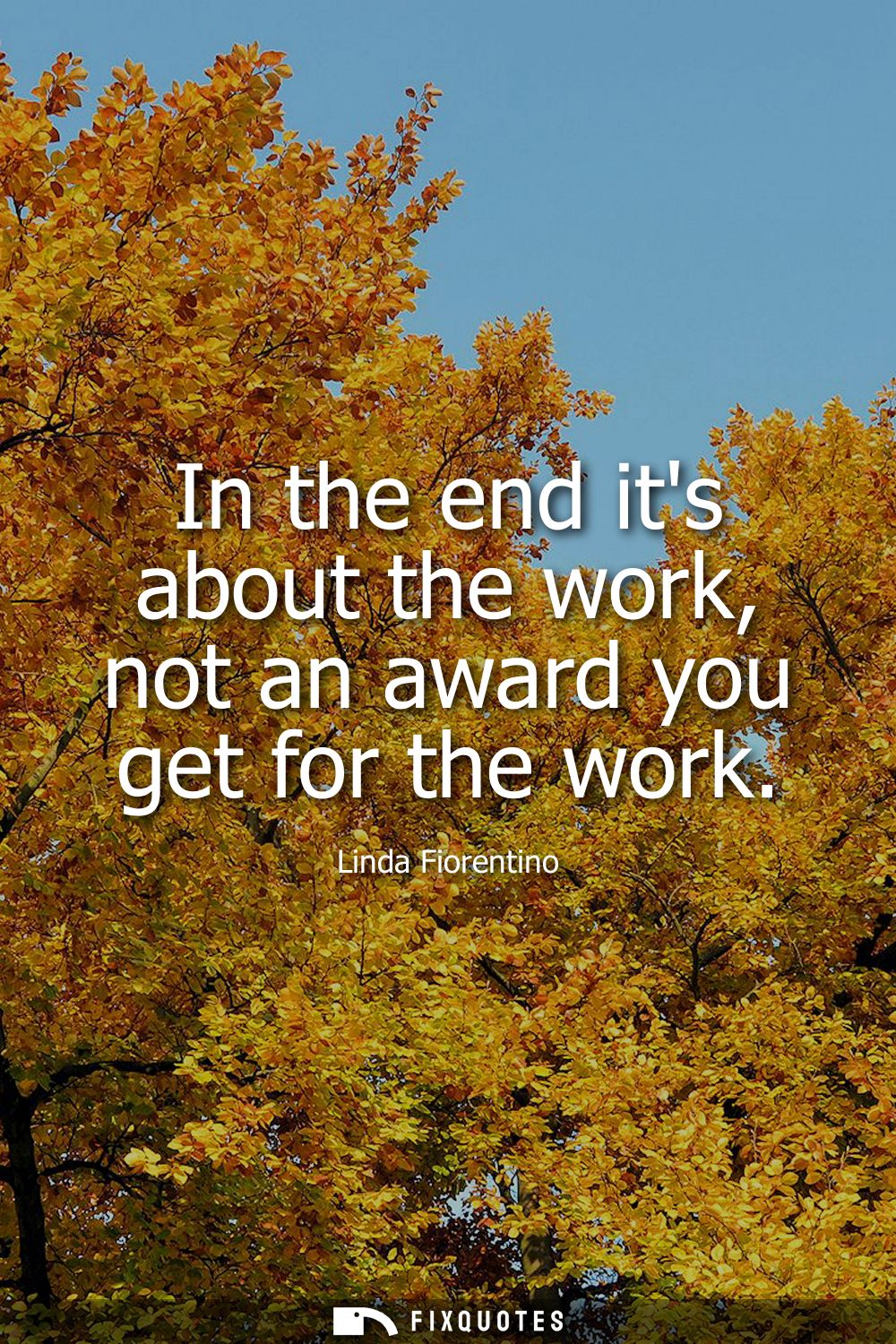
"In the end, it's about the work, not an award you get for the work"
About this Quote
There’s a quiet eye-roll baked into Linda Fiorentino’s line: a refusal to play the industry’s favorite game, where validation is minted in trophies and proximity to the right rooms. Coming from an actress, it lands as both self-protection and critique. Acting is a job built on external judgment - casting, reviews, box office, buzz - and awards are the most formalized, glamorous version of that judgment. Fiorentino flips the hierarchy. The point isn’t the medal; it’s the making.
The intent reads like boundary-setting. “In the end” signals a long view, the kind you adopt after seeing how fickle the spotlight can be. Awards don’t just recognize work; they edit it into a narrative that’s easy to market: this performance mattered, this person arrived, this year had a winner. Her subtext pushes back against that compression. A career, especially for women in Hollywood, is often treated as a series of peaks and disappearances, with awards functioning like proof-of-existence. By insisting on the work itself, she claims a steadier measure of worth that can’t be revoked by trends, politics, or ageist casting math.
The line also smuggles in a moral stance: craft over pageantry, process over outcome. It’s not anti-award so much as anti-dependence. In a culture that confuses visibility with value, Fiorentino’s phrasing is a reminder that the real thing happens offstage, long before anyone votes.
The intent reads like boundary-setting. “In the end” signals a long view, the kind you adopt after seeing how fickle the spotlight can be. Awards don’t just recognize work; they edit it into a narrative that’s easy to market: this performance mattered, this person arrived, this year had a winner. Her subtext pushes back against that compression. A career, especially for women in Hollywood, is often treated as a series of peaks and disappearances, with awards functioning like proof-of-existence. By insisting on the work itself, she claims a steadier measure of worth that can’t be revoked by trends, politics, or ageist casting math.
The line also smuggles in a moral stance: craft over pageantry, process over outcome. It’s not anti-award so much as anti-dependence. In a culture that confuses visibility with value, Fiorentino’s phrasing is a reminder that the real thing happens offstage, long before anyone votes.
Quote Details
| Topic | Work Ethic |
|---|---|
| Source | Help us find the source |
| Cite |
Citation Formats
APA Style (7th ed.)
Fiorentino, Linda. (2026, February 16). In the end, it's about the work, not an award you get for the work. FixQuotes. https://fixquotes.com/quotes/in-the-end-its-about-the-work-not-an-award-you-134017/
Chicago Style
Fiorentino, Linda. "In the end, it's about the work, not an award you get for the work." FixQuotes. February 16, 2026. https://fixquotes.com/quotes/in-the-end-its-about-the-work-not-an-award-you-134017/.
MLA Style (9th ed.)
"In the end, it's about the work, not an award you get for the work." FixQuotes, 16 Feb. 2026, https://fixquotes.com/quotes/in-the-end-its-about-the-work-not-an-award-you-134017/. Accessed 27 Mar. 2026.
More Quotes by Linda
Add to List