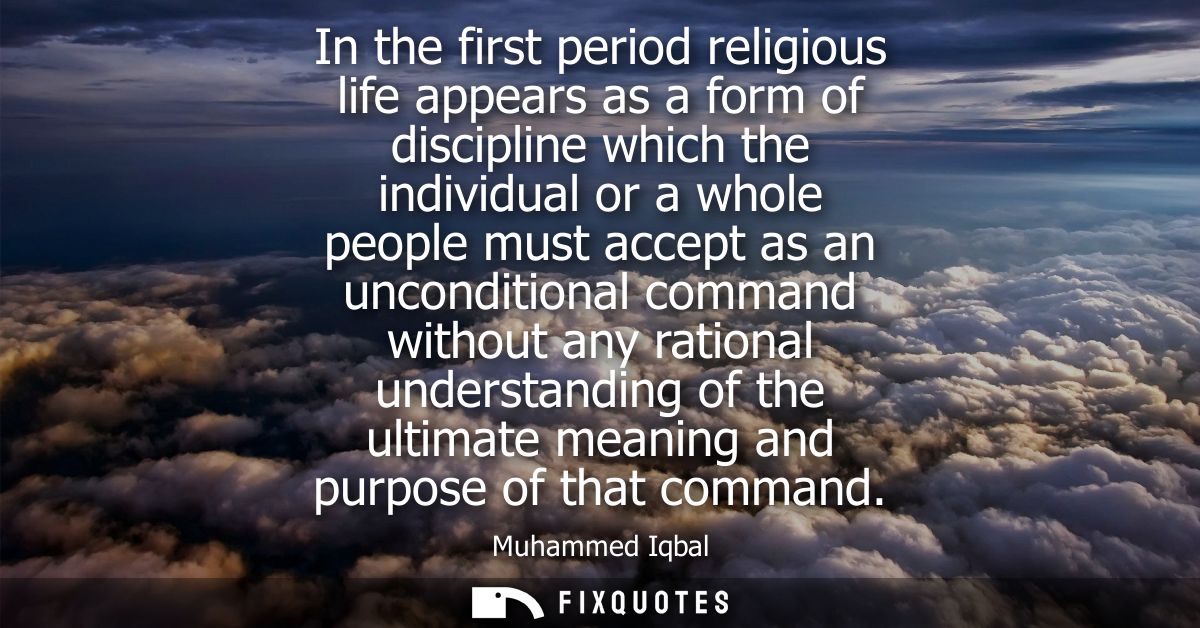
"In the first period, religious life appears as a form of discipline which the individual or a whole people must accept as an unconditional command without any rational understanding of the ultimate meaning and purpose of that command"
About this Quote
The subtext is a defense of religion against the common charge of “irrationality,” but it’s also a critique of a certain kind of modern rationalism. Iqbal isn’t celebrating blind obedience as the endpoint; he’s diagnosing it as a necessary beginning. Discipline, here, is formative: it produces a self and a community capable of higher moral and spiritual comprehension. The “individual or a whole people” pairing matters. He’s thinking at the scale of civilization-building, where shared practices create coherence before shared theories ever can.
Context sharpens the stakes. Writing in the late colonial era, Iqbal is addressing Muslims confronting Western secular modernity and its prestige language of “reason.” His move is to re-sequence the debate: religion doesn’t need to apologize for starting with authority, because cultures often do. The real question is whether discipline can mature into insight rather than calcify into mere control.
Quote Details
| Topic | Faith |
|---|---|
| Source | Help us find the source |
| Cite |
Citation Formats
APA Style (7th ed.)
Iqbal, Muhammed. (2026, February 18). In the first period, religious life appears as a form of discipline which the individual or a whole people must accept as an unconditional command without any rational understanding of the ultimate meaning and purpose of that command. FixQuotes. https://fixquotes.com/quotes/in-the-first-period-religious-life-appears-as-a-82228/
Chicago Style
Iqbal, Muhammed. "In the first period, religious life appears as a form of discipline which the individual or a whole people must accept as an unconditional command without any rational understanding of the ultimate meaning and purpose of that command." FixQuotes. February 18, 2026. https://fixquotes.com/quotes/in-the-first-period-religious-life-appears-as-a-82228/.
MLA Style (9th ed.)
"In the first period, religious life appears as a form of discipline which the individual or a whole people must accept as an unconditional command without any rational understanding of the ultimate meaning and purpose of that command." FixQuotes, 18 Feb. 2026, https://fixquotes.com/quotes/in-the-first-period-religious-life-appears-as-a-82228/. Accessed 7 Mar. 2026.