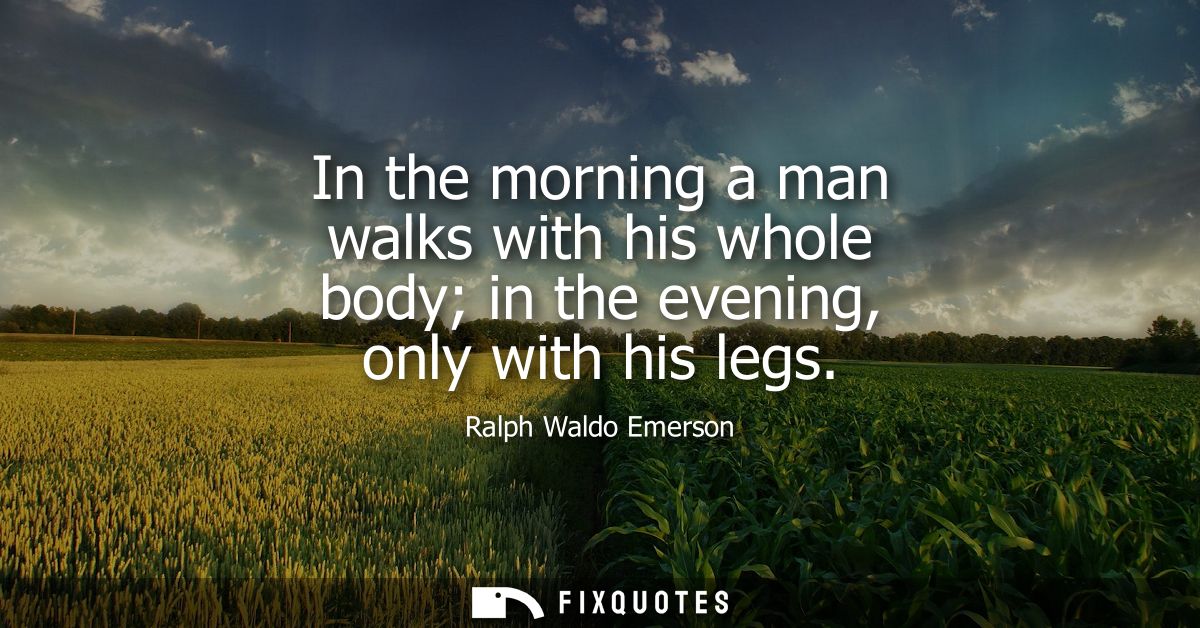
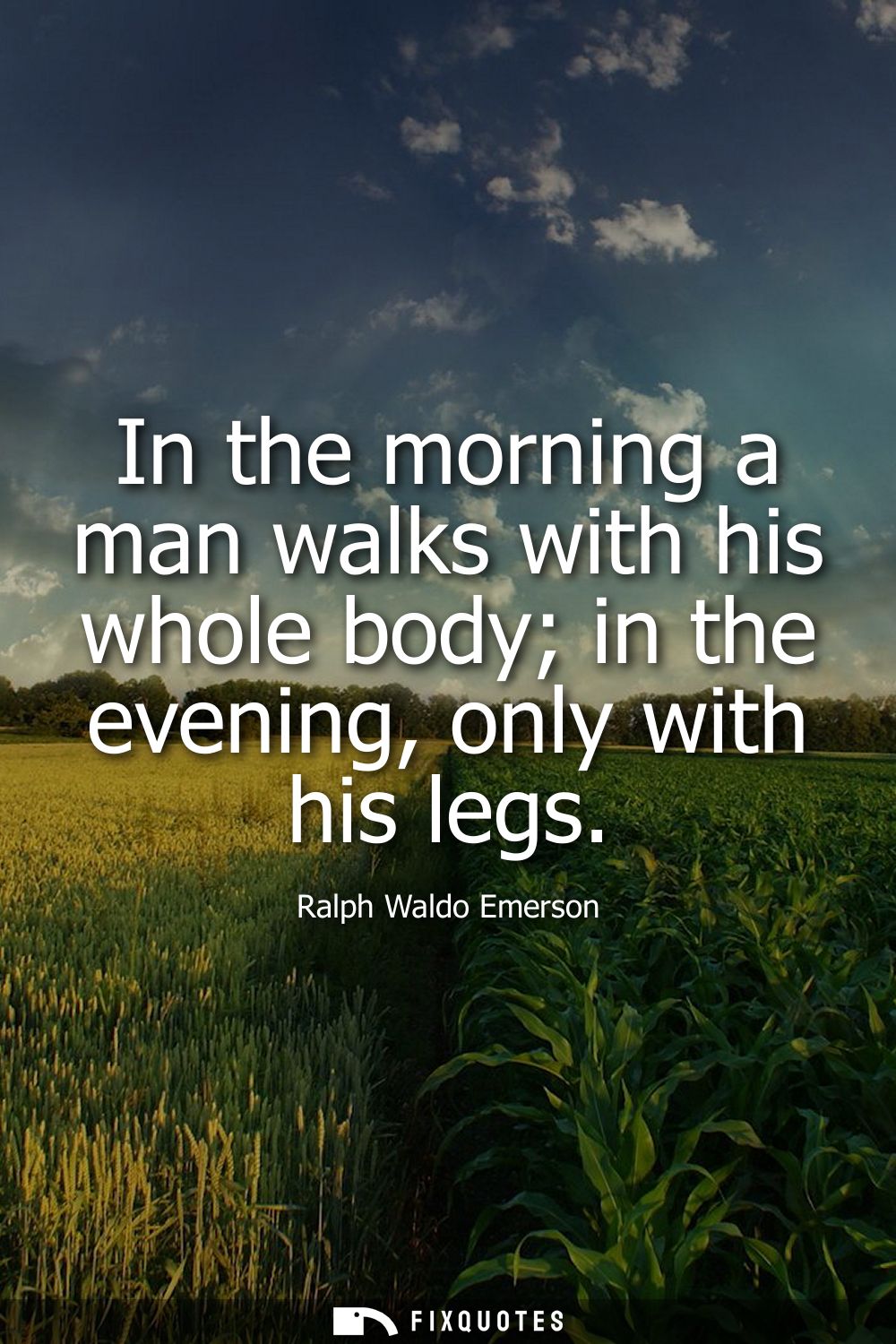
"In the morning a man walks with his whole body; in the evening, only with his legs"
About this Quote
Evening flips the metaphor into indictment. “Only with his legs” is what happens when living becomes mere locomotion: routine without inward assent, motion without meaning. Emerson’s edge is that he treats exhaustion not as an excuse but as a revelation. The day’s social grind - work, duty, compromise, the small corruptions of public life - can reduce a person to a delivery system for tasks. You still move, you still function, but you’re no longer fully there.
The line also carries Emerson’s suspicion of secondhand living. “Evening” isn’t just fatigue; it’s the late-stage habit of letting external schedules dictate the inner life, the slow surrender of perception. Read in the context of his broader project - self-reliance, renewed contact with nature, refusal of dead convention - the quote becomes a diagnostic tool: are you walking as a whole person, or merely being transported by obligation? The brilliance is the simplicity. Emerson smuggles a spiritual audit into a body check.
Quote Details
| Topic | Aging |
|---|---|
| Source | Help us find the source |
| Cite |
Citation Formats
APA Style (7th ed.)
Emerson, Ralph Waldo. (2026, January 18). In the morning a man walks with his whole body; in the evening, only with his legs. FixQuotes. https://fixquotes.com/quotes/in-the-morning-a-man-walks-with-his-whole-body-in-14182/
Chicago Style
Emerson, Ralph Waldo. "In the morning a man walks with his whole body; in the evening, only with his legs." FixQuotes. January 18, 2026. https://fixquotes.com/quotes/in-the-morning-a-man-walks-with-his-whole-body-in-14182/.
MLA Style (9th ed.)
"In the morning a man walks with his whole body; in the evening, only with his legs." FixQuotes, 18 Jan. 2026, https://fixquotes.com/quotes/in-the-morning-a-man-walks-with-his-whole-body-in-14182/. Accessed 20 Mar. 2026.