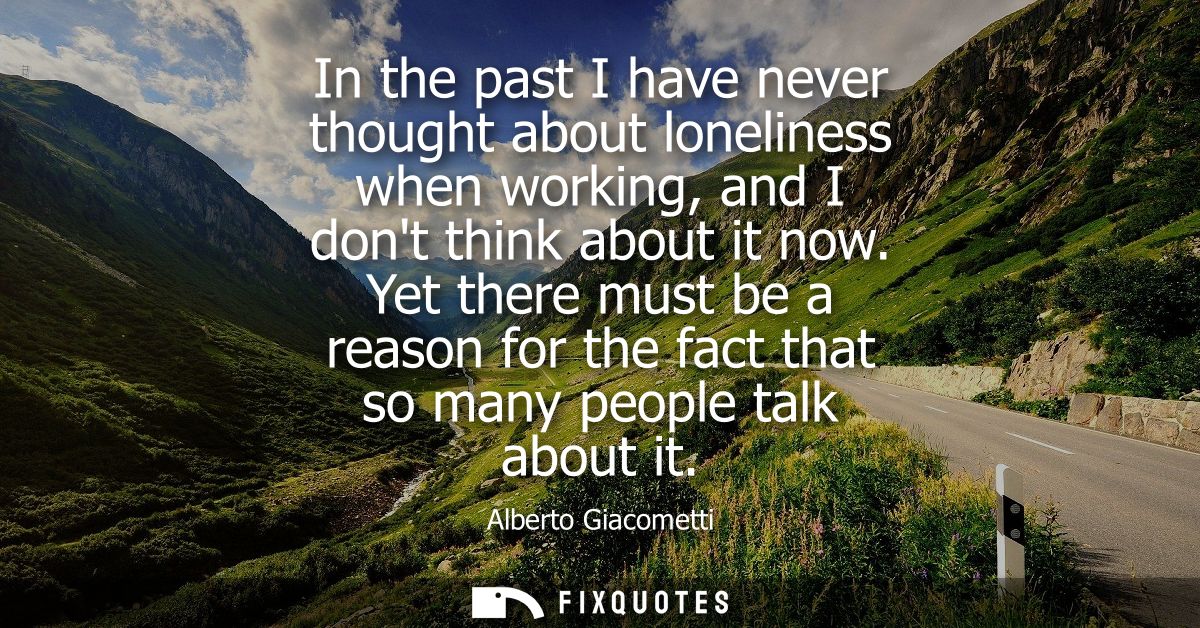
"In the past I have never thought about loneliness when working, and I don't think about it now. Yet there must be a reason for the fact that so many people talk about it"
About this Quote
The second sentence pivots from personal posture to cultural diagnosis. “Yet there must be a reason” is a small, surgical concession: maybe he doesn’t narrate his solitude, but he’s not naive about why everyone else does. Mid-century Europe had ample reasons - war, displacement, the thinning-out of old social certainties - and Paris’s existentialist scene made alienation a kind of public language. Giacometti’s line quietly resists that fashion. He won’t sentimentalize isolation, won’t use it as an artist’s brand.
Subtext: he’s hinting that talking about loneliness can be a symptom of it. The more a society verbalizes the feeling, the more it becomes shareable, even performable - which is its own paradox. In the studio, by contrast, loneliness can’t be performed; it either interferes or it doesn’t. Giacometti’s intent is to separate working solitude (a tool) from loneliness (a story), while admitting that the story keeps spreading for a reason worth interrogating.
Quote Details
| Topic | Loneliness |
|---|---|
| Source | Help us find the source |
| Cite |
Citation Formats
APA Style (7th ed.)
Giacometti, Alberto. (2026, January 17). In the past I have never thought about loneliness when working, and I don't think about it now. Yet there must be a reason for the fact that so many people talk about it. FixQuotes. https://fixquotes.com/quotes/in-the-past-i-have-never-thought-about-loneliness-74418/
Chicago Style
Giacometti, Alberto. "In the past I have never thought about loneliness when working, and I don't think about it now. Yet there must be a reason for the fact that so many people talk about it." FixQuotes. January 17, 2026. https://fixquotes.com/quotes/in-the-past-i-have-never-thought-about-loneliness-74418/.
MLA Style (9th ed.)
"In the past I have never thought about loneliness when working, and I don't think about it now. Yet there must be a reason for the fact that so many people talk about it." FixQuotes, 17 Jan. 2026, https://fixquotes.com/quotes/in-the-past-i-have-never-thought-about-loneliness-74418/. Accessed 30 Mar. 2026.