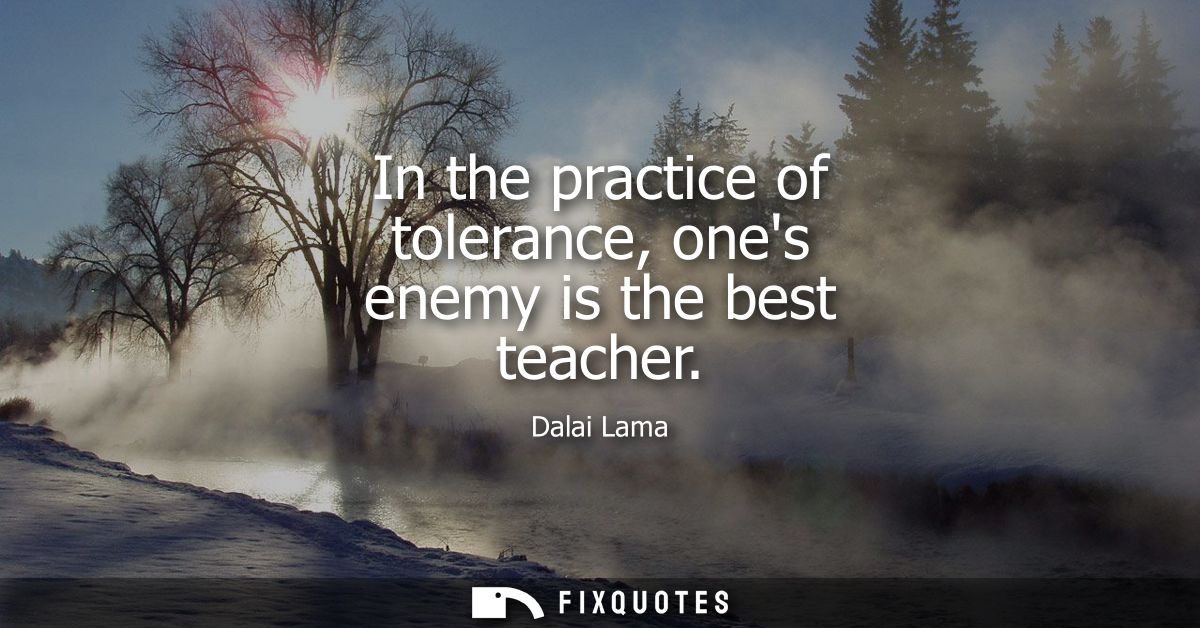
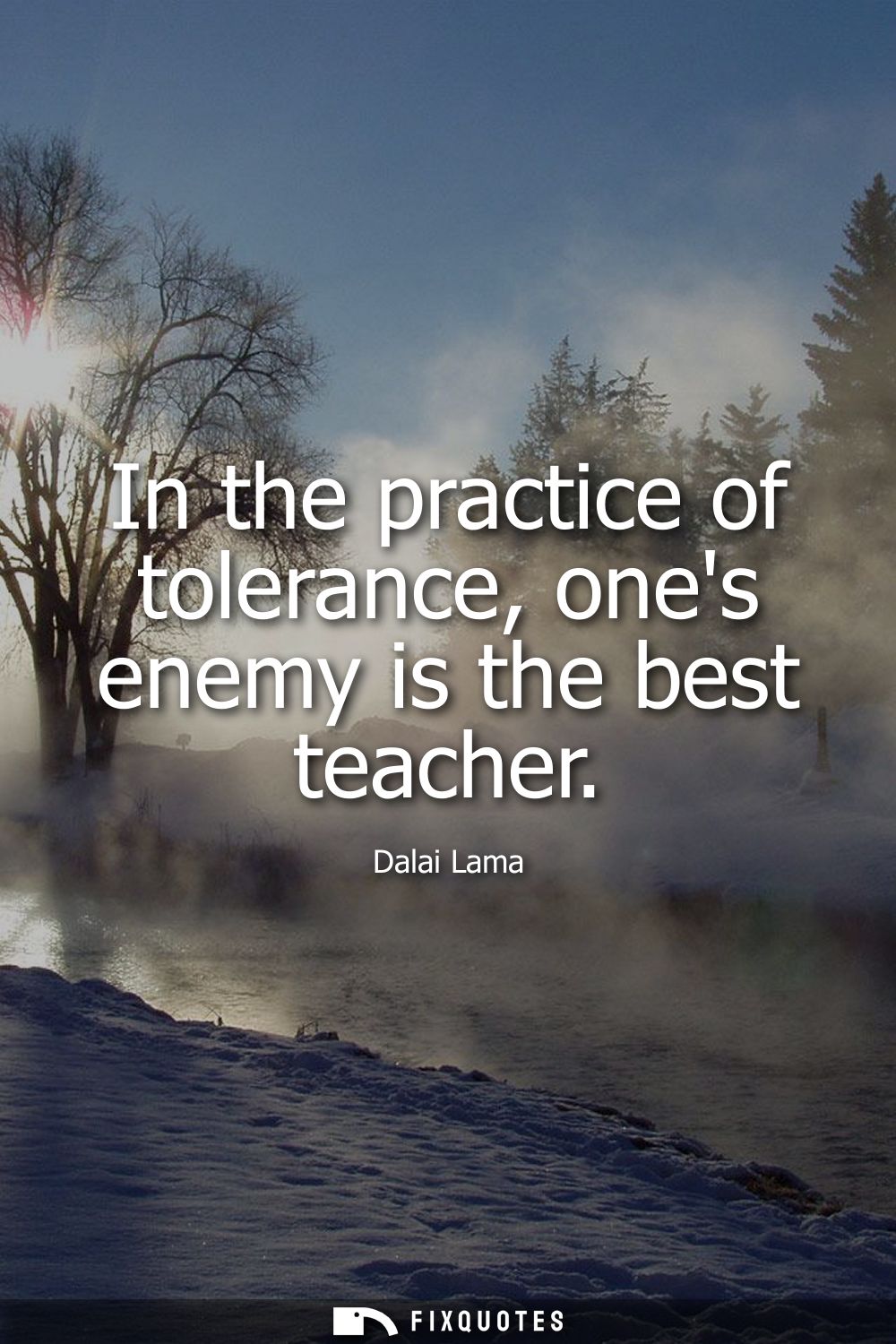
"In the practice of tolerance, one's enemy is the best teacher"
About this Quote
Tolerance stops being a cozy slogan the moment someone makes your blood boil. That is the Dalai Lama's pressure test: if you can only be tolerant toward the agreeable, you're not practicing a virtue, you're enjoying good company. By naming "one's enemy" as the "best teacher", he flips the moral hierarchy. The adversary isn't just an obstacle; they're the curriculum.
The intent is both spiritual and strategically human. An enemy forces specificity: what exactly do you believe, and how stable is it when provoked? Friends rarely expose the edge cases of our ethics; foes live in those edge cases. The subtext is bracingly unsentimental. Your enemy may be wrong, even cruel, but their very resistance can reveal your reflexes: the hunger to humiliate, the need to be seen as righteous, the easy slide from principle to revenge. Tolerance, in this frame, isn't passive endurance; it's disciplined attention to your own mind under stress.
Context matters. The Dalai Lama is a political and religious leader shaped by exile and an ongoing struggle defined by asymmetrical power. For him, tolerance isn't an abstract liberal nicety; it's a survival practice that aims to keep resentment from turning into identity. Calling the enemy a teacher also disarms the seductive narrative of purity: that moral clarity requires moral enemies. Instead, he suggests the opposite: your growth depends on staying human while facing someone who'd prefer you didn't.
It's a line that refuses the cheap triumph of hatred. Not because hatred is impolite, but because it's intellectually lazy.
The intent is both spiritual and strategically human. An enemy forces specificity: what exactly do you believe, and how stable is it when provoked? Friends rarely expose the edge cases of our ethics; foes live in those edge cases. The subtext is bracingly unsentimental. Your enemy may be wrong, even cruel, but their very resistance can reveal your reflexes: the hunger to humiliate, the need to be seen as righteous, the easy slide from principle to revenge. Tolerance, in this frame, isn't passive endurance; it's disciplined attention to your own mind under stress.
Context matters. The Dalai Lama is a political and religious leader shaped by exile and an ongoing struggle defined by asymmetrical power. For him, tolerance isn't an abstract liberal nicety; it's a survival practice that aims to keep resentment from turning into identity. Calling the enemy a teacher also disarms the seductive narrative of purity: that moral clarity requires moral enemies. Instead, he suggests the opposite: your growth depends on staying human while facing someone who'd prefer you didn't.
It's a line that refuses the cheap triumph of hatred. Not because hatred is impolite, but because it's intellectually lazy.
Quote Details
| Topic | Wisdom |
|---|---|
| Source | Help us find the source |
| Cite |
Citation Formats
APA Style (7th ed.)
Lama, Dalai. (2026, January 15). In the practice of tolerance, one's enemy is the best teacher. FixQuotes. https://fixquotes.com/quotes/in-the-practice-of-tolerance-ones-enemy-is-the-24777/
Chicago Style
Lama, Dalai. "In the practice of tolerance, one's enemy is the best teacher." FixQuotes. January 15, 2026. https://fixquotes.com/quotes/in-the-practice-of-tolerance-ones-enemy-is-the-24777/.
MLA Style (9th ed.)
"In the practice of tolerance, one's enemy is the best teacher." FixQuotes, 15 Jan. 2026, https://fixquotes.com/quotes/in-the-practice-of-tolerance-ones-enemy-is-the-24777/. Accessed 12 Feb. 2026.
More Quotes by Dalai
Add to List