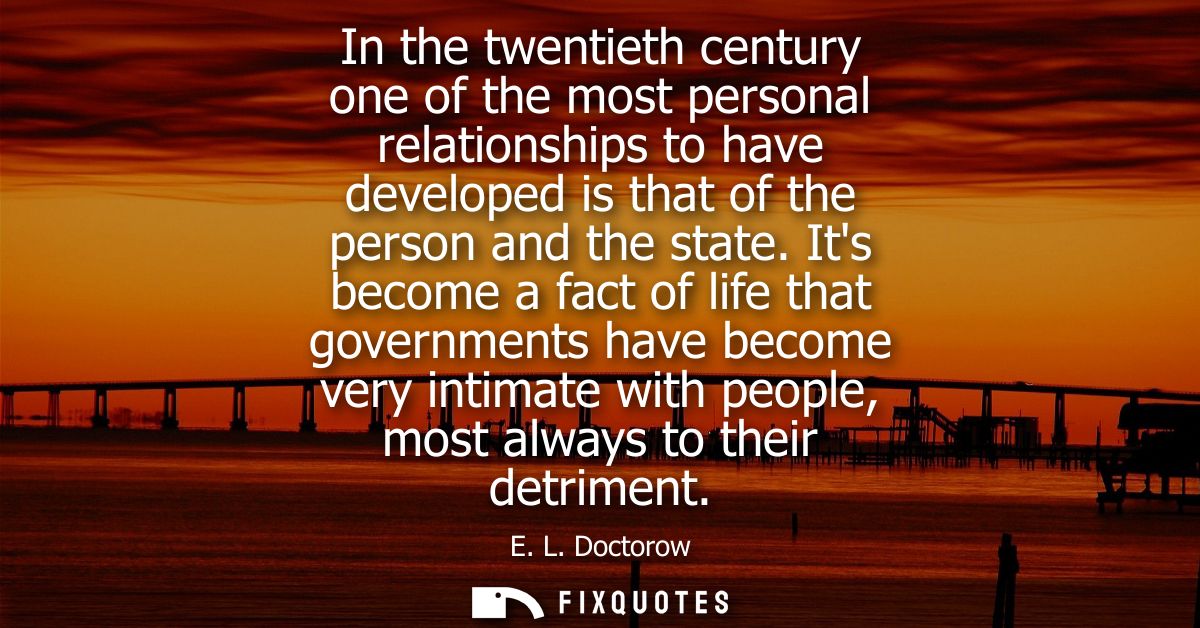
"In the twentieth century one of the most personal relationships to have developed is that of the person and the state. It's become a fact of life that governments have become very intimate with people, most always to their detriment"
About this Quote
The subtext is historical and literary at once. Doctorow wrote out of America’s long twentieth century of paperwork and suspicion: New Deal bureaucracies, two world wars, the Cold War’s loyalty tests, FBI files, surveillance, and the subtle coercions that come with passports, permits, welfare forms, and “national security.” He’s attentive to how modern states don’t only punish; they manage. They sort people, label them, and create incentives that quietly rewrite private life.
His cynicism lands because it refuses melodrama. “It’s become a fact of life” is the most damning phrase: intimacy with the state isn’t an emergency, it’s the baseline. The kicker - “most always to their detriment” - frames this relationship as structurally asymmetrical. When a government knows you intimately, it’s rarely to love you better. It’s to predict you, discipline you, recruit you, or preempt you. Doctorow, the novelist of power’s backstage, is warning that the modern citizen’s defining bond may be the one they never asked for.
Quote Details
| Topic | Human Rights |
|---|---|
| Source | Help us find the source |
| Cite |
Citation Formats
APA Style (7th ed.)
Doctorow, E. L. (2026, January 15). In the twentieth century one of the most personal relationships to have developed is that of the person and the state. It's become a fact of life that governments have become very intimate with people, most always to their detriment. FixQuotes. https://fixquotes.com/quotes/in-the-twentieth-century-one-of-the-most-personal-143218/
Chicago Style
Doctorow, E. L. "In the twentieth century one of the most personal relationships to have developed is that of the person and the state. It's become a fact of life that governments have become very intimate with people, most always to their detriment." FixQuotes. January 15, 2026. https://fixquotes.com/quotes/in-the-twentieth-century-one-of-the-most-personal-143218/.
MLA Style (9th ed.)
"In the twentieth century one of the most personal relationships to have developed is that of the person and the state. It's become a fact of life that governments have become very intimate with people, most always to their detriment." FixQuotes, 15 Jan. 2026, https://fixquotes.com/quotes/in-the-twentieth-century-one-of-the-most-personal-143218/. Accessed 4 Apr. 2026.