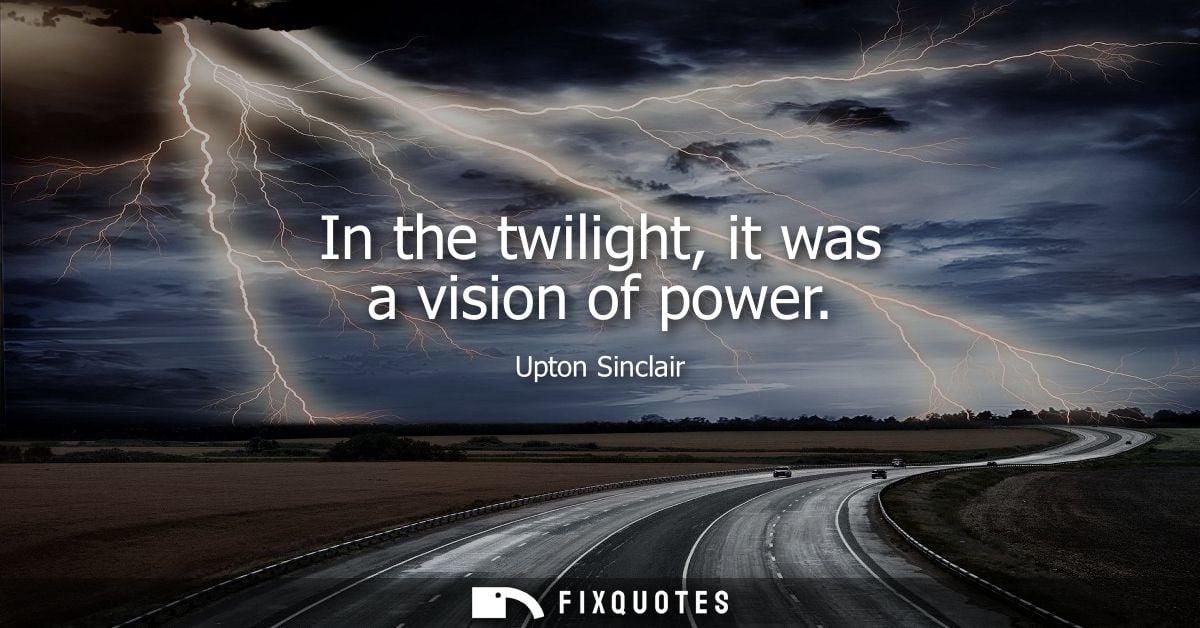
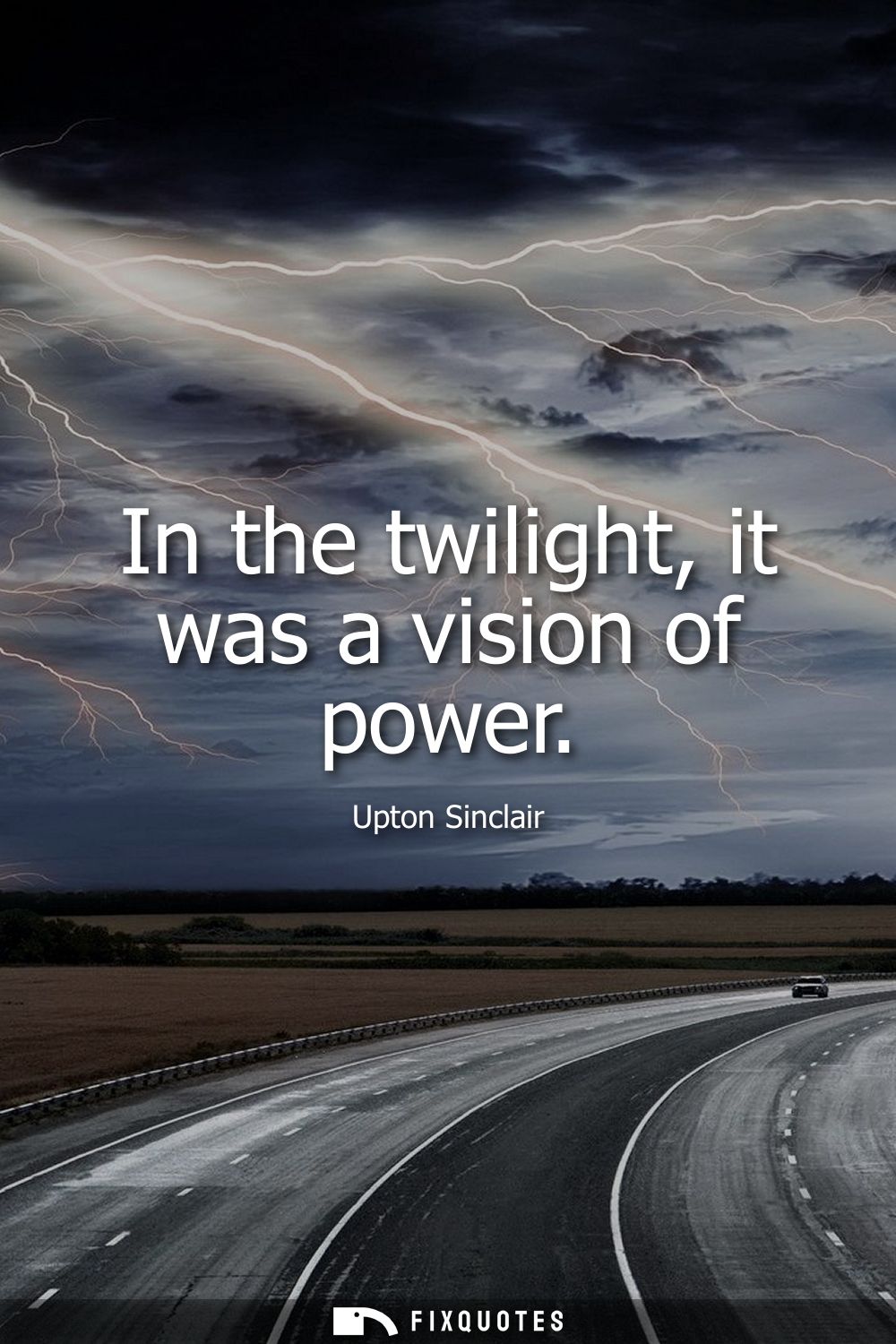
"In the twilight, it was a vision of power"
About this Quote
Sinclair’s phrase lands like a camera flash at dusk: “In the twilight, it was a vision of power.” Twilight is doing the heavy lifting. It’s the hour when outlines blur, when you can’t quite trust what you’re seeing, which makes it the perfect lighting for Sinclair’s favorite subject: power as spectacle. Not policy, not virtue, but a staged impression that reads as destiny precisely because conditions are dim.
The wording is deceptively neutral. “Vision” suggests something almost religious, a revelation, but it’s also optical and therefore suspect. Sinclair is alert to how authority sells itself through atmospherics - uniforms, architecture, crowds, ritual - the kind of pageantry that feels more convincing when details recede and the silhouette remains. Twilight turns power into a shape, and shapes are easier to worship than systems.
The subtext is cynical in a distinctly Sinclair way: power thrives in half-light. It prefers the soft focus where contradictions don’t show. In his era - industrial consolidation, labor conflict, propaganda around war and capital - “power” often arrived to ordinary people as an image first and a set of consequences second. You can read the line as a warning about aestheticized authority: when social forces are too complex or too exhausting to parse, we’re tempted to accept the most coherent picture available, especially if it’s dramatic.
Sinclair doesn’t describe who holds power here because that’s part of the point. The mechanism is portable. If it can become a “vision” at twilight, it can be manufactured again tomorrow.
The wording is deceptively neutral. “Vision” suggests something almost religious, a revelation, but it’s also optical and therefore suspect. Sinclair is alert to how authority sells itself through atmospherics - uniforms, architecture, crowds, ritual - the kind of pageantry that feels more convincing when details recede and the silhouette remains. Twilight turns power into a shape, and shapes are easier to worship than systems.
The subtext is cynical in a distinctly Sinclair way: power thrives in half-light. It prefers the soft focus where contradictions don’t show. In his era - industrial consolidation, labor conflict, propaganda around war and capital - “power” often arrived to ordinary people as an image first and a set of consequences second. You can read the line as a warning about aestheticized authority: when social forces are too complex or too exhausting to parse, we’re tempted to accept the most coherent picture available, especially if it’s dramatic.
Sinclair doesn’t describe who holds power here because that’s part of the point. The mechanism is portable. If it can become a “vision” at twilight, it can be manufactured again tomorrow.
Quote Details
| Topic | Deep |
|---|---|
| Source | Help us find the source |
| Cite |
Citation Formats
APA Style (7th ed.)
Sinclair, Upton. (2026, January 16). In the twilight, it was a vision of power. FixQuotes. https://fixquotes.com/quotes/in-the-twilight-it-was-a-vision-of-power-119893/
Chicago Style
Sinclair, Upton. "In the twilight, it was a vision of power." FixQuotes. January 16, 2026. https://fixquotes.com/quotes/in-the-twilight-it-was-a-vision-of-power-119893/.
MLA Style (9th ed.)
"In the twilight, it was a vision of power." FixQuotes, 16 Jan. 2026, https://fixquotes.com/quotes/in-the-twilight-it-was-a-vision-of-power-119893/. Accessed 2 Apr. 2026.
More Quotes by Upton
Add to List