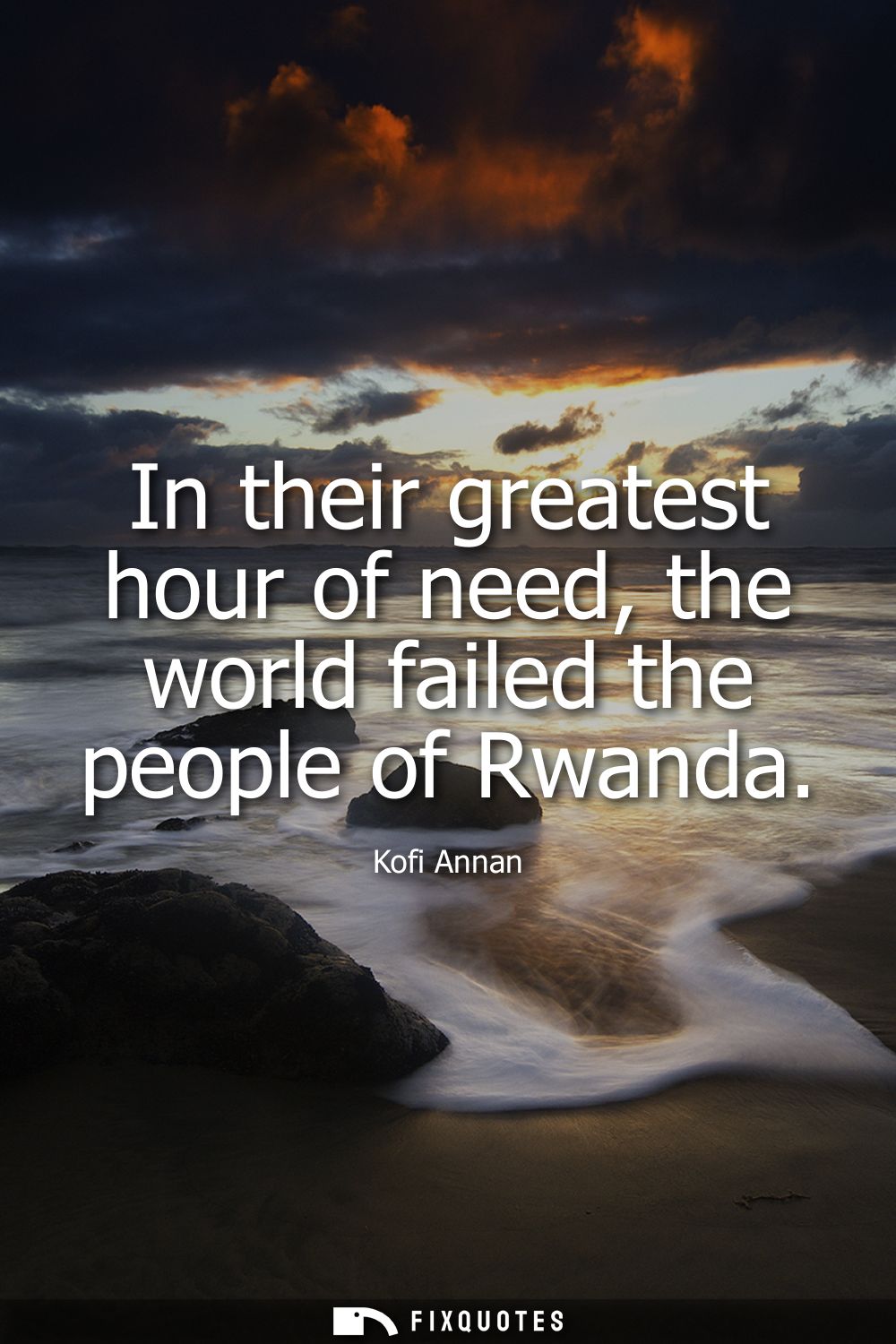
"In their greatest hour of need, the world failed the people of Rwanda"
About this Quote
A clean sentence, almost bureaucratically calm, and that is exactly why it lands like an indictment. Annan frames the 1994 Rwandan genocide not as a mystery or an inevitability but as a moral audit: the victims had an "hour of need", and there was a measurable, collective failure to meet it. The phrase "the world" is doing heavy work. It spreads responsibility across states, institutions, and publics, refusing the comforting fiction that this was simply someone else's civil war. No villains are named because, in a way, everyone is.
The subtext is sharper when you remember who is speaking. Annan was a senior UN official overseeing peacekeeping when the killing began; later, as Secretary-General, he became the face of an organization haunted by what it did not do. The line reads as both confession and prosecution, a rare kind of leadership language that admits institutional complicity without collapsing into self-pity. "Failed" is blunt, legalistic, and active: not "couldn't stop", not "didn't know", but failed.
Context matters: the UN withdrew troops, major powers avoided the word "genocide", and the machinery of international law and intervention moved at the speed of political convenience. Annan's intent is to strip away that convenience. By compressing catastrophe into a single "hour", he dramatizes urgency and exposes delay as choice. It's an appeal to memory as policy: if the world wants to claim moral authority, it has to live with the bill for its absence.
The subtext is sharper when you remember who is speaking. Annan was a senior UN official overseeing peacekeeping when the killing began; later, as Secretary-General, he became the face of an organization haunted by what it did not do. The line reads as both confession and prosecution, a rare kind of leadership language that admits institutional complicity without collapsing into self-pity. "Failed" is blunt, legalistic, and active: not "couldn't stop", not "didn't know", but failed.
Context matters: the UN withdrew troops, major powers avoided the word "genocide", and the machinery of international law and intervention moved at the speed of political convenience. Annan's intent is to strip away that convenience. By compressing catastrophe into a single "hour", he dramatizes urgency and exposes delay as choice. It's an appeal to memory as policy: if the world wants to claim moral authority, it has to live with the bill for its absence.
Quote Details
| Topic | Human Rights |
|---|---|
| Source | Help us find the source |
| Cite |
Citation Formats
APA Style (7th ed.)
Annan, Kofi. (2026, January 17). In their greatest hour of need, the world failed the people of Rwanda. FixQuotes. https://fixquotes.com/quotes/in-their-greatest-hour-of-need-the-world-failed-72146/
Chicago Style
Annan, Kofi. "In their greatest hour of need, the world failed the people of Rwanda." FixQuotes. January 17, 2026. https://fixquotes.com/quotes/in-their-greatest-hour-of-need-the-world-failed-72146/.
MLA Style (9th ed.)
"In their greatest hour of need, the world failed the people of Rwanda." FixQuotes, 17 Jan. 2026, https://fixquotes.com/quotes/in-their-greatest-hour-of-need-the-world-failed-72146/. Accessed 31 Mar. 2026.
More Quotes by Kofi
Add to List