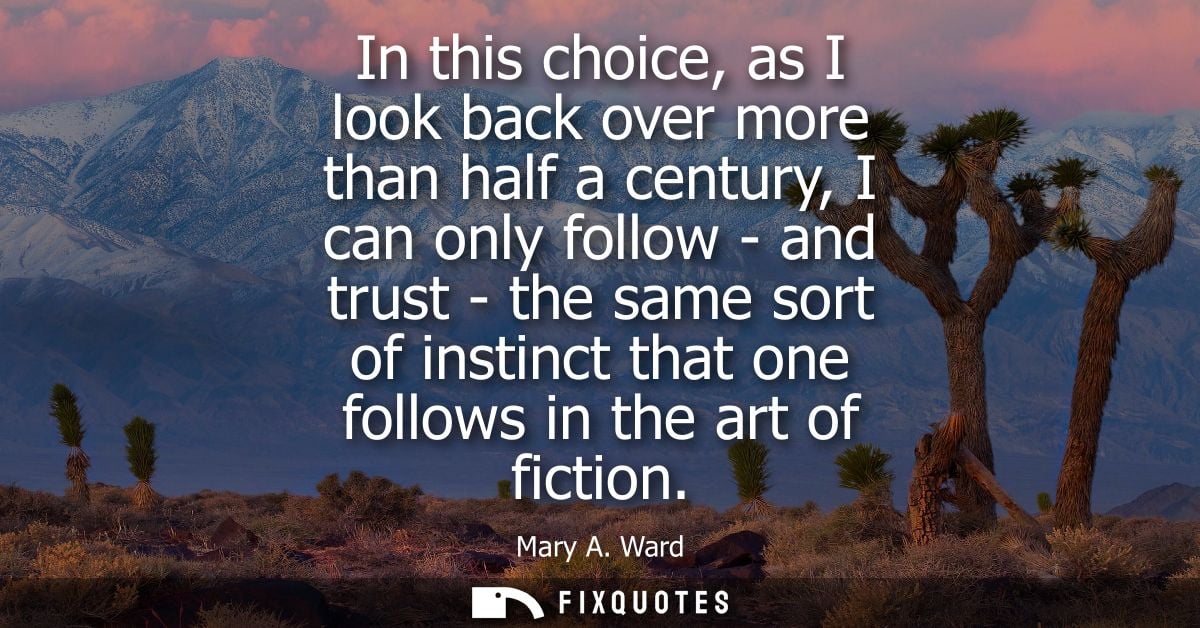
"In this choice, as I look back over more than half a century, I can only follow - and trust - the same sort of instinct that one follows in the art of fiction"
About this Quote
The craft comparison does sly work. In fiction, instinct isn't airy mysticism; it's disciplined feeling, built from long attention to people, motives, and consequences. By likening her choice to storytelling, Ward implies her decision is an act of composition: selecting an ending, arranging meaning, deciding what version of herself will be coherent. The subtext is a quiet rebellion against the era's demand (especially for a prominent Victorian woman) to justify decisions in public, rational, socially acceptable terms. Instinct becomes a rhetorical shield: you can't cross-examine a hunch the way you can audit a plan.
There's also a modesty that isn't entirely modest. To say you "follow" instinct in fiction is to claim the authority of an artist: someone trained to sense what rings true. Ward isn't confessing impulsiveness; she's arguing that the deepest choices operate like good narrative, guided less by proof than by an internal logic that only reveals itself once you commit to it.
Quote Details
| Topic | Wisdom |
|---|---|
| Source | Help us find the source |
| Cite |
Citation Formats
APA Style (7th ed.)
Ward, Mary A. (2026, January 15). In this choice, as I look back over more than half a century, I can only follow - and trust - the same sort of instinct that one follows in the art of fiction. FixQuotes. https://fixquotes.com/quotes/in-this-choice-as-i-look-back-over-more-than-half-149007/
Chicago Style
Ward, Mary A. "In this choice, as I look back over more than half a century, I can only follow - and trust - the same sort of instinct that one follows in the art of fiction." FixQuotes. January 15, 2026. https://fixquotes.com/quotes/in-this-choice-as-i-look-back-over-more-than-half-149007/.
MLA Style (9th ed.)
"In this choice, as I look back over more than half a century, I can only follow - and trust - the same sort of instinct that one follows in the art of fiction." FixQuotes, 15 Jan. 2026, https://fixquotes.com/quotes/in-this-choice-as-i-look-back-over-more-than-half-149007/. Accessed 3 Apr. 2026.