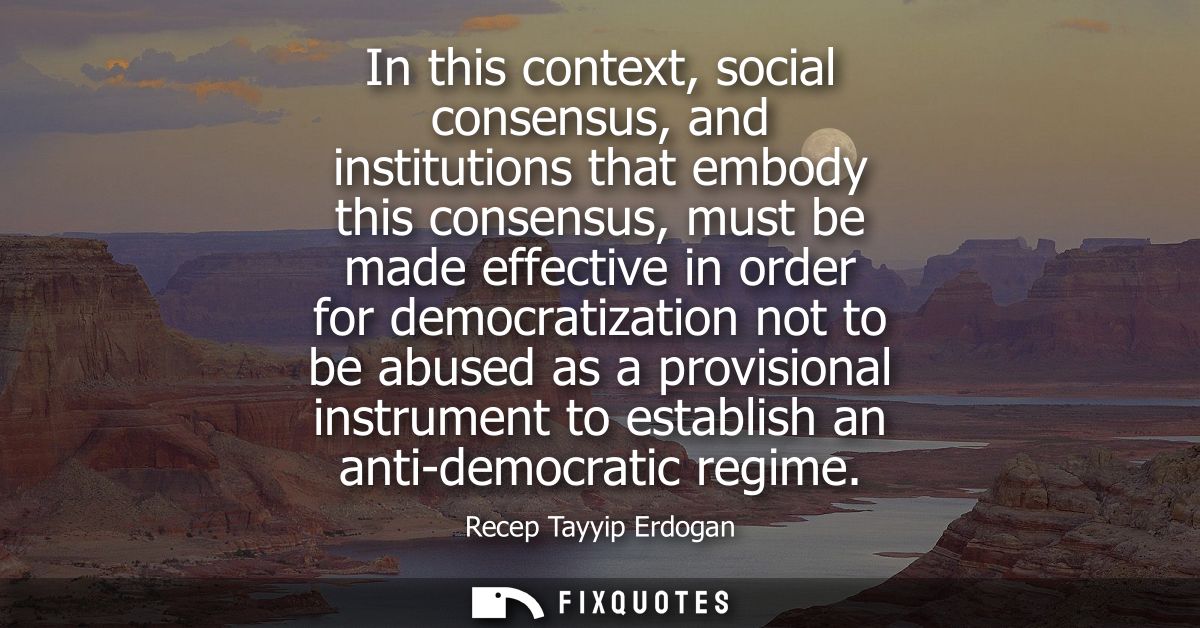
"In this context, social consensus and institutions that embody this consensus must be made effective in order for democratization not to be abused as a provisional instrument to establish an anti-democratic regime"
About this Quote
“Consensus” does heavy lifting here. It sounds benign, even soothing, but in practice it raises the question: whose consensus, and produced by what pressure? In polarized societies, consensus is rarely discovered; it’s manufactured, negotiated, or enforced. By insisting that institutions must “embody” and then “make effective” that consensus, Erdogan positions the state as the referee of legitimacy, not just the manager of elections.
The subtext is preventative permission. If democratization is merely “provisional,” then political rights can be treated as conditional and revocable until the nation is deemed mature, unified, or secure enough. That logic pairs neatly with measures that centralize authority: reshaping courts, disciplining media, purging bureaucracies, rewriting rules of civil society. Each can be sold as inoculation against an “anti-democratic regime,” even when the result is weakened opposition and reduced checks on the executive.
Context matters because Turkey’s modern political memory is haunted by coups, ideological violence, and the rise-and-fall cycle of parties and guardianship institutions. Erdogan taps that history to argue for stability through consolidation. The line’s real intent is to define democracy as something that must be controlled to be protected.
Quote Details
| Topic | Freedom |
|---|---|
| Source | Help us find the source |
| Cite |
Citation Formats
APA Style (7th ed.)
Erdogan, Recep Tayyip. (2026, February 16). In this context, social consensus and institutions that embody this consensus must be made effective in order for democratization not to be abused as a provisional instrument to establish an anti-democratic regime. FixQuotes. https://fixquotes.com/quotes/in-this-context-social-consensus-and-institutions-144873/
Chicago Style
Erdogan, Recep Tayyip. "In this context, social consensus and institutions that embody this consensus must be made effective in order for democratization not to be abused as a provisional instrument to establish an anti-democratic regime." FixQuotes. February 16, 2026. https://fixquotes.com/quotes/in-this-context-social-consensus-and-institutions-144873/.
MLA Style (9th ed.)
"In this context, social consensus and institutions that embody this consensus must be made effective in order for democratization not to be abused as a provisional instrument to establish an anti-democratic regime." FixQuotes, 16 Feb. 2026, https://fixquotes.com/quotes/in-this-context-social-consensus-and-institutions-144873/. Accessed 27 Mar. 2026.