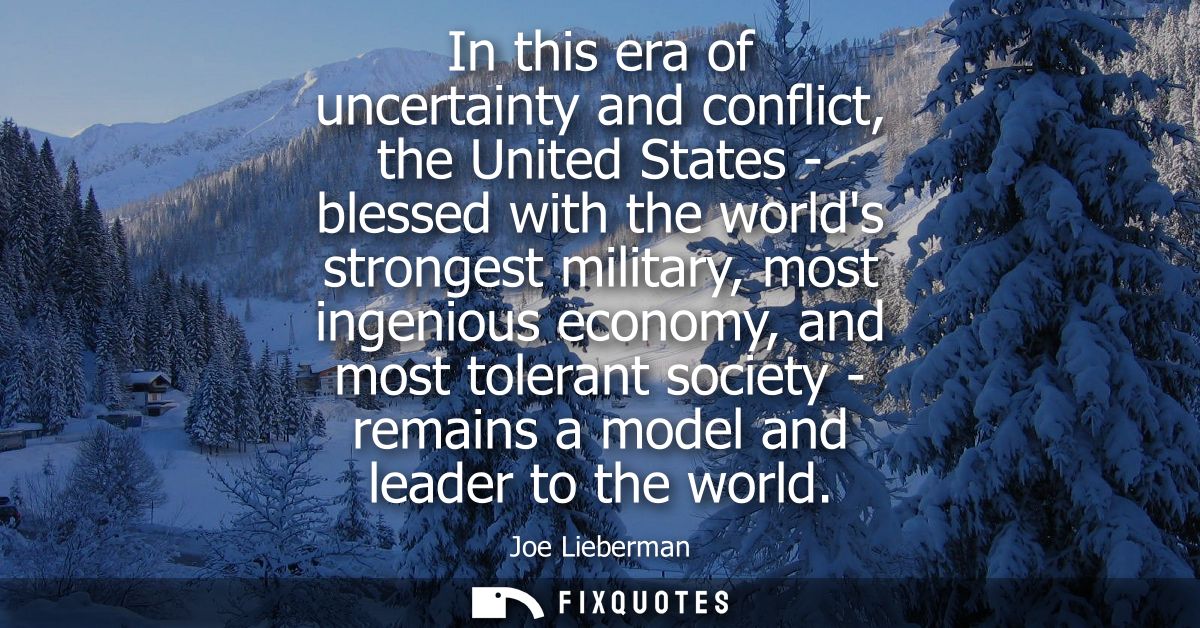
"In this era of uncertainty and conflict, the United States - blessed with the world's strongest military, most ingenious economy, and most tolerant society - remains a model and leader to the world"
About this Quote
The three-part construction is classic political choreography: force (“strongest military”), prosperity (“most ingenious economy”), virtue (“most tolerant society”). Each clause preemptively answers a different critique. Worried about war? The military is framed as protective competence. Skeptical of global capitalism? The economy is “ingenious,” implying creativity rather than exploitation. Concerned about hypocrisy at home? “Most tolerant society” supplies a moral alibi. It’s a strategic stack: might, money, and righteousness, in that order, with tolerance positioned as the ethical capstone that makes the first two easier to export.
The subtext is less about describing the country than disciplining doubt. If the U.S. is “a model,” dissent can be recoded as cynicism or ingratitude; if it is “leader,” restraint can look like abdication. Coming from a centrist politician who often straddled party lines yet embraced a hawkish, post-Cold War confidence, the sentence reads as early-2000s liberal internationalism in miniature: American exceptionalism with a humane gloss. The rhetorical trick is simplicity. Complex trade-offs dissolve into a confident hierarchy where U.S. supremacy feels not contested, but benevolent.
Quote Details
| Topic | Leadership |
|---|---|
| Source | Help us find the source |
| Cite |
Citation Formats
APA Style (7th ed.)
Lieberman, Joe. (2026, January 16). In this era of uncertainty and conflict, the United States - blessed with the world's strongest military, most ingenious economy, and most tolerant society - remains a model and leader to the world. FixQuotes. https://fixquotes.com/quotes/in-this-era-of-uncertainty-and-conflict-the-92400/
Chicago Style
Lieberman, Joe. "In this era of uncertainty and conflict, the United States - blessed with the world's strongest military, most ingenious economy, and most tolerant society - remains a model and leader to the world." FixQuotes. January 16, 2026. https://fixquotes.com/quotes/in-this-era-of-uncertainty-and-conflict-the-92400/.
MLA Style (9th ed.)
"In this era of uncertainty and conflict, the United States - blessed with the world's strongest military, most ingenious economy, and most tolerant society - remains a model and leader to the world." FixQuotes, 16 Jan. 2026, https://fixquotes.com/quotes/in-this-era-of-uncertainty-and-conflict-the-92400/. Accessed 9 Mar. 2026.