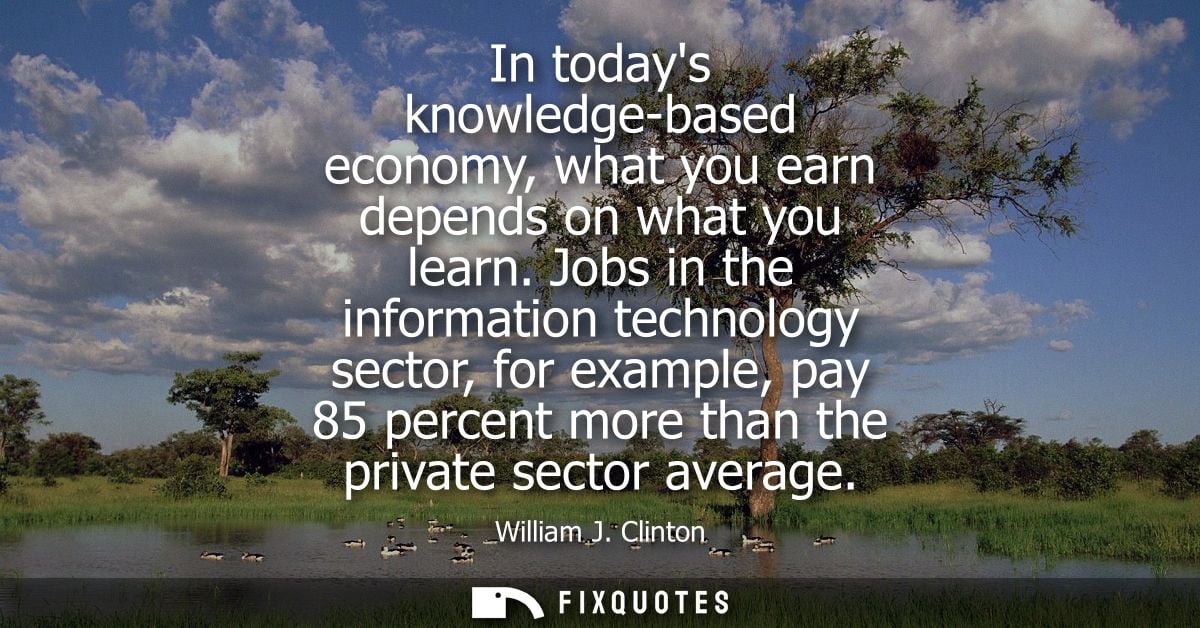
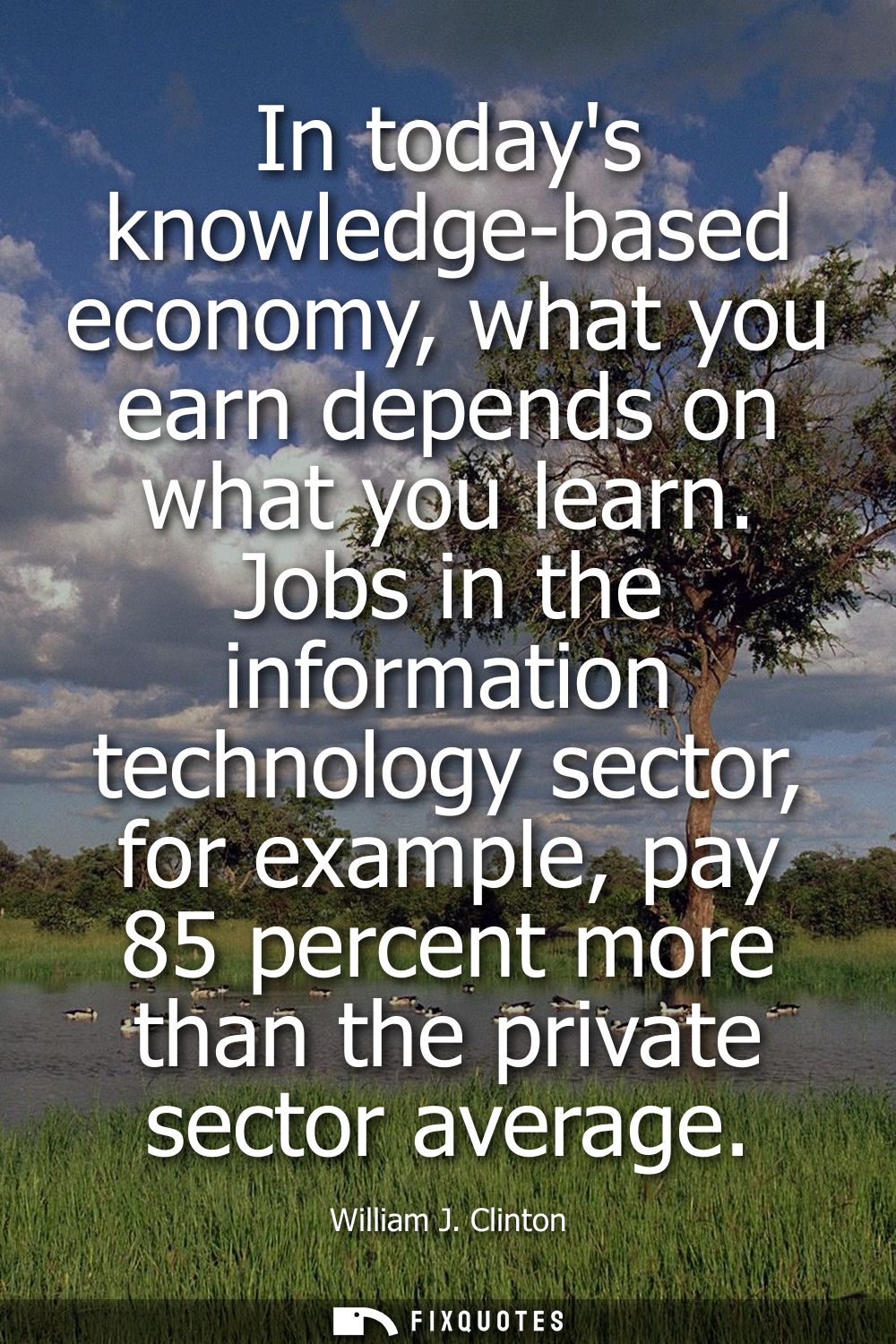
"In today's knowledge-based economy, what you earn depends on what you learn. Jobs in the information technology sector, for example, pay 85 percent more than the private sector average"
About this Quote
The phrase "knowledge-based economy" does heavy lifting. It frames economic upheaval as progress, not dislocation, and turns inequality into a skills gap problem rather than a power problem. Clinton is also doing coalition politics: reassuring business that government will feed the talent pipeline, while offering voters a nonthreatening promise of mobility. You can hear the 1990s confidence in metrics and market-friendly reform; even the 85 percent figure reads like a PowerPoint bullet aimed at suburban parents and anxious workers.
That statistic functions less as evidence than as a nudge. It implies a simple arbitrage: move into IT, earn more. The subtext is that losers in the transition are under-credentialed, not under-protected. It's an optimistic message with a quiet edge: if you fall behind, the economy didn't fail you; you failed to keep up. In the Clinton era, that was the political genius and the blind spot.
Quote Details
| Topic | Learning |
|---|---|
| Source | Help us find the source |
| Cite |
Citation Formats
APA Style (7th ed.)
Clinton, William J. (2026, January 17). In today's knowledge-based economy, what you earn depends on what you learn. Jobs in the information technology sector, for example, pay 85 percent more than the private sector average. FixQuotes. https://fixquotes.com/quotes/in-todays-knowledge-based-economy-what-you-earn-74674/
Chicago Style
Clinton, William J. "In today's knowledge-based economy, what you earn depends on what you learn. Jobs in the information technology sector, for example, pay 85 percent more than the private sector average." FixQuotes. January 17, 2026. https://fixquotes.com/quotes/in-todays-knowledge-based-economy-what-you-earn-74674/.
MLA Style (9th ed.)
"In today's knowledge-based economy, what you earn depends on what you learn. Jobs in the information technology sector, for example, pay 85 percent more than the private sector average." FixQuotes, 17 Jan. 2026, https://fixquotes.com/quotes/in-todays-knowledge-based-economy-what-you-earn-74674/. Accessed 29 Mar. 2026.