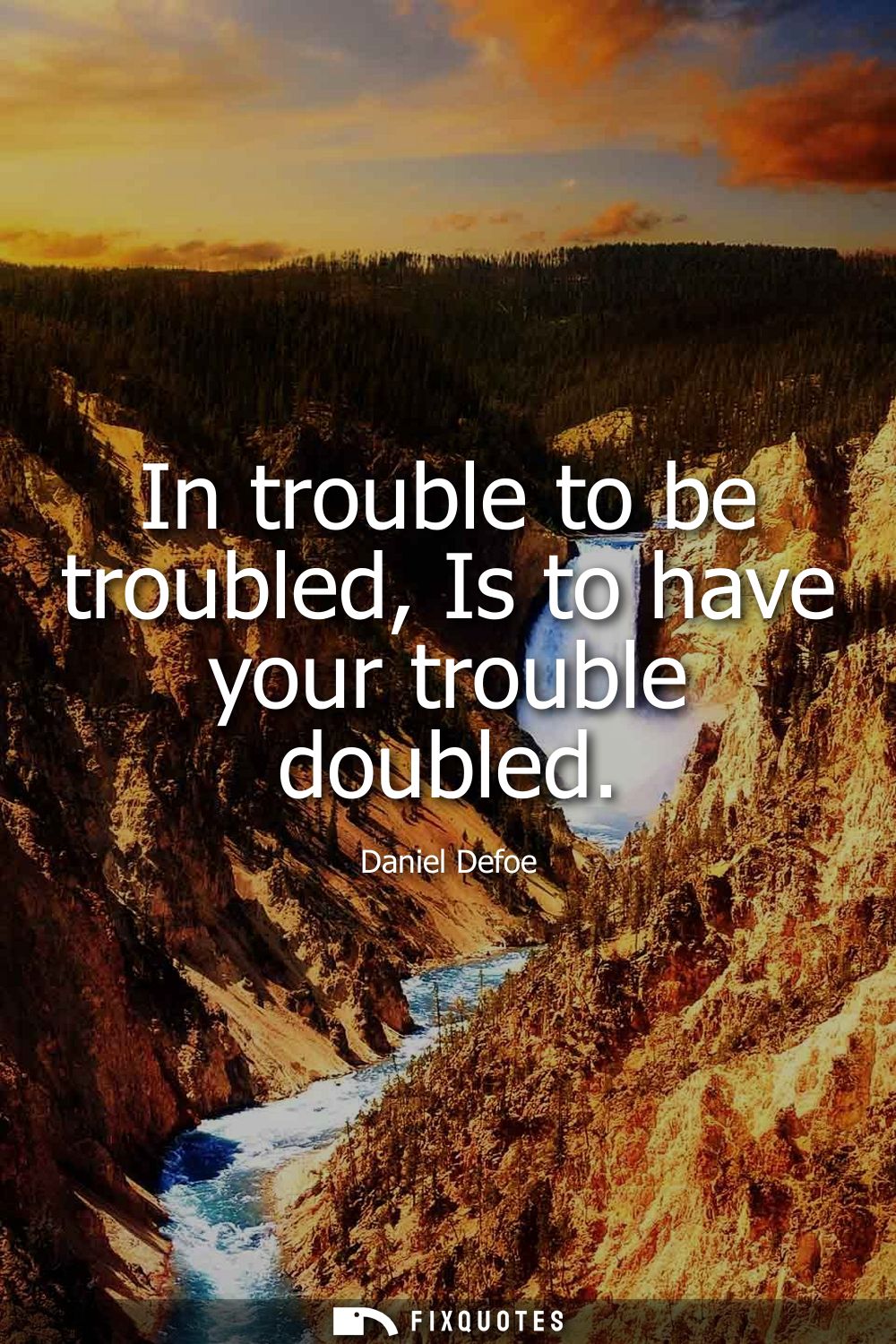
"In trouble, to be troubled is to have your trouble doubled"
About this Quote
Defoe’s line lands like advice your sternest friend gives you right before you spiral: the panic about a problem is often worse than the problem itself. The sing-song rhythm and the near-comic repetition (“trouble” stacked on “trouble”) aren’t just decorative. They mimic rumination, that mental loop where anxiety keeps replaying the same grim clip until it feels like evidence. By turning worry into a kind of self-inflicted math - one trouble plus your distress equals two - Defoe makes emotional excess sound not only unhelpful but faintly ridiculous. The wit is a pressure valve.
The intent is practical, even moral: discipline your mind, because ungoverned feeling becomes a second enemy. That fits Defoe the journalist and pamphleteer, writing in an era when crisis was ambient rather than exceptional: debtors’ prisons, plague memory, religious conflict, commercial risk. Early modern London was a place where fortunes could swing on rumor, credit, and catastrophe. “Trouble doubled” isn’t abstract stoicism; it’s survival economics.
Subtextually, the line flatters the reader’s agency. Trouble arrives from outside, but “being troubled” is framed as a choice, or at least a habit you can interrupt. There’s also a quiet Protestant-work-ethic undertone: suffering isn’t automatically ennobling; indulging it can be a form of vanity. Defoe’s genius is packaging restraint as common sense, using a proverb’s bite to make self-control feel less like repression and more like intelligence.
The intent is practical, even moral: discipline your mind, because ungoverned feeling becomes a second enemy. That fits Defoe the journalist and pamphleteer, writing in an era when crisis was ambient rather than exceptional: debtors’ prisons, plague memory, religious conflict, commercial risk. Early modern London was a place where fortunes could swing on rumor, credit, and catastrophe. “Trouble doubled” isn’t abstract stoicism; it’s survival economics.
Subtextually, the line flatters the reader’s agency. Trouble arrives from outside, but “being troubled” is framed as a choice, or at least a habit you can interrupt. There’s also a quiet Protestant-work-ethic undertone: suffering isn’t automatically ennobling; indulging it can be a form of vanity. Defoe’s genius is packaging restraint as common sense, using a proverb’s bite to make self-control feel less like repression and more like intelligence.
Quote Details
| Topic | Anxiety |
|---|---|
| Source | Later attribution: The Novels and Miscellaneous Works of Daniel DeFoe (Daniel Defoe, 1889) modern compilationID: uuU-AQAAIAAJ
Evidence:
Daniel Defoe. the same words that he spoke it in , yet I remember I made.tirto en English proverb of my own , thus : In trouble to be troubled , Is to have your trouble doubled . He ran on then in remarks upon all the little improvements ... |
| Cite |
Citation Formats
APA Style (7th ed.)
Defoe, Daniel. (2026, March 25). In trouble, to be troubled is to have your trouble doubled. FixQuotes. https://fixquotes.com/quotes/in-trouble-to-be-troubled-is-to-have-your-trouble-148741/
Chicago Style
Defoe, Daniel. "In trouble, to be troubled is to have your trouble doubled." FixQuotes. March 25, 2026. https://fixquotes.com/quotes/in-trouble-to-be-troubled-is-to-have-your-trouble-148741/.
MLA Style (9th ed.)
"In trouble, to be troubled is to have your trouble doubled." FixQuotes, 25 Mar. 2026, https://fixquotes.com/quotes/in-trouble-to-be-troubled-is-to-have-your-trouble-148741/. Accessed 1 Apr. 2026.
More Quotes by Daniel
Add to List