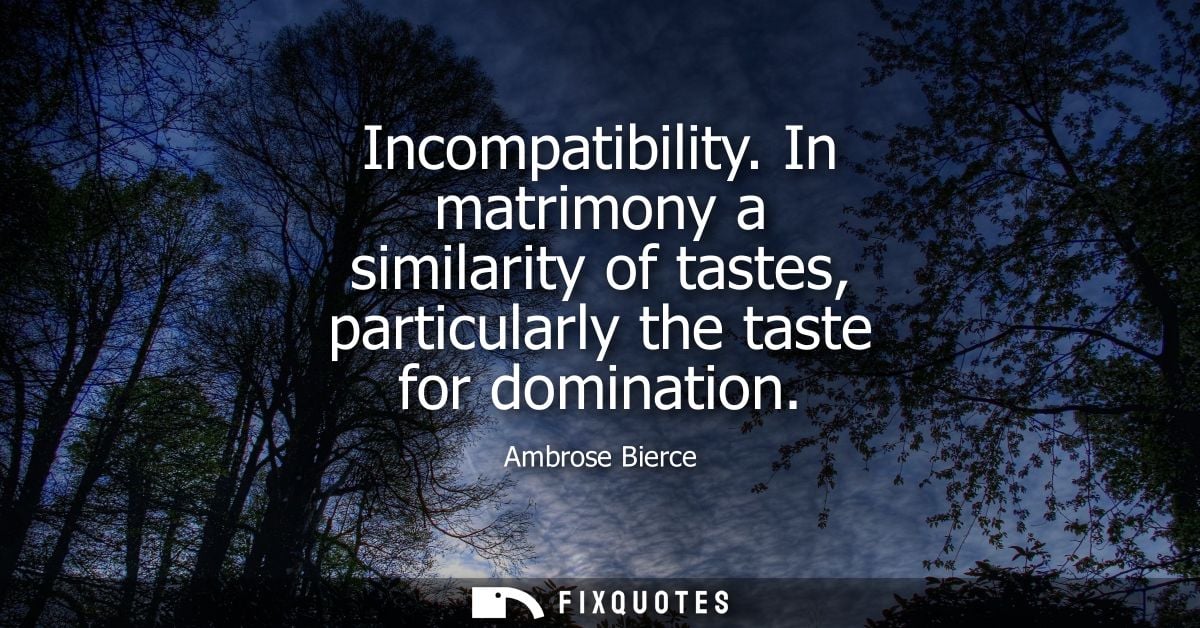
"Incompatibility. In matrimony, a similarity of tastes, particularly the taste for domination"
About this Quote
The line works like much of Bierce’s The Devil’s Dictionary: a definition that pretends to clarify but actually exposes the social myth underneath. Victorian matrimony sold itself as moral order and companionate harmony, while often functioning as a legal and economic arrangement that granted men formal authority and demanded women’s compliance. Bierce doesn’t give a reformist speech about patriarchy; he compresses it into a poisoned bonbon. If both partners crave control, the union becomes a permanent contest. If only one does, "compatibility" is simply another name for surrender.
The subtext is that conflict in marriage isn’t an accident of mismatched hobbies; it’s structural. The institution trains people to treat intimacy like territory: who decides, who yields, who gets the last word, the last dollar, the last version of reality. Bierce’s brilliance is making domination sound like a shared "taste", as casual as preferring oysters, which implicates not just individuals but a culture that normalizes control as romance’s hidden ingredient.
Quote Details
| Topic | Marriage |
|---|---|
| Source | Help us find the source |
| Cite |
Citation Formats
APA Style (7th ed.)
Bierce, Ambrose. (2026, February 20). Incompatibility. In matrimony, a similarity of tastes, particularly the taste for domination. FixQuotes. https://fixquotes.com/quotes/incompatibility-in-matrimony-a-similarity-of-3702/
Chicago Style
Bierce, Ambrose. "Incompatibility. In matrimony, a similarity of tastes, particularly the taste for domination." FixQuotes. February 20, 2026. https://fixquotes.com/quotes/incompatibility-in-matrimony-a-similarity-of-3702/.
MLA Style (9th ed.)
"Incompatibility. In matrimony, a similarity of tastes, particularly the taste for domination." FixQuotes, 20 Feb. 2026, https://fixquotes.com/quotes/incompatibility-in-matrimony-a-similarity-of-3702/. Accessed 30 Mar. 2026.