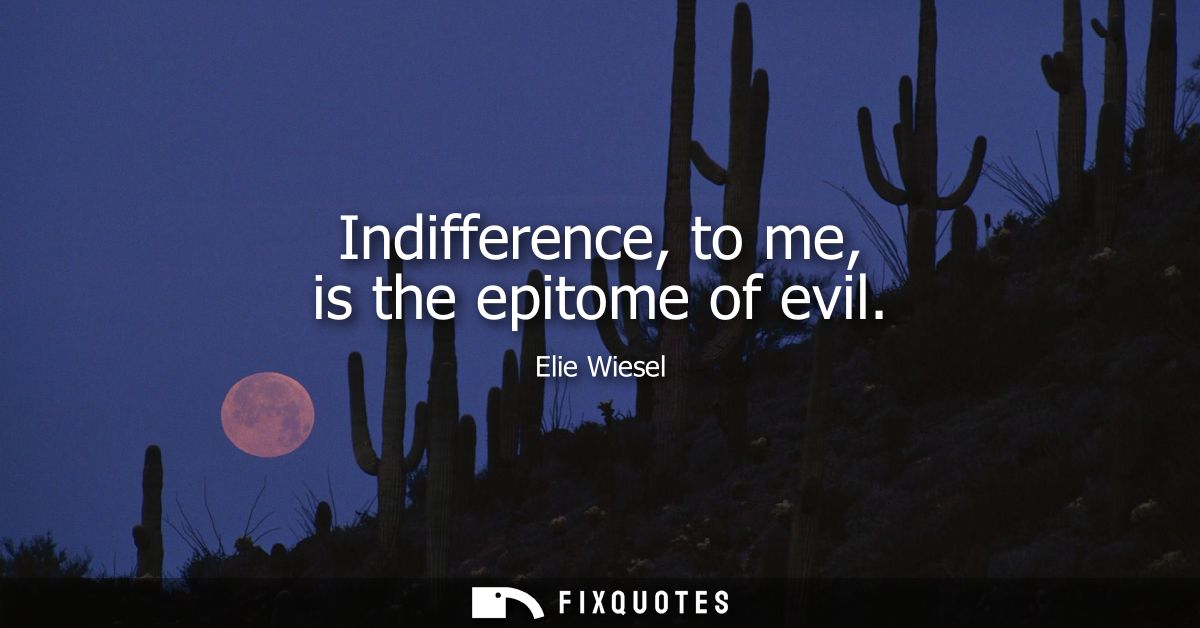
"Indifference, to me, is the epitome of evil"
About this Quote
Indifference is Wiesel's chosen villain because it’s the one that lets every other villain breathe. Coming from a Holocaust survivor, the line is less a philosophical flourish than an accusation aimed at bystanders, institutions, and comfortable publics who prefer moral neutrality to costly empathy. He doesn’t call hatred the epitome of evil; hatred at least acknowledges the humanity of its target. Indifference erases the target entirely, turning people into background noise. That’s why the sentence lands with such force: it reframes evil as a failure of attention.
The phrasing is deceptively personal - "to me" - but the modesty is strategic. Wiesel isn’t claiming a monopoly on morality; he’s grounding an argument in lived witness, daring the reader to disagree without sounding callous. "Epitome" does heavy lifting too. It suggests a distilled essence, the pure concentrate of wrongdoing: not the dramatic spectacle of cruelty, but the quiet administrative shrug, the neighbor who looks away, the official who follows procedure, the newspaper that moves on.
Context sharpens the blade. Wiesel spent much of his postwar life fighting amnesia: the tendency of societies to treat atrocity as a completed chapter rather than a recurring temptation. The subtext is a warning about modern comfort - how democracies, media cycles, and political incentives reward detachment. Indifference isn’t just passivity; it’s collaboration by omission, the moral loophole people use to keep their hands clean while the world gets dirty.
The phrasing is deceptively personal - "to me" - but the modesty is strategic. Wiesel isn’t claiming a monopoly on morality; he’s grounding an argument in lived witness, daring the reader to disagree without sounding callous. "Epitome" does heavy lifting too. It suggests a distilled essence, the pure concentrate of wrongdoing: not the dramatic spectacle of cruelty, but the quiet administrative shrug, the neighbor who looks away, the official who follows procedure, the newspaper that moves on.
Context sharpens the blade. Wiesel spent much of his postwar life fighting amnesia: the tendency of societies to treat atrocity as a completed chapter rather than a recurring temptation. The subtext is a warning about modern comfort - how democracies, media cycles, and political incentives reward detachment. Indifference isn’t just passivity; it’s collaboration by omission, the moral loophole people use to keep their hands clean while the world gets dirty.
Quote Details
| Topic | Ethics & Morality |
|---|---|
| Source | Help us find the source |
| Cite |
Citation Formats
APA Style (7th ed.)
Wiesel, Elie. (2026, January 17). Indifference, to me, is the epitome of evil. FixQuotes. https://fixquotes.com/quotes/indifference-to-me-is-the-epitome-of-evil-30970/
Chicago Style
Wiesel, Elie. "Indifference, to me, is the epitome of evil." FixQuotes. January 17, 2026. https://fixquotes.com/quotes/indifference-to-me-is-the-epitome-of-evil-30970/.
MLA Style (9th ed.)
"Indifference, to me, is the epitome of evil." FixQuotes, 17 Jan. 2026, https://fixquotes.com/quotes/indifference-to-me-is-the-epitome-of-evil-30970/. Accessed 20 Mar. 2026.
More Quotes by Elie
Add to List