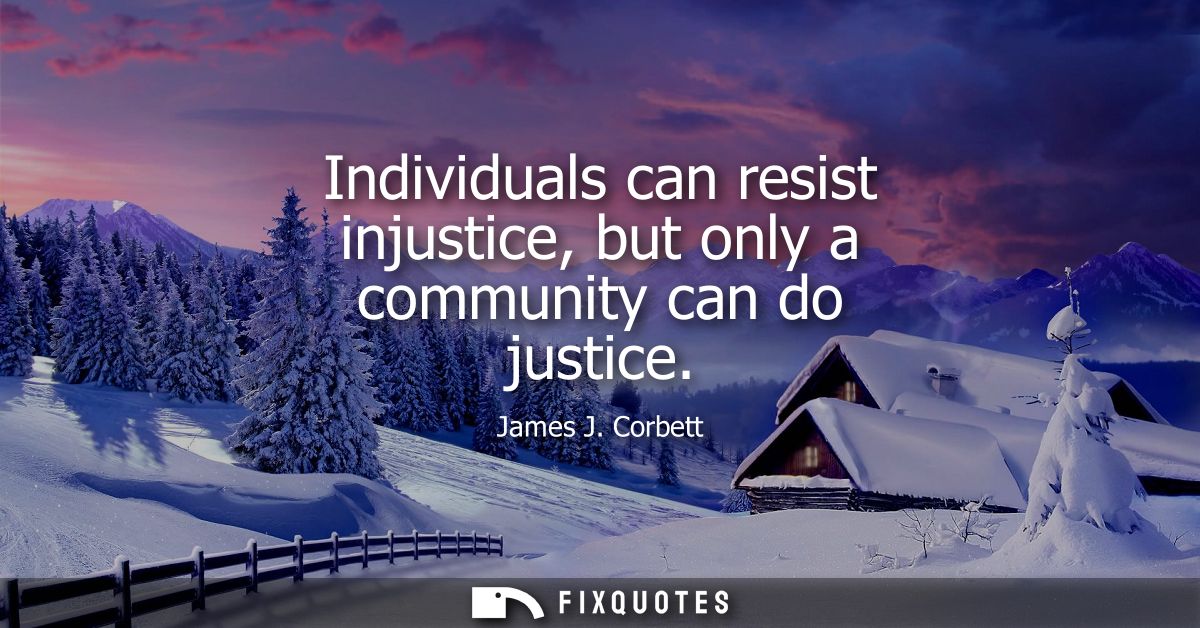
"Individuals can resist injustice, but only a community can do justice"
About this Quote
Corbett’s line reads like a fighter’s lesson smuggled into civic philosophy: you can throw a punch at unfairness, but you can’t win the whole bout alone. Coming from an athlete - and not just any athlete, but a prizefighter from an era when boxing was sliding from bare-knuckle grit into regulated spectacle - the contrast matters. “Resist injustice” is the instinctive move: the lone body refusing to go down, the personal boycott, the whistle blown, the boss confronted. It’s visceral, immediate, and often heroic. It also stops at negation: no, I won’t accept this.
“Only a community can do justice” flips from defiance to construction. Justice isn’t just stopping harm; it’s building conditions where harm is less likely to recur. That requires institutions, norms, witnesses, and follow-through - the slow, unglamorous work that doesn’t fit on a highlight reel. Corbett is quietly demoting the myth of the lone savior, which is especially pointed in sports culture, where individual greatness gets most of the credit and collective scaffolding gets none.
The subtext is accountability. A community can record, remember, and enforce; it can also fail, excuse, and look away. Corbett’s sentence dares the listener to stop treating justice as a personal virtue and start treating it as a shared responsibility with infrastructure: rules that apply to the powerful, consequences that outlast outrage, support systems that make courage less costly.
It’s a reminder that resistance is an act. Justice is a system.
“Only a community can do justice” flips from defiance to construction. Justice isn’t just stopping harm; it’s building conditions where harm is less likely to recur. That requires institutions, norms, witnesses, and follow-through - the slow, unglamorous work that doesn’t fit on a highlight reel. Corbett is quietly demoting the myth of the lone savior, which is especially pointed in sports culture, where individual greatness gets most of the credit and collective scaffolding gets none.
The subtext is accountability. A community can record, remember, and enforce; it can also fail, excuse, and look away. Corbett’s sentence dares the listener to stop treating justice as a personal virtue and start treating it as a shared responsibility with infrastructure: rules that apply to the powerful, consequences that outlast outrage, support systems that make courage less costly.
It’s a reminder that resistance is an act. Justice is a system.
Quote Details
| Topic | Justice |
|---|---|
| Source | Help us find the source |
More Quotes by James
Add to List