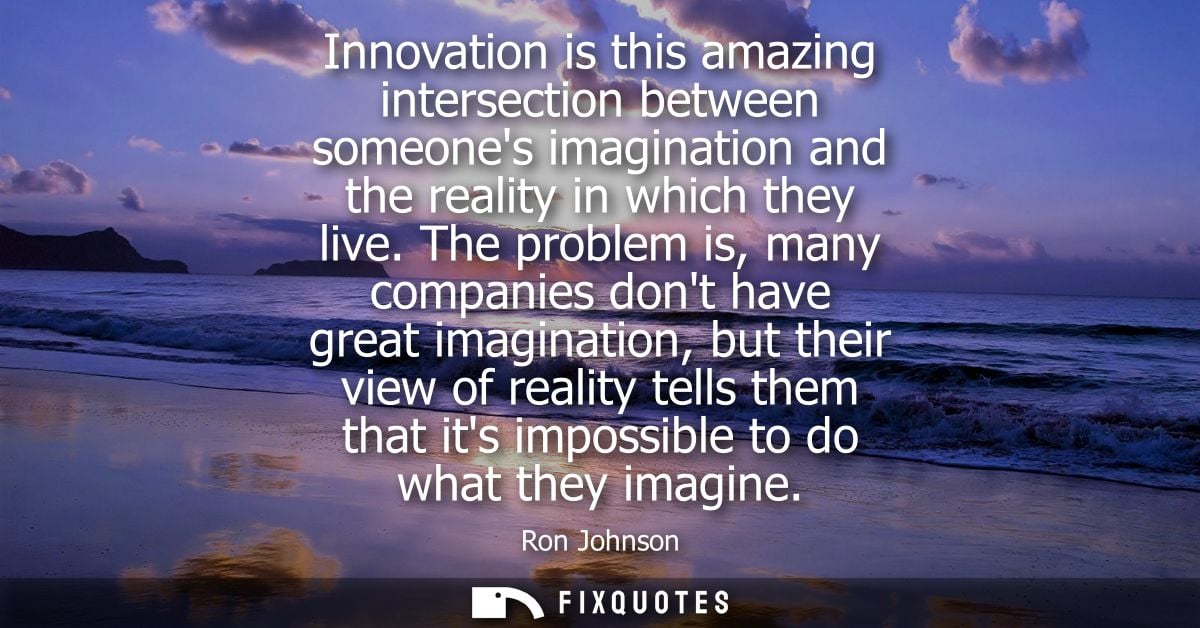
"Innovation is this amazing intersection between someone's imagination and the reality in which they live. The problem is, many companies don't have great imagination, but their view of reality tells them that it's impossible to do what they imagine"
About this Quote
Innovation, in Ron Johnson's framing, isn't a lightning bolt or a lab coat; it's a collision between what people can picture and what their environment will tolerate. That "intersection" metaphor does a lot of work. It makes invention sound less like genius and more like navigation: you have to drive with one eye on the map (imagination) and one eye on the road (reality). The rhetorical move is slyly generous at first, then quietly accusatory.
The sting lands in the second sentence. Johnson doesn't say companies lack capital, talent, or strategy; he says they lack imagination. That's not a market failure so much as a moral one, a critique of corporate culture that rewards risk management over risk taking. The subtext is that "reality" isn't neutral data - it's a story organizations tell themselves, shaped by incentives, bureaucracy, and fear of being wrong in public. When he says their view of reality tells them it's impossible, he's pointing at a familiar corporate reflex: using constraints as a shield. It's not that the idea can't be done; it's that the internal narrative makes trying feel irrational.
As a politician, Johnson is also borrowing a business-friendly language of innovation to make a broader argument about institutional stagnation. It flatters entrepreneurs and scolds incumbents, implying that obstacles are often self-authored. The context is a culture that celebrates disruption while building systems designed to prevent it. His line plays well because it captures that contradiction: the same organization that asks for big ideas is structurally invested in proving those ideas can't exist.
The sting lands in the second sentence. Johnson doesn't say companies lack capital, talent, or strategy; he says they lack imagination. That's not a market failure so much as a moral one, a critique of corporate culture that rewards risk management over risk taking. The subtext is that "reality" isn't neutral data - it's a story organizations tell themselves, shaped by incentives, bureaucracy, and fear of being wrong in public. When he says their view of reality tells them it's impossible, he's pointing at a familiar corporate reflex: using constraints as a shield. It's not that the idea can't be done; it's that the internal narrative makes trying feel irrational.
As a politician, Johnson is also borrowing a business-friendly language of innovation to make a broader argument about institutional stagnation. It flatters entrepreneurs and scolds incumbents, implying that obstacles are often self-authored. The context is a culture that celebrates disruption while building systems designed to prevent it. His line plays well because it captures that contradiction: the same organization that asks for big ideas is structurally invested in proving those ideas can't exist.
Quote Details
| Topic | Technology |
|---|
More Quotes by Ron
Add to List