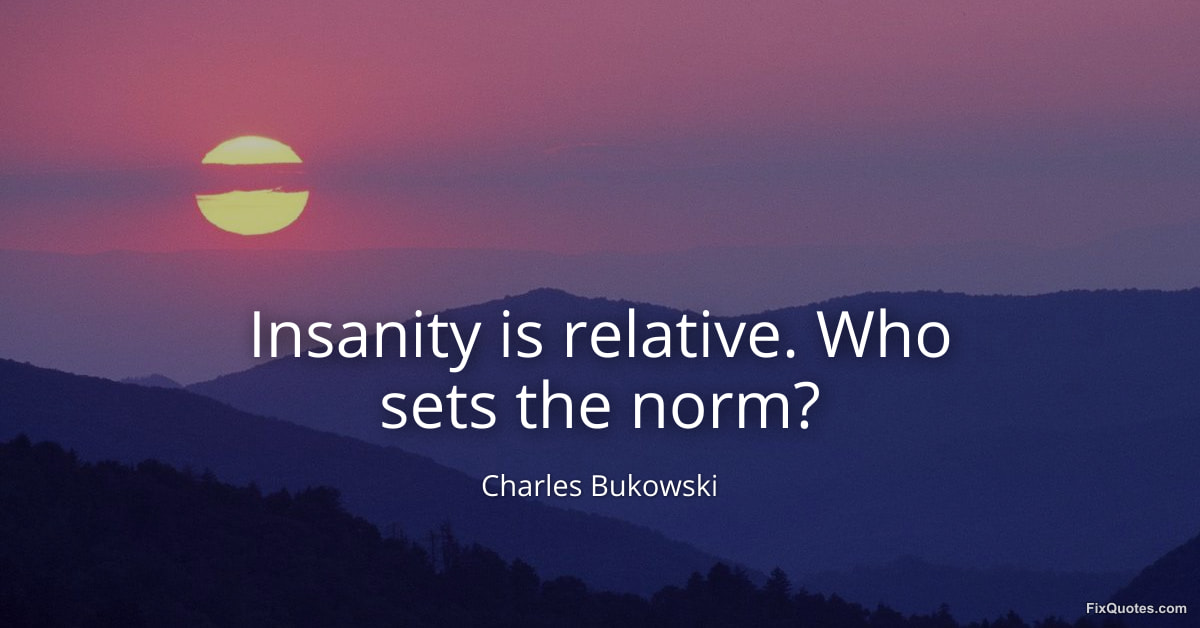
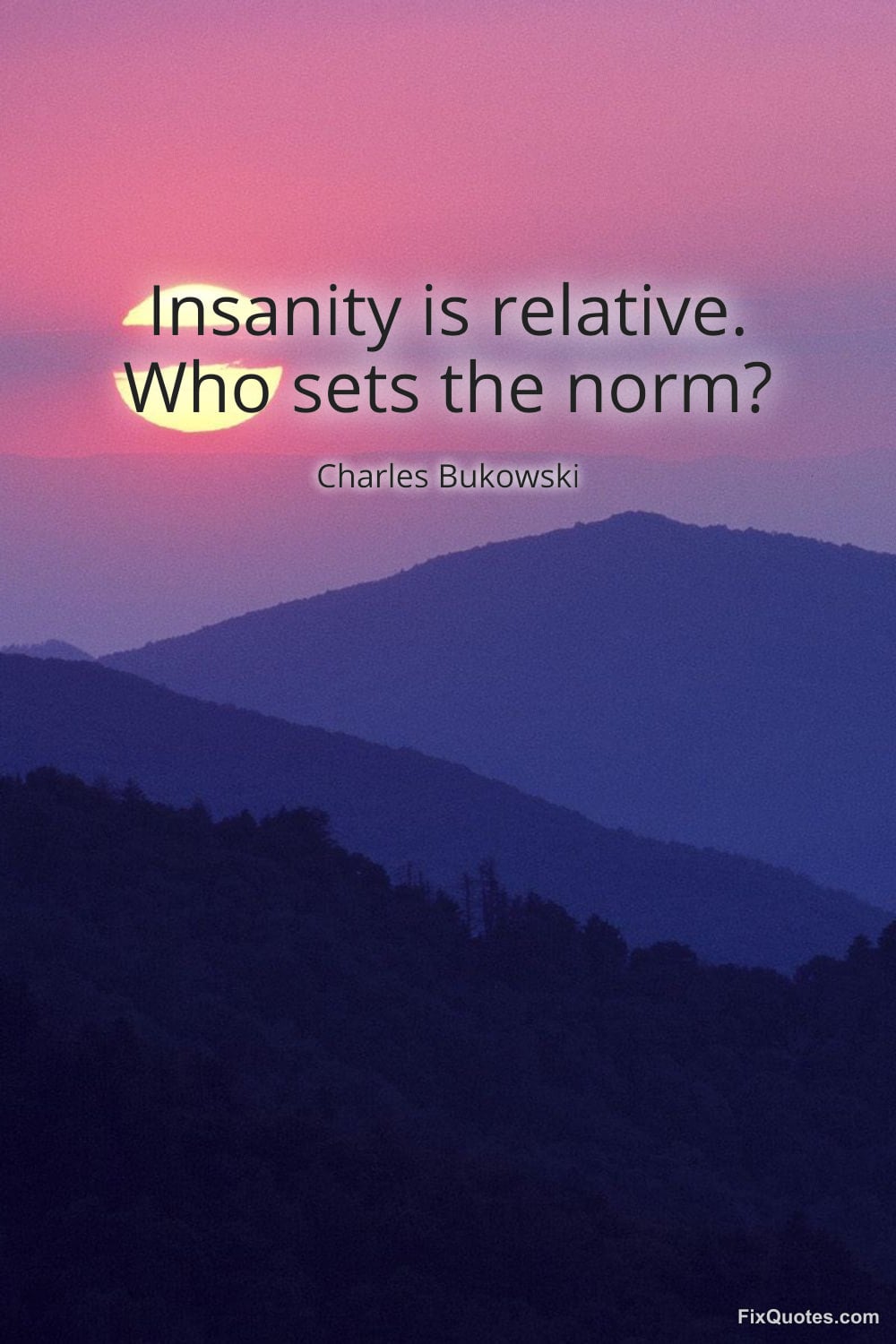
"Insanity is relative. Who sets the norm?"
About this Quote
Bukowski’s line lands like a barstool dare: you think you know what “insane” looks like until someone asks who gets to police the definition. The first sentence, “Insanity is relative”, pretends to be a cool observation, almost clinical. Then the second sentence snaps it into street-level suspicion: “Who sets the norm?” That pivot is the whole move. It exposes “sanity” less as a medical fact than as a social verdict, handed down by institutions that rarely feel neutral when you’re the one being judged.
The intent isn’t to romanticize mental illness; it’s to interrogate the machinery of respectability. Bukowski spent his career writing from the margins - skid-row rooms, dead-end jobs, the humiliations that don’t make it into polite memoir. In that world, “normal” often means “functioning for someone else”: showing up on time, speaking the right language, swallowing the right grief. Calling a person insane can be a shortcut for disciplining noncompliance, poverty, addiction, or simple refusal to perform optimism.
The subtext carries Bukowski’s signature cynicism: norms are set by whoever has the power to enforce them, then packaged as common sense. The question isn’t innocent; it’s accusatory. It invites the reader to notice how quickly societies diagnose what they don’t want to understand, and how easily “madness” becomes a label that protects the comfortable from the uncomfortable.
It works because it’s compact and antagonistic - a one-two punch that turns a category into a contest.
The intent isn’t to romanticize mental illness; it’s to interrogate the machinery of respectability. Bukowski spent his career writing from the margins - skid-row rooms, dead-end jobs, the humiliations that don’t make it into polite memoir. In that world, “normal” often means “functioning for someone else”: showing up on time, speaking the right language, swallowing the right grief. Calling a person insane can be a shortcut for disciplining noncompliance, poverty, addiction, or simple refusal to perform optimism.
The subtext carries Bukowski’s signature cynicism: norms are set by whoever has the power to enforce them, then packaged as common sense. The question isn’t innocent; it’s accusatory. It invites the reader to notice how quickly societies diagnose what they don’t want to understand, and how easily “madness” becomes a label that protects the comfortable from the uncomfortable.
It works because it’s compact and antagonistic - a one-two punch that turns a category into a contest.
Quote Details
| Topic | Deep |
|---|---|
| Source | Help us find the source |
| Cite |
Citation Formats
APA Style (7th ed.)
Bukowski, Charles. (2026, February 10). Insanity is relative. Who sets the norm? FixQuotes. https://fixquotes.com/quotes/insanity-is-relative-who-sets-the-norm-185171/
Chicago Style
Bukowski, Charles. "Insanity is relative. Who sets the norm?" FixQuotes. February 10, 2026. https://fixquotes.com/quotes/insanity-is-relative-who-sets-the-norm-185171/.
MLA Style (9th ed.)
"Insanity is relative. Who sets the norm?" FixQuotes, 10 Feb. 2026, https://fixquotes.com/quotes/insanity-is-relative-who-sets-the-norm-185171/. Accessed 25 Mar. 2026.
More Quotes by Charles
Add to List