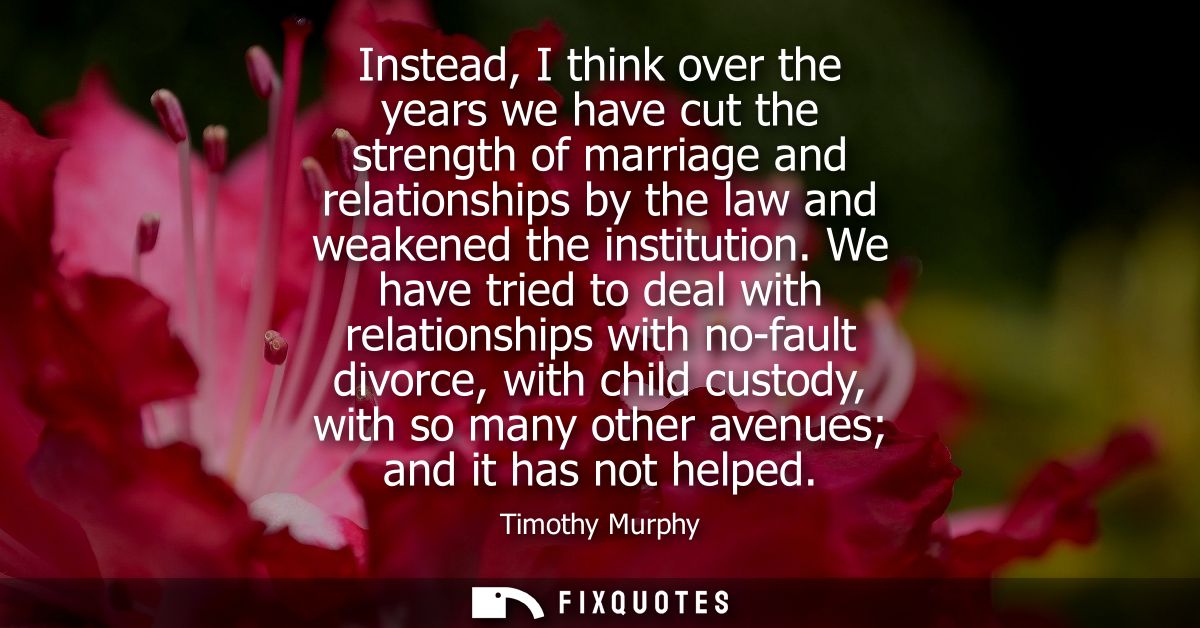
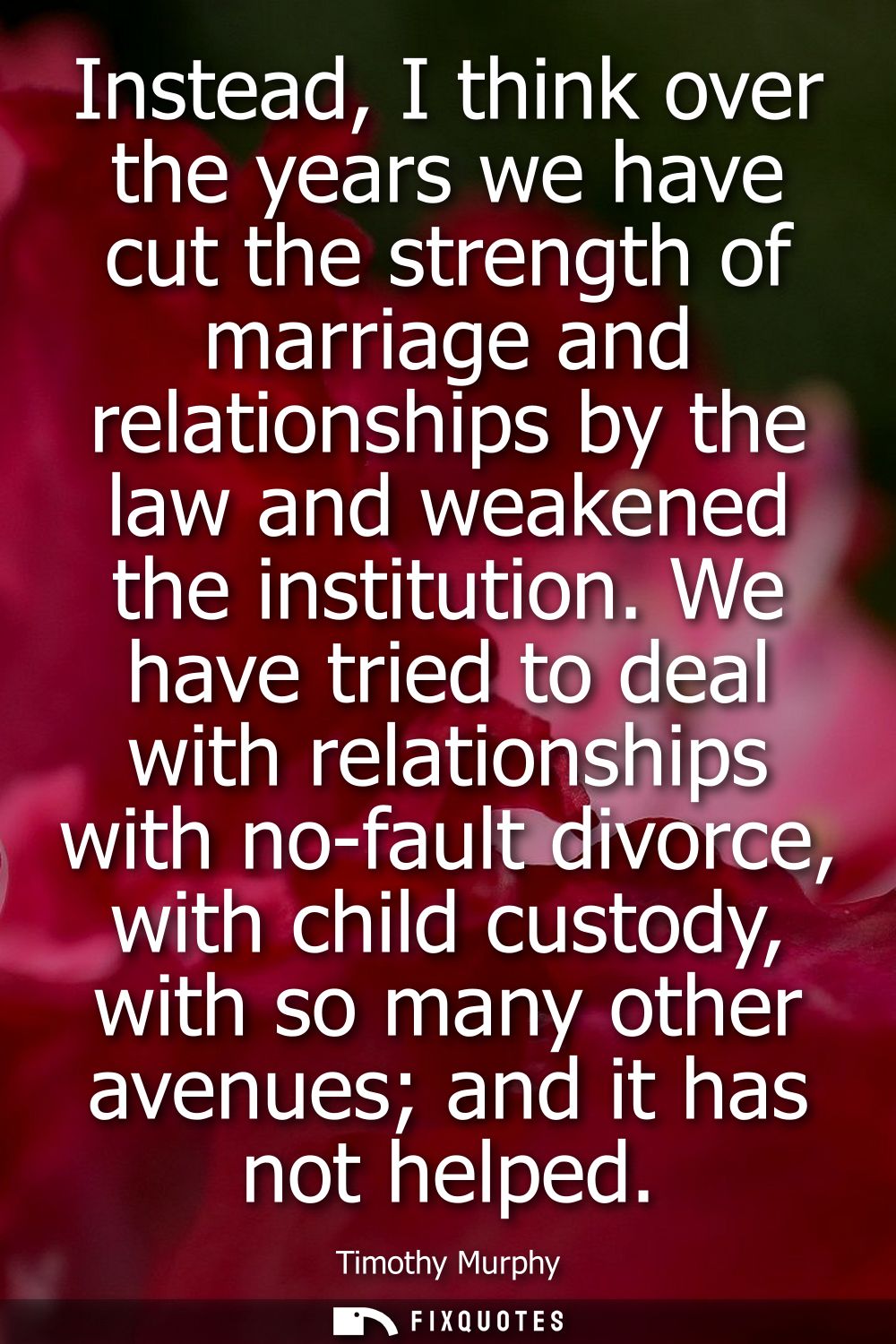
"Instead, I think over the years we have cut the strength of marriage and relationships by the law and weakened the institution. We have tried to deal with relationships with no-fault divorce, with child custody, with so many other avenues; and it has not helped"
About this Quote
The rhetoric leans on institutional language - “strength,” “weakened,” “the institution” - to smuggle a moral argument into what sounds like an administrative one. “No-fault divorce” and “child custody” are named like tactical maneuvers that were supposed to reduce harm but instead produced new vulnerabilities: incentives to leave, litigate, and treat family life as a set of negotiable claims. The subtext is a fear that once marriage becomes governable by flexible rules, it becomes psychologically optional, and once it’s optional, it stops doing its social job: binding adults to long-term responsibility, especially around children.
Context matters because the quote feels anachronistic for someone who died in 1818. The phrasing belongs to late-20th-century legal debates, when no-fault divorce and modern custody regimes became cultural flashpoints. Read charitably, it’s a conservative diagnosis of unintended consequences: reforms meant to reduce conflict might instead normalize dissolution and bureaucratize care. Read skeptically, it’s also a nostalgia for constraint - a belief that making it harder to leave is the same thing as making it better to stay.
Quote Details
| Topic | Divorce |
|---|---|
| Source | Help us find the source |
| Cite |
Citation Formats
APA Style (7th ed.)
Murphy, Timothy. (2026, January 16). Instead, I think over the years we have cut the strength of marriage and relationships by the law and weakened the institution. We have tried to deal with relationships with no-fault divorce, with child custody, with so many other avenues; and it has not helped. FixQuotes. https://fixquotes.com/quotes/instead-i-think-over-the-years-we-have-cut-the-86581/
Chicago Style
Murphy, Timothy. "Instead, I think over the years we have cut the strength of marriage and relationships by the law and weakened the institution. We have tried to deal with relationships with no-fault divorce, with child custody, with so many other avenues; and it has not helped." FixQuotes. January 16, 2026. https://fixquotes.com/quotes/instead-i-think-over-the-years-we-have-cut-the-86581/.
MLA Style (9th ed.)
"Instead, I think over the years we have cut the strength of marriage and relationships by the law and weakened the institution. We have tried to deal with relationships with no-fault divorce, with child custody, with so many other avenues; and it has not helped." FixQuotes, 16 Jan. 2026, https://fixquotes.com/quotes/instead-i-think-over-the-years-we-have-cut-the-86581/. Accessed 3 Apr. 2026.